Feds reports progress on climate adaptation but climate groups say it isn’t enough
Advertisement
Read this article for free:
or
Already have an account? Log in here »
To continue reading, please subscribe:

Digital Subscription
One year of digital access for only $205*
- Enjoy unlimited reading on winnipegfreepress.com
- Read the E-Edition, our digital replica newspaper
- Access News Break, our award-winning app
- Play interactive puzzles
*First annual payment billed as $205.00 + GST for one year. This annual subscription will automatically renew at $233.00 + GST every 52 weeks (10% off the regular annual price of $259.35). Offer available to new and qualified returning subscribers only. Cancel any time.
To continue reading, please subscribe:
Add Free Press access to your Brandon Sun subscription for only an additional
$1 for the first 4 weeks*
- Enjoy unlimited reading on winnipegfreepress.com
- Read the E-Edition, our digital replica newspaper
- Access News Break, our award-winning app
- Play interactive puzzles
*Your next Brandon Sun subscription payment will increase by $1.00 and you will be charged $17.95 plus GST for four weeks. After four weeks, your payment will increase to $24.95 plus GST every four weeks.
Read unlimited articles for free today:
or
Already have an account? Log in here »
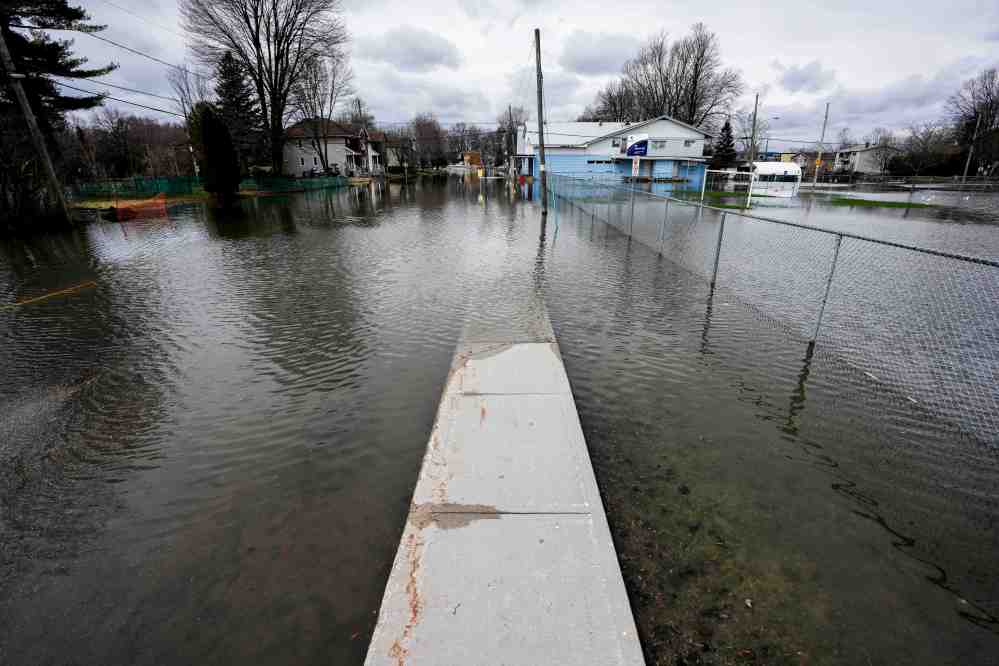
OTTAWA – Three years after it formally launched its national climate adaptation strategy, the federal government says Canadians are more aware of the risks and more resilient to flooding, wildfires and major storms caused by climate change.
But an analysis by the Canadian Climate Institute suggests there is little sign any of that work has actually reduced the risks Canadians face.
The strategy, finalized in 2023, set out a road map for preparing communities for extreme weather events and a warming climate. The government estimates every dollar spent on proactive adaptation measures can save taxpayers between $13 and $15 in the long term.
The progress report touts the work Ottawa has done on the strategy since its launch and claims it hit its short-term targets along the way.
Those targets include having 92 per cent of Canadians aware of risks facing their household and getting 30 per cent of Canadians to take steps to respond to risks facing their household.
But Ryan Ness, director of adaptation for the Canadian Climate Institute, said the report “paints an overly optimistic picture of success.”
“The progress report shows that the federal government’s been doing quite a number of things. Lots of programs and initiatives and projects,” Ness said.
“But there’s little evidence that any of it is actually reducing the most important risk that Canada is facing right now.”
Ness said the biggest risks facing Canadians are the growing number of wildfires, large-scale flooding and extreme heat waves. Since the adaptation strategy was released, Canada has experienced its two worst wildfire seasons on record.
The Canadian National Fire database shows that in 2023, the summer the strategy was released, more than 170,000 square kilometres burned — an area more than twice the size of New Brunswick. In 2025, the second worst year on record, fires consumed about 83,000 square kilometres, an area larger than Lake Superior.
Ness said that while the strategy speaks to almost everything Ottawa could do about adaptation, it doesn’t identify priority actions or map out ways to make communities more resilient.
“There’s no doubt that sort of on an individual basis, these projects — at least many of them — have had a positive impact,” Ness said.
“The issue is that the data is largely anecdotal. It describes a program that was done here or an investment that was made over there. It doesn’t take the big picture of (whether) things (are) actually getting better in Canada.
“Are fewer people dying from extreme heat? Are fewer homes getting flooded every year? Are the losses and number of evacuations from wildfire getting less over time?”
So far this year, wildfires have burned more than 4 million hectares in Canada — an area almost the size of Nova Scotia — setting this wildfire season up to be the fourth-worst on record.
In a report last year on the adaptation strategy, Canada’s environment commissioner said Ottawa’s efforts to prepare the country for the impacts of climate change had stumbled out of the gate.
Jerry DeMarco’s report concluded the strategy was not effectively designed and did not prioritize Canada’s climate change risks, and that departments relied instead on existing priorities and consultations.
DeMarco cited the short-term health impacts of wildfire smoke, estimated to cost between $410 million and $1.8 billion annually between 2013 and 2018. He also remarked on the spike in the number of Lyme disease cases from 144 in 2009 to 2,525 in 2022 — an increase of more than 1,500 per cent.
Ness said Canada is falling behind on climate adaptation. He pointed to government data suggesting 1.5 million homes in Canada are facing flood risks severe enough to make them uninsurable.
The progress report says there are hundreds of new flood-mapping projects underway to better identify flood-prone areas, but it also acknowledged that 94 per cent of people located in high-risk areas don’t yet know their home is susceptible to floods.
The progress report suggests the federal government has taken 73 actions across 22 different departments and agencies since the strategy was introduced.
Those actions include 18 projects launched by Health Canada to help protect Canadians from extreme heat — the report doesn’t specify what they were.
It also lists as a success the Two Billion Trees program, which was a key campaign promise by the Liberals under former prime minister Justin Trudeau in 2021.
The report does not mention that Prime Minister Mark Carney shelved the program in a budget-cutting exercise last year. The government’s website said almost one billion trees had been planted as of 2025.
Environment Minister Julie Dabrusin was unavailable for an interview on the progress report.
In an emailed statement, Dabrusin’s press secretary Chris Zhou said Ottawa has spent $2.1 billion over the past four years to implement the strategy.
“Budget 2025 introduced new community infrastructure and youth-focused initiatives that will further advance climate adaptation and resilience objectives across the country,” Zhou said.
Zhou pointed to Dabrusin’s announcement this week of $34 million for 141 climate resilience projects in 128 communities. That announcement committed $34 million to projects like installing cooling stations in parks in Halifax, retrofitting public housing units with heat pumps and flood-reduction measures for the Kanesatake Lands in Quebec.

Responding to the criticisms from the Climate Institute, Zhou said all new federal infrastructure funding programs now incorporate climate resilience.
”By the end of 2025, nine (national adaptation strategy) targets had been met or exceeded, demonstrating strong early progress towards improving awareness of climate risks, access to climate services, and consideration of climate resilience in decision-making and safeguarding nature,” Zhou said.
Still, Ness said Ottawa isn’t tracking data that aligns with the goals of the strategy.
“They’re not collecting the data that they need to show whether or not big outcomes that are making Canada safer and more resilient are actually happening,” Ness said.
This report by The Canadian Press was first published Aug. 14, 2026