Feds move to repeal EV sales mandate without new stringent emission rules in place

Advertisement

Advertise with us

OTTAWA - The federal government moved last week to formally repeal the electric vehicle sales mandate, but the more stringent emission standards Prime Minister Mark Carney promised to replace it with is not close to being finalized.

Read this article for free:


or

Already have an account? Log in here »

To continue reading, please subscribe:

Subscribe and receive a limited-edition Free Press branded hat or tote.

Digital Subscription

One year of digital access for only $205*

  • Enjoy unlimited reading on winnipegfreepress.com
  • Read the E-Edition, our digital replica newspaper
  • Access News Break, our award-winning app
  • Play interactive puzzles

*First annual payment billed as $205.00 + GST for one year. This annual subscription will automatically renew at $233.00 + GST every 52 weeks (10% off the regular annual price of $259.35). Offer available to new and qualified returning subscribers only. Cancel any time.

To continue reading, please subscribe:

Add Free Press access to your Brandon Sun subscription for only an additional

$1 for the first 4 weeks*

  • Enjoy unlimited reading on winnipegfreepress.com
  • Read the E-Edition, our digital replica newspaper
  • Access News Break, our award-winning app
  • Play interactive puzzles
Start now

*Your next Brandon Sun subscription payment will increase by $1.00 and you will be charged $17.95 plus GST for four weeks. After four weeks, your payment will increase to $24.95 plus GST every four weeks.

OTTAWA – The federal government moved last week to formally repeal the electric vehicle sales mandate, but the more stringent emission standards Prime Minister Mark Carney promised to replace it with is not close to being finalized.

In a notice in the Canada Gazette posted on Friday, the government outlined the proposed regulations to repeal the mandate, which would have set a target of having EVs account for at least 20 per cent of auto sales across Canada this year. The target was to increase to 100 per cent by 2035.

The government forecasted the change would drive the adoption rate of EVs to 75 per cent of new sales by 2035, and 90 per cent by 2040.
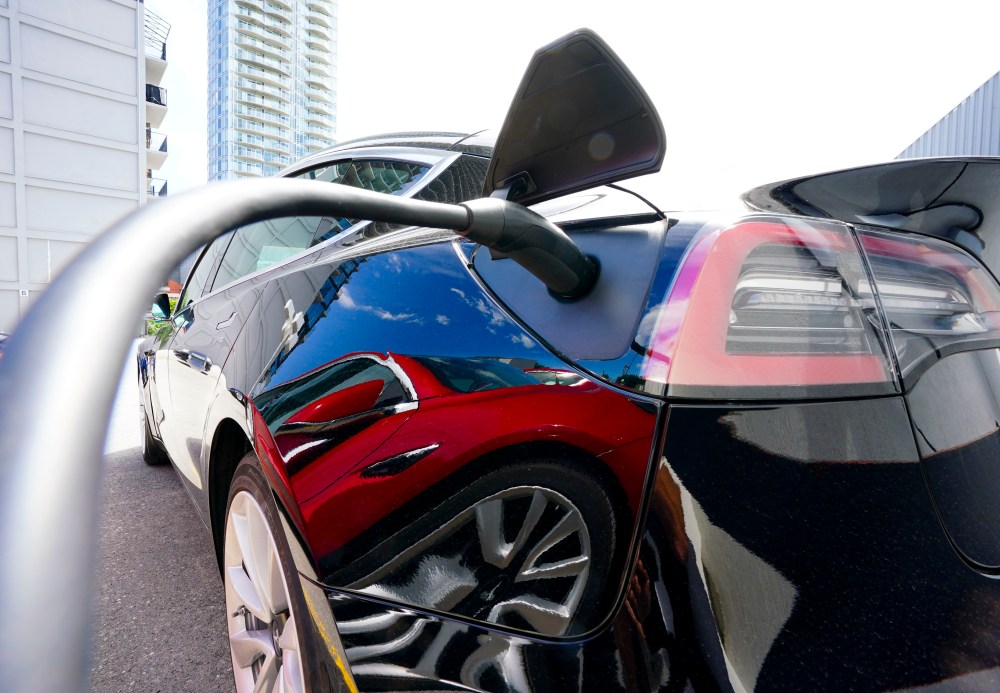
An electric vehicle is charged in Ottawa on Wednesday, July 13, 2022. THE CANADIAN PRESS/Sean Kilpatrick

The mandate is among a growing list of climate policies introduced by former prime minister Justin Trudeau which Carney is dismantling, including repealing the consumer carbon price and scrapping the emissions cap on oil and gas production.

The government acknowledges that ending the sales mandate would slow the rate of adoption of EVs, and could cause $90.3 billion in “potential climate change-related global damages.”

The EV mandate was expected to reduce Canada’s greenhouse gas emissions by 376 million tonnes over 25 years — or annually about the emissions produced by three million cars — though the estimate is based on the amount of greenhouse gas emissions without factoring in new standards for emissions from gas-powered passenger vehicles.

Carney promised those more stringent tailpipe standards when he announced the plan to repeal the mandate in February. But on Monday, the government said it’s only set to begin consultations on the new tailpipe standards in the fall.

Environment Minister Julie Dabrusin was unavailable for an interview Monday on the plans.

“Getting this right is paramount for our economy and our environment,” Dabrusin’s press secretary Keean Nembhard wrote in a statement, adding Ottawa is also planning to launch a national charging infrastructure strategy in the coming months.

“That is why we are launching a new round of consultations, not just with the auto industry but also with environmental groups.”

A senior government official, speaking on background, said Ottawa is aiming to have draft regulations in place by early 2027. Multiple environment organizations told The Canadian Press they expected the draft regulations to be ready by the end of June.

“We were expecting this to come out a long time ago. Initially, we heard this was gonna come out in early summer, and we were told that over and over again,” said Sam Hersh, the clean transportation program manager at Environmental Defence.

“Climate hasn’t necessarily been a priority for this government. So I’m not really surprised that they sort of were so willy-nilly with this sort of thing.”

Carney first paused, and then ultimately said he would scrap the mandate, following pressure from provinces and carmakers who argued there were better ways to reduce emissions without potentially penalizing car manufacturers for not hitting their targets — particularly as the auto industry has been hammered by the trade war with the United States.

Carney said in February the new emissions standard will set a maximum of 74 grams of carbon dioxide, or its equivalent, per mile. That’s down from the current federal tailpipe emissions standard of 172 grams per mile — a 56.9 per cent reduction — which remains in effect.

At the time, government officials said they were still working on the path to get to the 74 grams per mile figure. One official said the work would happen through the regulatory process, with initial regulations targeting the 2027 to 2032 model years.

Environment groups say repealing the EV sales mandate without having the new tailpipe standards in place risks jeopardizing EV adoption, as other countries forge ahead with more EVs on their roads.

Joanna Kyriazis, the director of policy and strategy at Clean Energy Canada, said tailpipe emission standards are already prominent in most other regions around the world — except for the United States.

“As a result, other markets continue to see record-breaking EV sales, more affordable EVs on the market, more fuel efficient gas-powered vehicles available to their drivers at a time when gas prices are high and continually impacted by global geopolitical events,” Kyriazis told The Canadian Press.

“At this point, Canadians are being deprived of those options and exposed to volatile gas prices, that are just exacerbating their kind of cost of living challenges.”

This report by The Canadian Press was first published Aug. 17, 2026.

Report Error Submit a Tip

More Stories

‘Soapy disco’ for your ride

Aaron Epp 4 minute read Preview

‘Soapy disco’ for your ride

Aaron Epp 4 minute read Friday, Sep. 4, 2026

For Kyle Thompson, foam is where the heart is.

As a high school student at Winnipeg’s Transcona Collegiate, one of his classes required him to create a business plan. He was cleaning vehicles part-time at the Chamois Car Wash and Detail Centre, so he used the assignment to envision a car wash of his own — one with a Regent Avenue address.

Fast forward some 25 years later and that dream is a reality. Thompson is the co-owner and general manager at Flamingo Express Car Wash.

Located at 868 Regent Ave. West — east of the row of car dealerships that call the thoroughfare home and across the street from an Amazon distribution hub — Flamingo opened last month.

Read
Friday, Sep. 4, 2026

Letters, Sept. 8

6 minute read 3:00 AM CDT

Keep momentum goingThere has been some genuinely good news for women’s health in Manitoba.

And it is worth saying that plainly.

Prescription birth control is now covered. Hormone replacement therapy is covered. Pharmacists can now prescribe several forms of contraception. Breast screening access is expanding. Prenatal supports have improved. Some pregnant patients can access funded non-invasive prenatal testing. Fertility supports have also become more generous.

None of this is trivial.

Canadians do not want to sacrifice nature for development

Emily McMillan and Akaash Maharaj 4 minute read 2:00 AM CDT

Prime Minister Mark Carney’s pledge to build faster — “Build, baby, build” — helped propel the Liberals to victory, but his government’s push to fast-track major development projects by cutting environmental oversight is sharply out of step with Canadians’ priorities.

It is a political miscalculation that could come back to haunt the Liberals at the ballot box.

New polling, commissioned by Nature Canada and conducted by EKOS Research Associates, shows strong support among Canadians for protecting nature and endangered species while building the economy.

Canadians soundly reject the notion that they must sacrifice conservation protections for economic development.

Thousands affected by storm-related power outages

1 minute read Updated: Yesterday at 8:45 PM CDT

Thousands are still without power in Winnipeg after high winds and thunderstorms knocked out power lines Sunday.

About 4,000 Manitoba Hydro customers were still dealing with outages this morning after crews worked to restore power in the Westwood and River Heights areas, Hydro spokesman Peter Chura said. On Sunday, Hydro reported outages affecting approximately 6, 700 customers.

The high winds and heavy rain brought down trees and broke power poles, causing "very severe damage," in River Heights, one of the hardest-hit neighbourhoods, while some of the damage in the Westwood area appeared to be caused by lightning strikes, Chura said.

Thunderstorms rolled in at about 6 p.m. Sunday and brought heavy rain and high winds to some areas of the province. Winnipeg received about 35 mm of rain, while some areas got almost double that. More than 62 mm was recorded at The Forks and 68.8 mm was recorded at Portage Southport, according to Environment Canada.

‘We belong… and we are giving back”: Sikh celebration enlivens downtown Winnipeg

Melissa Martin 3 minute read Preview

‘We belong… and we are giving back”: Sikh celebration enlivens downtown Winnipeg

Melissa Martin 3 minute read Sunday, Sep. 6, 2026

Downtown Winnipeg came alive with vibrant sights, sounds, and scents on Sunday, as Manitoba’s Sikh community flocked to Memorial Park to celebrate its annual Nagar Kirtan procession and festival.

This year marked the 422nd anniversary of the completion of the Guru Granth Sahib, the holy scripture central to the Sikh faith. Shortly after 1 p.m., a palanquin bearing a copy of the scripture was led in parade through downtown Winnipeg, with musical accompaniment.

“This is a chance to tell the public and the whole community where we come from and who we are,” said volunteer Prabh Grewal shortly before the procession got underway. “In a community there are people from every race and every country, and our main objective is to have everybody live in peace and harmony together.”

Before, during, and after the procession, the park hummed with life. As many as 55,000 people converged on the site, with the majority dressed in festive traditional attire. Near the height of the day’s 30 C heat, families relaxed in patches of shade, enjoying plates of Punjabi cuisine dished out for free at dozens of tents sponsored by local businesses.

Read
Sunday, Sep. 6, 2026

Trump’s trade war with Canada is becoming a ballot box issue ahead of U.S. midterms

Kelly Geraldine Malone, The Canadian Press 6 minute read Preview

Trump’s trade war with Canada is becoming a ballot box issue ahead of U.S. midterms

Kelly Geraldine Malone, The Canadian Press 6 minute read Updated: Yesterday at 12:01 PM CDT

WASHINGTON - As the United States braces for pivotal midterm elections this November, there's a new and unexpected issue on voters' minds in many states: President Donald Trump's escalating trade war with Canada.

"Canada is our friend, our closest ally and our biggest trading partner," Maine Republican Sen. Susan Collins told Politico in an interview published last week.

"This is not China that we are talking about. This is not an adversarial country. And … our economies are so linked, if you try to hurt one you end up hurting Maine."

Collins has long been a political force in her border state but Trump's unpopular policies — including his tariff campaign against Canada — have put her seat in jeopardy.

Read
Updated: Yesterday at 12:01 PM CDT