

Trump’s 50 per cent tariffs set to kick in just after midnight unless deal is reached
Advertisement
Read this article for free:
or
Already have an account? Log in here »
To continue reading, please subscribe:

Digital Subscription
One year of digital access for only $205*
- Enjoy unlimited reading on winnipegfreepress.com
- Read the E-Edition, our digital replica newspaper
- Access News Break, our award-winning app
- Play interactive puzzles
*First annual payment billed as $205.00 + GST for one year. This annual subscription will automatically renew at $233.00 + GST every 52 weeks (10% off the regular annual price of $259.35). Offer available to new and qualified returning subscribers only. Cancel any time.
To continue reading, please subscribe:
Add Free Press access to your Brandon Sun subscription for only an additional
$1 for the first 4 weeks*
- Enjoy unlimited reading on winnipegfreepress.com
- Read the E-Edition, our digital replica newspaper
- Access News Break, our award-winning app
- Play interactive puzzles
*Your next Brandon Sun subscription payment will increase by $1.00 and you will be charged $17.95 plus GST for four weeks. After four weeks, your payment will increase to $24.95 plus GST every four weeks.
Read unlimited articles for free today:
or
Already have an account? Log in here »
OTTAWA – The “delicate and intense” negotiations to avoid a new round of punishing tariffs from the American president are in their final hours in Washington, D.C.
U.S. President Donald Trump is set to impose a 50 per cent tariff on some $28-billion worth of Canadian goods one minute after midnight.Canada-U.S. Trade Minister Dominic LeBlanc and the country’s chief trade negotiator, Janice Charette, have been in Washington since last week trying to broker a deal to prevent that from happening.
The pair met for nearly two hours on Monday with U.S. Trade Representative Jamieson Greer and Commerce Secretary Howard Lutnick.
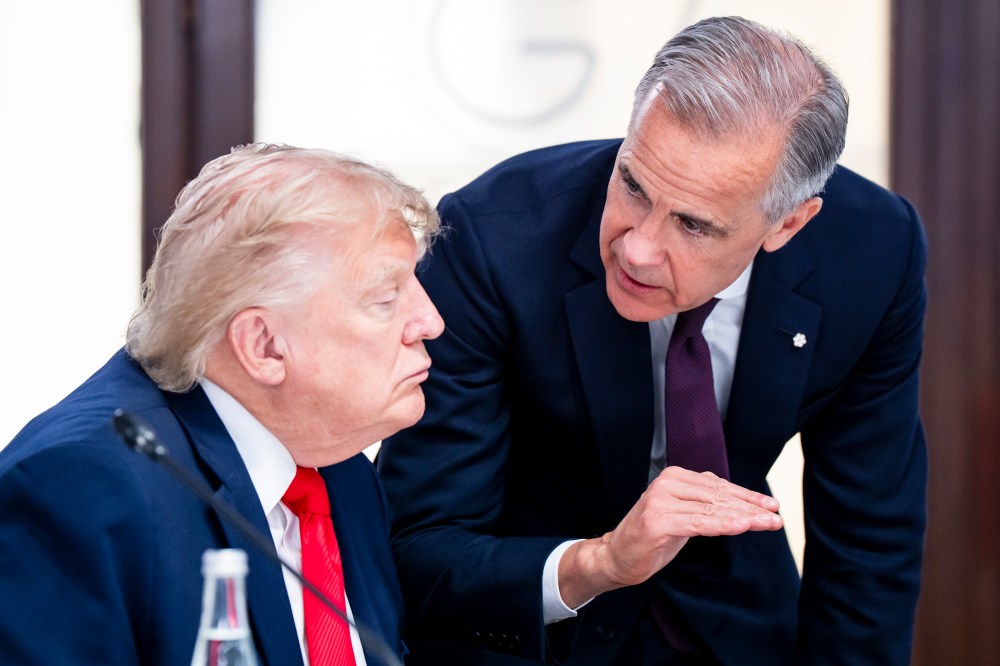
Prime Minister Mark Carney, who described the eleventh-hour talks as delicate and intense on Monday, spoke to Trump by phone Monday afternoon. The Prime Minister’s Office and an official from the White House did not share any details about the call.
Before that, the prime minister said at a press conference that Canada was negotiating from a place of strength and that his government had a plan ready for any situation.
Greer has warned that the U.S. will not tolerate any retaliation.
The deadline leaves many, including Quebec Premier Christine Frechette, anxious.
“There’s a lot at stake,” Frechette said at a press conference in Montreal.
“I mean, we’re talking about imposing a 50 per cent tariff on products coming from Quebec which were protected by the (Canada-U.S.-Mexico Agreement on trade) until today.”
She said impact of the tariffs would be “dramatic for many sectors,” and said she’s asked the federal government to be ready to help businesses and workers.
Trump’s latest move marks a new step in his tariff regime, which has faced setbacks from American court rulings that have declared some levies invalid.
This time, the president looked to Section 338 of the Tariff Act of 1930 for the authority to impose tariffs on a country deemed to be discriminating against U.S. products.
He signed an executive order July 20 to impose 50 per cent tariffs on goods such as hockey sticks, honey, cement and wine. The affected products account for about five per cent of Canadian exports to the U.S., and unlike previous tariffs, do not include exemptions for products covered by the CUSMA deal.
The U.S. side said it was responding to a collection of irritants that include the provincial bans on American alcohol, lack of access for U.S. dairy in Canada’s supply management system and Canadian quotas for tariff-free U.S. auto imports.
The two countries have been locked in a tit-for-tat trade battle since Trump took office. Canada imposed counter-tariffs in early 2025 in response to American tariffs on steel, aluminum and autos. Carney later rolled back many of the countermeasures.
The auto quotas and the booze bans, which are in place in all provinces except Alberta and Saskatchewan, were part of that retaliation.
In the negotiations Canada is also looking for relief on existing U.S. tariffs on metals, autos and softwood lumber — a long-standing sore spot in trade relations between the two countries. The U.S. maintains Canadian lumber receives unfair government subsidies.
Arnold Viersen, a Conservative natural resources critic, said tariffs and mill closures are causing distress in lumber towns.
“When a mill closes, the consequences extend far beyond the individual workers who lose their jobs. Local businesses suffer, families leave, municipal revenues decline and communities risk becoming ghost towns,” Viersen said in a statement on Tuesday.
He called on the government to “keep its promise” and negotiate a deal with the U.S. that’s good for Canadian workers.
The U.S. Chamber of Commerce urged both sides to keep working toward a deal on Tuesday.

“A deal that at once significantly reduces U.S. Section 232 tariffs on imported Canadian steel, aluminum, lumber and auto components, returns U.S. wine and spirits to Canadian shelves, enhances Canadian market access for U.S. dairy producers and addresses Canadian retaliatory tariffs would be a boon to U.S. consumers, producers, farmers and manufacturers,” said Neil Herrington, the Chamber’s senior vice-president for the Americas.
Bea Bruske, Canadian Labour Congress president, said Tuesday that staying strong during tense negotiations means being unafraid to walk away from a bad deal.
“Canada must be prepared to hold firm on our interests and our red lines, while also having a clear plan to support workers and communities if tariffs come into effect,” she said in a statement.
This report by The Canadian Press was first published Aug. 18, 2026.
— With files from David Baxter in Ottawa and Kelly Geraldine Malone in Washington
Related Articles
Here's the (long) list of items facing possible tariffs from the United States

Advertisement Advertise With Us
Advertisement Advertise With Us