Roadside giants towering symbols of Canada’s quirkiness

Advertisement
Read this article for free:
or
Already have an account? Log in here »
To continue reading, please subscribe:

Digital Subscription
One year of digital access for only $205*
- Enjoy unlimited reading on winnipegfreepress.com
- Read the E-Edition, our digital replica newspaper
- Access News Break, our award-winning app
- Play interactive puzzles
*First annual payment billed as $205.00 + GST for one year. This annual subscription will automatically renew at $233.00 + GST every 52 weeks (10% off the regular annual price of $259.35). Offer available to new and qualified returning subscribers only. Cancel any time.
To continue reading, please subscribe:
Add Free Press access to your Brandon Sun subscription for only an additional
$1 for the first 4 weeks*
- Enjoy unlimited reading on winnipegfreepress.com
- Read the E-Edition, our digital replica newspaper
- Access News Break, our award-winning app
- Play interactive puzzles
*Your next Brandon Sun subscription payment will increase by $1.00 and you will be charged $17.95 plus GST for four weeks. After four weeks, your payment will increase to $24.95 plus GST every four weeks.
Read unlimited articles for free today:
or
Already have an account? Log in here »
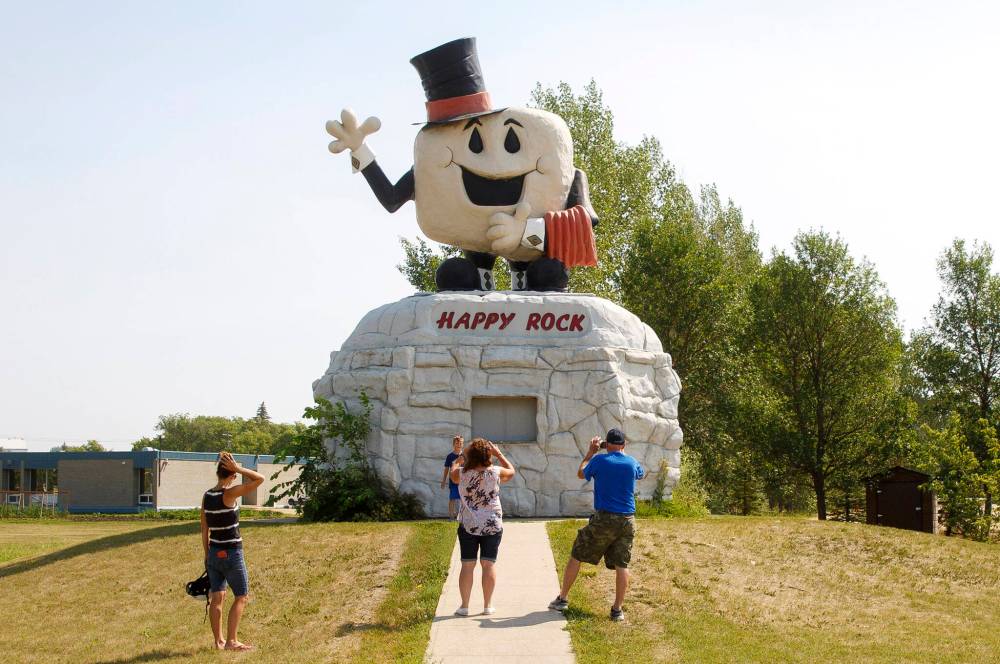
Could you imagine a Canada without Mr. PG repping Prince George, B.C.? Or the Big Nickel in Sudbury? Or, my personal favourite, Happy Rock in Gladstone?
Earlier this summer, CBC’s Cost of Living looked at the economics of these giant roadside attractions — of which there are more than 1,500 in Canada — and the cost of keeping them.
Some are falling into disrepair — this is why public art funding is necessary, by the way, not just for construction, but maintenance — and some towns are weighing whether or not that money is better spent elsewhere.
MIKE DEAL / WINNIPEG FREE PRESS
The Happy Rock in the town of Gladstone is among the larger-than-life monuments attracting travellers to towns across Canada.
The main character of the story: Tyra the Tyrannosaurus, the rather literal symbol of Drumheller, Alta., a.k.a. the Dinosaur Capital of the World since 2000, who could be facing extinction after the lease agreement between the town and the Drumheller and District Chamber of Commerce ends in 2029.
Roadside attractions — especially the “world’s largest” variety — aren’t strictly a Canadian thing, but they do feel like a distinctly Canadian thing. Many of these monuments were erected owing to the advent of the Trans-Canada Highway, serving as a way to break up a very long drive across a very big country.
They could convince people to pull over, take pictures, and then, ideally, spend some tourism dollars in their neighbouring towns. One might not discover the bakery famed for its cinnamon buns or the lovely scenic greenspace or the generations-old greasy-spoon if not for these quirky beacons.
They are whimsical. They are weird. They are often funny. They are us and we are them. Yes, they are sources of pride for individual places. But taken together, they form part of our national identity.
Canada is a country built on whimsy and quirkiness and humour. This is a country that calls its currency loonies and toonies. This is a country that calls kickball “soccer baseball.” This is a country whose chief export is comedians.
So, of course this is also a country that would have giant moose and beavers and lobsters populating its landscape. We don’t do nationalism big here, but we will show our pride by erecting a 12.8-metre (or 42-foot) farmer’s sausage in Mundare, Alta., or a truly harrowing muskie in Kenora, Ont. (Don’t look at its eyes!)
I would be sad to see these giants fall. For decades, whimsy and fun have been slowly sapped from everything, and I’m going to use McDonald’s — another staple, for better or worse, of the big roadtrip — as a case study.

Before, you could walk into a McDonald’s and reliably be able to sit in a moulded plastic chair that looked like a stack of burgers — you know, the way it should be. Now, they all resemble grey corporate offices if grey corporate offices smelled like french fries.
This mass minimalist greyscaling of everything also happened in home design, most visibly in the scourge of grey plank vinyl flooring and every other safe decision made for the sake of “resale value.” No clutter and no friction, but also no weirdness and no warmth and no personality. And certainly no tchotchkes.
You can find this standardization along the highway, too, where identical-looking exits take you to the same chain restaurants and gas stations. And what is a roadside monument if not a giant tchotchke?
I understand these big weirds are expensive to keep. But it would be a terrible shame if the golden arches or any other monument to capitalism were our only roadside attractions.
jen.zoratti@winnipegfreepress.com
Jen Zoratti is a columnist and feature writer working in the Arts & Life department, as well as the author of the weekly newsletter NEXT. A National Newspaper Award finalist for arts and entertainment writing, Jen is a graduate of the Creative Communications program at RRC Polytech and was a music writer before joining the Free Press in 2013. Read more about Jen.
Every piece of reporting Jen produces is reviewed by an editing team before it is posted online or published in print – part of the Free Press‘s tradition, since 1872, of producing reliable independent journalism. Read more about Free Press’s history and mandate, and learn how our newsroom operates.
Our newsroom depends on a growing audience of readers to power our journalism. If you are not a paid reader, please consider becoming a subscriber.
Our newsroom depends on its audience of readers to power our journalism. Thank you for your support.
Jen Zoratti is a columnist and feature writer working in the Arts & Life department, as well as the author of the weekly newsletter NEXT. A National Newspaper Award finalist for arts and entertainment writing, Jen is a graduate of the Creative Communications program at RRC Polytech and was a music writer before joining the Free Press in 2013. Read more about Jen.
Every piece of reporting Jen produces is reviewed by an editing team before it is posted online or published in print – part of the Free Press‘s tradition, since 1872, of producing reliable independent journalism. Read more about Free Press’s history and mandate, and learn how our newsroom operates.
Our newsroom depends on a growing audience of readers to power our journalism. If you are not a paid reader, please consider becoming a subscriber.
Our newsroom depends on its audience of readers to power our journalism. Thank you for your support.
Advertisement Advertise With Us
Advertisement Advertise With Us