3-year college degrees grow more popular in the US, saving time and cash. But critics aren’t sold
Advertisement
Read this article for free:
or
Already have an account? Log in here »
To continue reading, please subscribe:
Digital Subscription
One year of digital access for only $1.44 a week*
- Enjoy unlimited reading on winnipegfreepress.com
- Read the E-Edition, our digital replica newspaper
- Access News Break, our award-winning app
- Play interactive puzzles
*Billed as $5.77 plus GST every four weeks. After 52 weeks, price increases to the regular rate of $19.95 plus GST every four weeks. Offer available to new and qualified returning subscribers only. Cancel any time.
To continue reading, please subscribe:
Add Free Press access to your Brandon Sun subscription for only an additional
$1 for the first 4 weeks*
- Enjoy unlimited reading on winnipegfreepress.com
- Read the E-Edition, our digital replica newspaper
- Access News Break, our award-winning app
- Play interactive puzzles
*Your next Brandon Sun subscription payment will increase by $1.00 and you will be charged $17.95 plus GST for four weeks. After four weeks, your payment will increase to $24.95 plus GST every four weeks.
Read unlimited articles for free today:
or
Already have an account? Log in here »
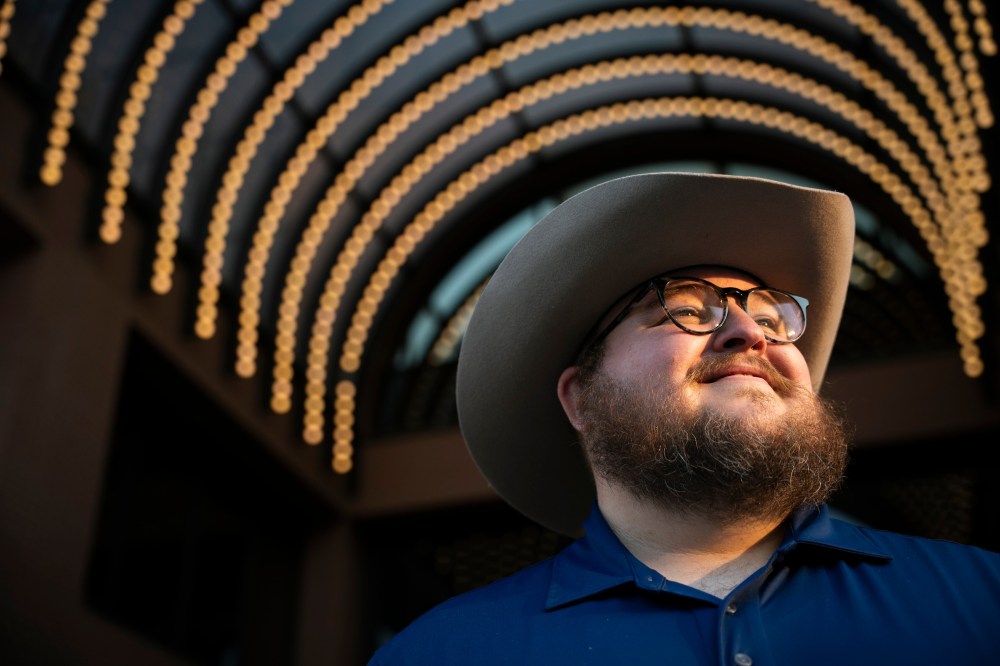
Giles Sims, 34, was sick of getting passed over for jobs because he didn’t have a college degree.
But with a wife and a widowed mother to help support, he needed a quick solution. So the laid-off web developer turned to one of a growing number of three-year degree programs.
“I can’t afford to be out of the workforce for four years. That just seems like forever, and the three-year made it seem less daunting,” said Sims, a student at Ensign College, a private Salt Lake City school that recently changed all its bachelor’s degrees to require fewer classes than a traditional four-year degree.
The condensed programs have exploded in popularity. As of this spring, 26 U.S. states have a college that offers at least one reduced-credit, three-year bachelor’s, according to the nonprofit research group RAND.
Advocates say these programs are a solution to the college affordability crisis and a godsend for non-traditional students like Sims.
Critics, however, worry that they’ll narrow too much what students learn, confuse employers, limit graduate school options and create headaches in fields that require state licenses.
The American Association of University Professors, for one, says the programs devalue the meaning of a college credential.
“This is not innovation. This is just cutting corners,” said Todd Wolfson, AAUP’s president.
A new option to graduate more quickly, but with reduced credit
For decades, colleges have offered accelerated programs that let students finish faster, often by forgoing long summer breaks, maximizing transfer credits and condensing semester-long courses into shorter, five- to 10-week terms.
But those programs maintained the same course load, measured as credits. The new programs let students finish faster by completing as few as 90 credit hours. That shaves a year off the typical 120-hour bachelor’s degree.
Three-year bachelor’s degrees are common in other countries including the United Kingdom, India, France and Italy. But they can create complications for graduates seeking admission to U.S. graduate schools, which sometimes require extra coursework.
Some of the earliest colleges in colonial America, modeled after English institutions like Oxford and Cambridge, initially had three-year degrees, said John Thelin, the author of “A History of American Higher Education.” By the 19th century, the four-year format had taken hold, partly because there wasn’t an established system of public high schools to prepare students, Thelin said.
“The colleges would have to kind of start from scratch,” he said.
A change in accreditation opened the door to shorter degrees
The idea of bringing three-year degrees to the U.S. got attention in 2009 when Robert Zemsky, the founding director of the Institute for Research on Higher Education at the University of Pennsylvania Graduate School of Education, argued in a Newsweek cover story that three-year degrees could shake up a broken system.
But there was a roadblock, he recalled recently. “Accreditors said, ‘College is 120 credits, not 90 credits,’” he said.
Years passed. And in 2022, amid mounting concerns about college affordability, Zemsky helped revive the idea. The College-in-3 Exchange was born, and dozens of higher education institutions joined the network to look for ways to help students get degrees faster.
The Northwest Commission on Colleges and Universities was the first accreditor to say yes in 2023, when it approved reduced-credit programs at Ensign and Brigham Young University-Idaho. Other accreditors quickly followed.
As of May, 119 reduced-credit programs had been publicly announced, according to the RAND analysis, which was conducted to help education officials in Ohio as they weigh the feasibility of reduced-credit degrees.
It comes at a time when tuition and fees averaged $11,950 for in-state students at public schools and $45,000 at private nonprofits last school year, although many students get discounts that reduce the price, according to a report from the College Board, the nonprofit that oversees the SAT.
Some degrees are easier to compress
Private nonprofit schools offer three-quarters of the reduced-credit programs, frequently online. Typically, they compress the majors by reducing electives. Business degrees in fields such as marketing and management are the most common, followed by computer and information sciences.
Other majors, such as engineering, with its extensive math requirements, have been harder to shrink. And RAND found just six reduced-credit degrees in teacher education, which involves real-world experience requirements and state licensure.
Jill Cohen, 42, lives on a ranch in rural Yoder, Colorado, and is completing her teaching degree through one such program at Indiana Wesleyan.
She quit her old job selling life insurance and turned to teaching after a farming accident nearly claimed her life. Already, she is in the classroom, teaching middle school English, as she works on the degree through a special “Grow Your Own” program designed to address staff shortages.
Because her home is busy — she has twin 12-year-olds, along with a menagerie that includes horses, goats and chickens — she appreciates the streamlined degree.
“Why do I need to take, you know, underwater basket weaving when I could just take the evolutionary structure of the English language — what I’m going to be teaching,” she said.
However, programs with state licensing requirements are one of the biggest worries for Jenna Kramer, a policy researcher at RAND.
Indiana Wesleyan, which has a growing slate of reduced-credit offerings, said its education programs are specifically designed to meet Indiana licensing requirements. Students from elsewhere will need to check if the programs meet their state requirements, said Pam Downing, the school’s director of communications, in an email.
The RAND report also found the programs are so new that there are no standard practices for admitting three-year degree recipients into graduate school.
Students acknowledge it’s a gamble
Gabriella Staten, a 20-year-old student in the reduced-credit digital marketing program at Mount Mary University, a Catholic women’s institution in Milwaukee, estimates it will save her at least $20,000. While she sometimes wonders whether employers will take her degree as seriously as a four-year degree, she decided she could prove herself.
“Even if they were to look a little bit down on the three-year pathway, I can show them otherwise with the work,” she said.
Wesley Hardy, who is three semesters into a bachelor of applied science in accounting at Ensign, also sees the pros and cons. He likes that the three-year format will get him into the workforce faster.

But he noted that the requirements to become a certified public accountant — something he has considered — vary by state. Many require 120 semester hours to sit for the exam and 150 to become licensed. Graduate school often is needed.
Bruce Kusch, president of Ensign, said he has talked to multiple college presidents and doesn’t anticipate that graduate school will be a problem. But Hardy, 22, has questions about how it would work.
“Would I have to take extra classes?” he asked. “It’s definitely something I’ve thought of.”
___
The Associated Press’ education coverage receives financial support from multiple private foundations. AP is solely responsible for all content. Find AP’s standards for working with philanthropies, a list of supporters and funded coverage areas at AP.org.