

‘Buy Canadian’ takes on new meaning
Retaliatory tariffs on U.S. underscore need to shop local: premier

Advertisement
Read this article for free:
or
Already have an account? Log in here »
To continue reading, please subscribe:

Digital Subscription
One year of digital access for only $205*
- Enjoy unlimited reading on winnipegfreepress.com
- Read the E-Edition, our digital replica newspaper
- Access News Break, our award-winning app
- Play interactive puzzles
*First annual payment billed as $205.00 + GST for one year. This annual subscription will automatically renew at $233.00 + GST every 52 weeks (10% off the regular annual price of $259.35). Offer available to new and qualified returning subscribers only. Cancel any time.
To continue reading, please subscribe:
Add Free Press access to your Brandon Sun subscription for only an additional
$1 for the first 4 weeks*
- Enjoy unlimited reading on winnipegfreepress.com
- Read the E-Edition, our digital replica newspaper
- Access News Break, our award-winning app
- Play interactive puzzles
*Your next Brandon Sun subscription payment will increase by $1.00 and you will be charged $17.95 plus GST for four weeks. After four weeks, your payment will increase to $24.95 plus GST every four weeks.
Read unlimited articles for free today:
or
Already have an account? Log in here »
The “Buy Canadian” push has re-emerged as the federal government rolls out tariffs on $27.6 billion worth of imports from the United States.
Premier Wab Kinew led the Manitoba charge Tuesday, hours after the federal government announced the retaliatory levies that will take effect Sept. 8.
“Whether you look at it as an affordability initiative, or you look at it as a way to support our economy here, buying local always makes sense,” Kinew said at an unrelated press conference. “It makes even more sense right now.”
JOHN WOODS / FREE PRESS Premier Wab Kinew met with Manitoba business leaders, unions and indigenous leaders to discuss trade relations with the United States at the Manitoba Legislature, Monday.
Mark Carney’s government has responded to new 50 per cent tariffs imposed by the United States on $27.6 billion worth of Canadian products. Trade talks between the countries broke down late Friday.
Canada’s tariffs, which range from 15 to 50 per cent, target a slew of items including honey, toilet paper and makeup.
Ramsey Zeid, owner of Food Fare at 115 Maryland St., said its “Buy Canadian” signage will be increased to boost the purchase of local goods.
“Buying local always makes sense… It makes even more sense right now.”
He expects to pass on tariff-related price hikes to customers.
“Prices are terrible right now,” Zeid said. “We see it all the time… people can’t afford to eat anymore.”
He used chicken noodle soup as an example: the price of chicken, flour, tin, labels and shipping have increased, he said.
Still, Food Fare can’t absorb the extra costs — there are bills and staff to pay, and margins are tight already, Zeid said.
“It’s just very important that we really take this (moment) as a learning lesson and buy Canadian as much as possible,” Zeid said. “If this ever happens again, we don’t have to worry about our prices increasing.”
He said lower-cost items sell faster, and he expects incidents of theft to increase.
ROBERT LEE / FREE PRESS Owner of Maryland Food Fare Ramsey Zeid says he expects to pass on tariff-related price hikes to customers.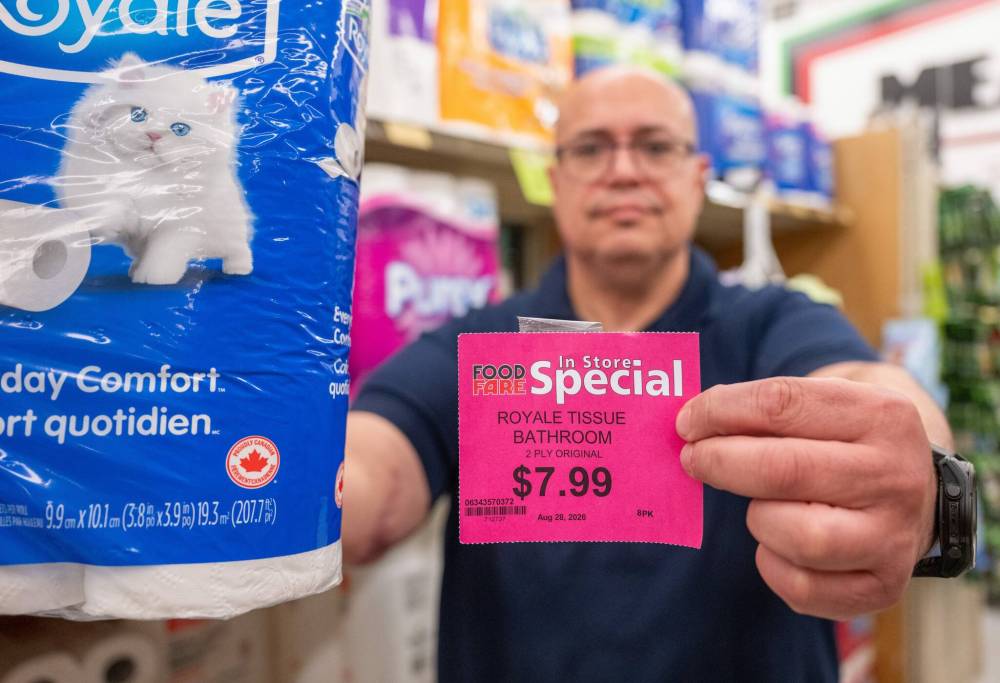
Bram Strain, the president of the Business Council of Manitoba, said the Liberal government has been “very surgical” with the items it chose to target.
“The products that they (listed) have Canadian counter-suppliers,” Strain said. “Counter tariffs were not meant to hurt Canadians.”
He’s one member of Manitoba’s U.S. Trade Council, which is made up of business leaders and provincial politicians. The group convened Monday to discuss the tariffs and support for local firms.
“We were being a little hypothetical,” Strain said. “Now, obviously… we’ll know more and be more precise moving forward.”
“We see it all the time… people can’t afford to eat anymore.”
The premier said staff in the business and agriculture departments are studying Ottawa’s announcement, which included $7.5 billion in supports for tariff-hit businesses. It will announce its own supports for companies and workers later this week, Kinew said.
Ralph Fehr, whose business, Elias Woodwork, has lost millions of dollars monthly since late last year, when 25 per cent tariffs hit Canadian kitchen cabinet exports, is also looking at the fine print of Canada’s targeted tariffs.
Elias Woodwork continues to ship cabinet doors to the United States. It has increased its prices three times, but the “appetite for paying more is pretty much gone,” Fehr said.
“We just basically have to survive until saner heads prevail.”
Fehr said he considers loans a last resort.
“Sometimes government programs, in our experience, have so much red tape involved that… it’s almost counterproductive to be enrolled in them,” he said, adding he’ll investigate whether the new programs are “economical.”
ROBERT LEE / FREE PRESS “Made in Canada” signs are placed throughout Maryland Food Fare to direct customers to Canadian goods.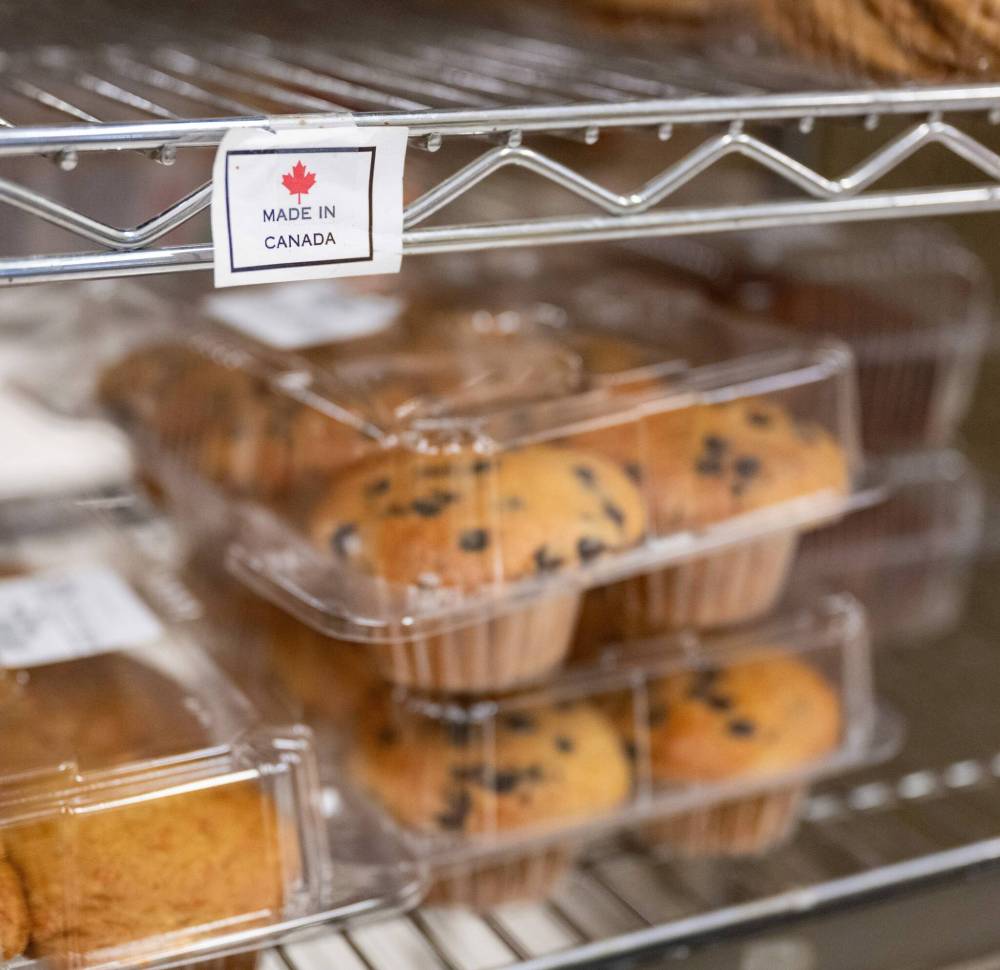
The Business Development Bank of Canada and regional development agencies, including Prairies Economic Development Canada, are among the entities that will hand out federal funding.
The seven regional development agencies will split $1.5 billion announced Tuesday, adding to $1.95 billion previously tabbed. The agencies will determine money distribution and delivery timelines, said David Lauer, spokesman for Prairies Economic Development Canada.
Eligible businesses could get up to $2 million in non-repayable support and $1 million — also non-repayable — for “pivot projects” or capital investment plans, Lauer wrote in a statement.
Around $663 million worth of Manitoba goods — 5.1 per cent of the province’s overall exports to the U.S. — are affected by the latest U.S. 50 per cent tariffs. This doesn’t include longer-lasting tariffs, including on steel and autos industries.
Much of the cash announced Tuesday will be integrated into established programs, which simplifies the process and saves businesses time, said Loren Remillard, the president of the Winnipeg Chamber of Commerce.
Tariff-hit companies require liquidity and cash flow help, which seems to be on the table, Remillard said.
“I think Canada is showing the rest of the world right now that you don’t have to take a knee. You don’t have to bow down.”
“We are early days in this,” he said. “But what the programs announced (Tuesday) signify is the federal government acknowledges flexibility will be key.
“It can’t just be a one-and-done approach.”
Kinew said the premiers are contacting their U.S. counterparts to discuss the trade dispute.
“I think it’s always a time to negotiate and engage,” he said about reigniting trade talks ahead of the counter tariffs’ Sept. 8 implementation date.
“But I think Canada is showing the rest of the world right now that you don’t have to take a knee. You don’t have to bow down. You can be proud, you can have backbone and you can stand up for your own economy and your own jobs.
“I’m proud of our country right now. I’m proud of Canadians’ response right now.”
The trade war will worsen inflation, said Laura Brown, a University of Manitoba economics professor.

“It will definitely slow economic activity, but… we’ve put so many measures in place to counter it,” Brown said, pointing to governments’ small business programs and efforts to diversify trade.
“Is there going to be a cost? Obviously, but I think it’s a cost worth paying,” she said.
Kevin Rebeck, president of the Manitoba Federation of Labour, applauded Ottawa’s decision to expand employment insurance amid the trade war.
He said fewer than 100 steelworkers in Manitoba, who don’t work at Gerdau in Selkirk, have tapped into work-share and employment insurance programs.
gabrielle.piche@winnipegfreepress.com
Gabrielle Piché reports on business for the Free Press. She interned at the Free Press and worked for its sister outlet, Canstar Community News, before entering the business beat in 2021. Read more about Gabrielle.
Every piece of reporting Gabrielle produces is reviewed by an editing team before it is posted online or published in print — part of the Free Press‘s tradition, since 1872, of producing reliable independent journalism. Read more about Free Press’s history and mandate, and learn how our newsroom operates.
Our newsroom depends on a growing audience of readers to power our journalism. If you are not a paid reader, please consider becoming a subscriber.
Our newsroom depends on its audience of readers to power our journalism. Thank you for your support.
Manitobans support Team Canada
Canada comes first in the eyes of most Manitobans.
Seventy-five per cent of Manitobans want a “Team Canada” approach from the provincial government rather than a “province-first” stance, new survey results by the Angus Reid Institute show.
Respondents were asked about their feelings regarding the Canada-U.S. trade war. Nationally, 69 per cent of respondents said they expect a “Team Canada” approach from their provincial government.
Quebec was just behind Manitoba with 72 per cent supporting a united Team Canada stance.
Fifty-five per cent of Manitobans said they expect the Canada-U.S. trade dispute to hurt the province.
Fifty-two per cent favour governments redirecting money from other spending to support tariff-impacted workers and industries.
The Angus Reid Institute polled 116 Manitobans, and 1,770 adults nationally, from Aug. 22 to 24. The poll was conducted online and doesn’t have a margin of error.
– Free Press staff
Gabrielle Piché reports on business for the Free Press. She interned at the Free Press and worked for its sister outlet, Canstar Community News, before entering the business beat in 2021. Read more about Gabrielle.
Every piece of reporting Gabrielle produces is reviewed by an editing team before it is posted online or published in print — part of the Free Press‘s tradition, since 1872, of producing reliable independent journalism. Read more about Free Press’s history and mandate, and learn how our newsroom operates.
Our newsroom depends on a growing audience of readers to power our journalism. If you are not a paid reader, please consider becoming a subscriber.
Our newsroom depends on its audience of readers to power our journalism. Thank you for your support.
Related Articles
‘I’m proud of our country right now’: Kinew on Canada’s counter-tariffs




Advertisement Advertise With Us
Advertisement Advertise With Us