

The ‘Buy Canadian’ trade war challenge
Advertisement
Read this article for free:
or
Already have an account? Log in here »
To continue reading, please subscribe:
Digital Subscription
One year of digital access for only $1.44 a week*
- Enjoy unlimited reading on winnipegfreepress.com
- Read the E-Edition, our digital replica newspaper
- Access News Break, our award-winning app
- Play interactive puzzles
*Billed as $5.77 plus GST every four weeks. After 52 weeks, price increases to the regular rate of $19.95 plus GST every four weeks. Offer available to new and qualified returning subscribers only. Cancel any time.
To continue reading, please subscribe:
Add Free Press access to your Brandon Sun subscription for only an additional
$1 for the first 4 weeks*
- Enjoy unlimited reading on winnipegfreepress.com
- Read the E-Edition, our digital replica newspaper
- Access News Break, our award-winning app
- Play interactive puzzles
*Your next Brandon Sun subscription payment will increase by $1.00 and you will be charged $17.95 plus GST for four weeks. After four weeks, your payment will increase to $24.95 plus GST every four weeks.
Read unlimited articles for free today:
or
Already have an account? Log in here »
“Buy Canadian,” they tell us, as trade tensions escalate between Canada and the United States. “Elbows up,” the pithy slogan advises again and again, in response to the latest daily affront from increasingly unbalanced U.S. President Donald Trump.
And there’s no question Canadians from coast to coast to coast have bought into the patriotic mindset that politicians, from Prime Minister Mark Carney right on down to elected officials at the municipal level, have implored us to adopt.
“We were attacked,” is how Carney described the Aug. 21 unraveling of trade talks, after U.S. negotiators reportedly inserted last-minute demands the Canadian side viewed as both unreasonable and unacceptable. “You’re at war when you get attacked. We got attacked.”
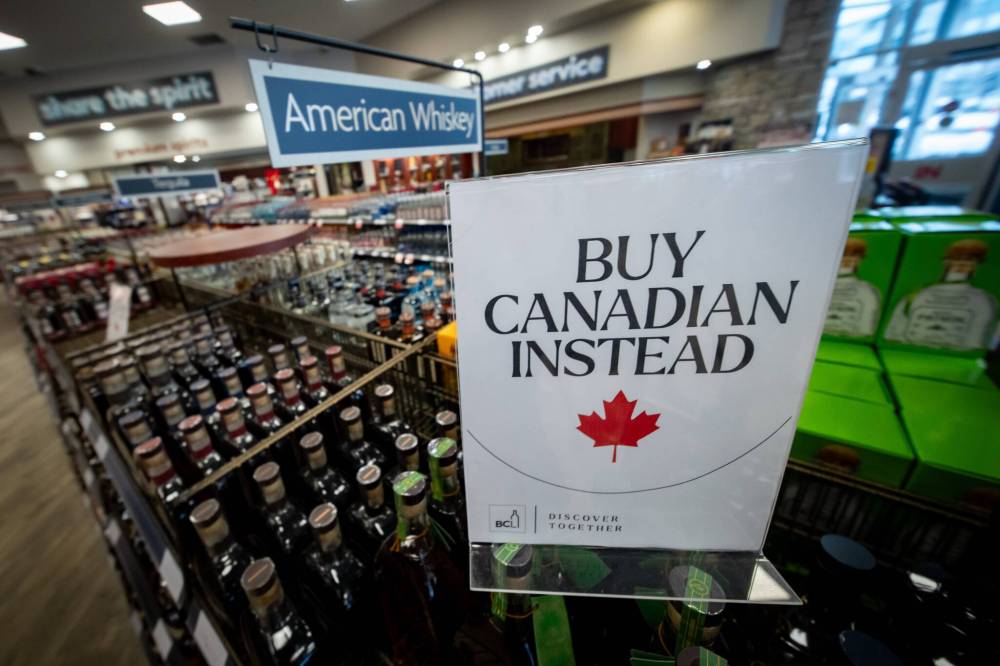
The Canadian Press files
Shoppers have been caught up in ‘Buy Canadian’ fervour since U.S. President Donald Trump announced tariffs on Canadian goods in 2025. It has only increased in intensity.
The breakdown led to the immediate imposition by Trump of steep new tariffs on $29 billion worth of Canadian goods headed to south-of-the-border markets. A targeted, dollar-for-dollar Canadian tariff response will take effect after the Labour Day weekend. In the meantime, Canadians are more motivated than ever to stand firm against Trump’s tyrannical tactics.
In a rhetorical and attitudinal sense, we are a country galvanized. But what’s a bit more tricky amid all the waved flags, defiant T-shirt slogans and metaphorically elevated elbows is the question of matching actions to words in a way that has actual, measurable impact.
What, exactly, does “buy Canadian” mean? How many of us are committed to actually doing it, and how do we know when our efforts to redirect our spending to homegrown goods and services (or non-American alternatives) are having the intended result?
Some of it is relatively easy. Many Canadians have opted to cease spending their tourism dollars south of the border, choosing instead to vacation across our vast nation or travel to destinations located anywhere but on American soil.
The choice not to buy or consume U.S. wines and spirits was (in most provinces) essentially made for us, as governments removed American products from liquor-store shelves in response to Trump’s first wave of ill-considered tariffs.

As for other “buy Canadian” choices … as it turns out, it isn’t that easy to know. In the inevitable reaction to Trump’s bullying, insults, tariff impositions and patently juvenile threats to Canadian sovereignty (Lake America? Seriously?), businesses everywhere have scrambled to declare themselves “proudly Canadian,” even when the products on offer are genuinely anything but.
Just exactly how Canadian is something that claims such a disinction? In order for its label to say “product of Canada,” at least 98 per cent of the major ingredients, labour and processing involved in producing it must be Canadian. If the label says “made in Canada,” however, only 51 per cent of the production cost must be Canadian. And things get murkier when the process involves companies that have bases in Canada but subcontract production abroad, making it difficult to pinpoint how much Canadian materials and labour are involved.
There’s effort involved in buying Canadian, and sacrifice. Such things are necessary when a nation is “at war.”
“This emotional response to President Trump’s tariffs and remarks about Canada has increased people’s willingness to take on a little bit of extra work or increase their efforts to facilitate that switch,” says François Neville, associate professor of strategic management at McMaster University’s DeGroote School of Business. “It’s costing them more in terms of money, time and effort, but it seems they are motivated to bear these costs.”
The thing about keeping your elbows up is that eventually your arms get tired. Fighting our way through what remains of the Trump ordeal is going to require determination, stamina and unwavering focus, but Canadians are up to the challenge.