Prehistoric Yukon ‘cheetahs’ were fish eaters, not really cheetahs at all: study

Advertisement

Advertise with us

Slender, agile cheetahs that roamed the Yukon 30,000 years ago were not technically cheetahs at all, but relatives of the puma that adapted to mostly eat fish instead of antelopes in a harsh northern climate, new research shows.

Read this article for free:


or

Already have an account? Log in here »

To continue reading, please subscribe:

Subscribe and receive a limited-edition Free Press branded hat or tote.

Digital Subscription

One year of digital access for only $205*

  • Enjoy unlimited reading on winnipegfreepress.com
  • Read the E-Edition, our digital replica newspaper
  • Access News Break, our award-winning app
  • Play interactive puzzles

*First annual payment billed as $205.00 + GST for one year. This annual subscription will automatically renew at $233.00 + GST every 52 weeks (10% off the regular annual price of $259.35). Offer available to new and qualified returning subscribers only. Cancel any time.

To continue reading, please subscribe:

Add Free Press access to your Brandon Sun subscription for only an additional

$1 for the first 4 weeks*

  • Enjoy unlimited reading on winnipegfreepress.com
  • Read the E-Edition, our digital replica newspaper
  • Access News Break, our award-winning app
  • Play interactive puzzles
Start now

*Your next Brandon Sun subscription payment will increase by $1.00 and you will be charged $17.95 plus GST for four weeks. After four weeks, your payment will increase to $24.95 plus GST every four weeks.

Slender, agile cheetahs that roamed the Yukon 30,000 years ago were not technically cheetahs at all, but relatives of the puma that adapted to mostly eat fish instead of antelopes in a harsh northern climate, new research shows.

A study published in the journal Current Biology analyzed fossils found in the Yukon and Wyoming in the United States belonging to Miracinonyx trumani, also known as the “American cheetah.”

With their gracefully slim bodies and long legs, the now-extinct cats appeared to resemble African cheetahs.
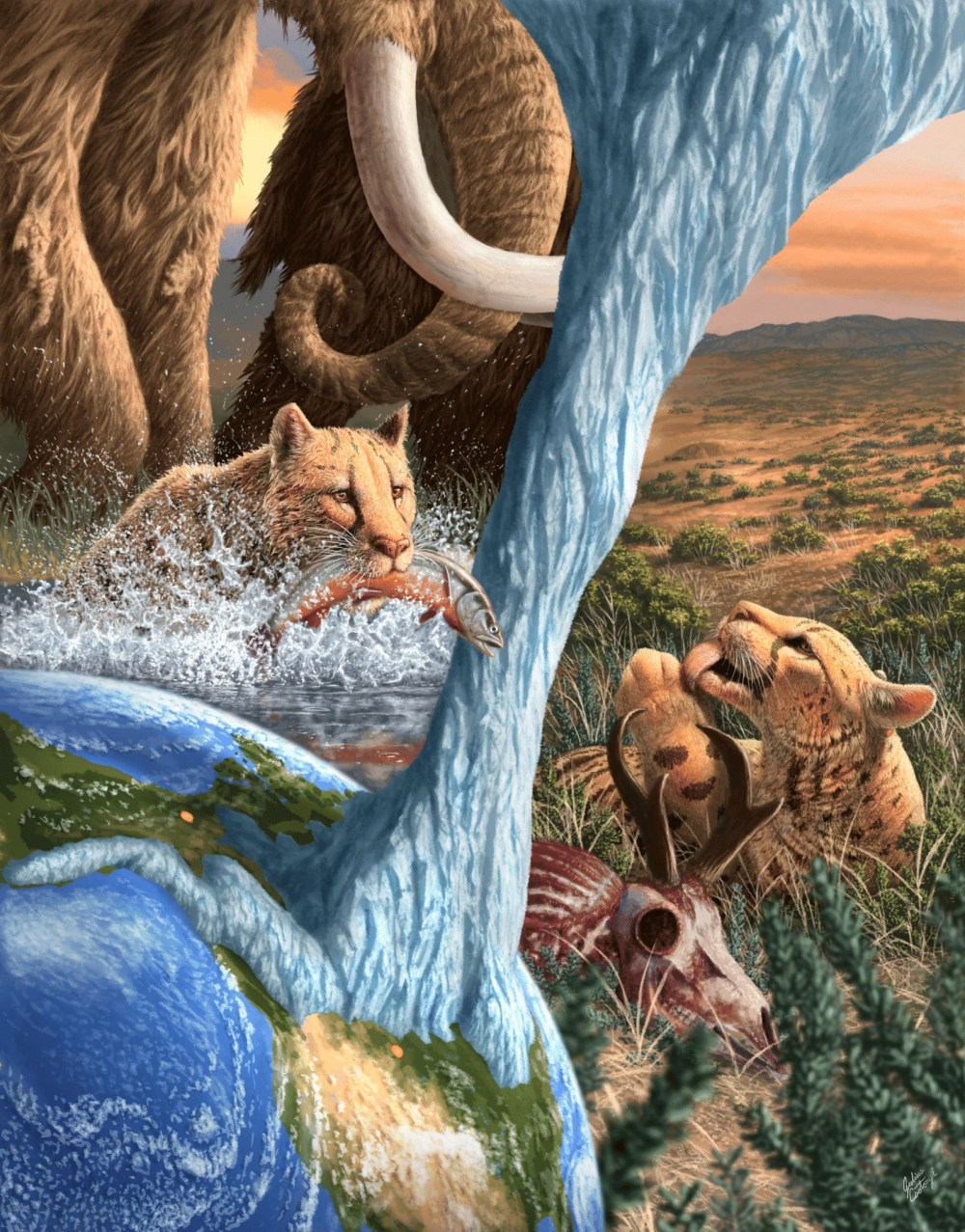
Two Miracinonyx hunt in this artistic rendering. A new study says the cheetah-like species which roamed the Yukon 30,000 years ago developed a unique fish diet to survive. (Julius Csotonyi via The Canadian Press)

But the researchers found the cats were actually closer relatives of the puma, having diverged from the puma lineage around 2.6 million years ago as growing grasslands and cooling temperatures drove diversification in many North American mammals.

Grant Zazula, a paleontologist for the Yukon government and one of the study’s co-authors, said the species’ identification in the territory was interesting because the pronghorn antelope hunted by their southern counterparts never existed there.

The researchers wanted to find out what the Yukon cats were eating instead, so they sent the fossils for analysis. The results showed a chemical signature that matched other fish-eating predators like grizzly bears, Zazula said.

In fact, the Yukon cats adapted to eat mostly fish, a unique preference compared to the more diverse diet favoured by their southern kin.

“We’ve never seen a cat behave like this before,” Zazula said in an interview Thursday.

He said the cats likely made the change to adapt to their new environment after travelling farther north into a Yukon that was vastly different 30,000 years ago.

Gone were the boreal forests with their spruce trees and animals such as moose found in modern-day Yukon. Instead, the cats would have faced tree-barren grasslands and walked alongside woolly mammoths, wild horses, bison and other large mammals.

“Because there were so many of these big herbivorous animals on the landscape, we had lots of carnivores that were eating them,” Zazula said. The other predators included lions, sabretooth cats, wolves and grizzly bears.

The Yukon cheetahs would have had to find their niche in a competitive and unforgiving environment, Zazula added.

Luckily, the region’s rivers were rich with salmon and the cats could eat fish carcasses along the banks or have their pick from fish-packed spawning grounds.

Their distinct diet was likely key to their survival in the north, Zazula said.

“In order to live and be successful in the Yukon during the Ice Age, it had to figure out its way to live. And that fishing niche wasn’t occupied,” he said.

The Yukon environment also had an impact on the cats’ genetics, the researchers found. Two of the genes that regulate circadian rhythm — essentially the body’s internal alarm clock that reacts to changes in brightness — were non-functional in the cats.

It could be because the animals had to adapt to seasonal extremes of sunlight and darkness because of their high-altitude homes, or the cats could have been nocturnal.

The cats eventually went extinct after they couldn’t adapt to ecosystem changes at the end of the Ice Age.

But Zazula said their hardiness in adapting to their Yukon environment had parallels to the people who now live there.

“Everybody that moves to the Yukon has to figure out a different way to live if you’re not from here,” he said. “(The cats) made their way, they figured it out by adapting to new resources and new environmental conditions. It became something unique — the Yukon cheetah.”

This report by The Canadian Press was first published Sept. 4, 2026.

Report Error Submit a Tip

More Stories

New Jets show promise despite loss to experienced Oilers

Mike McIntyre 8 minute read Preview

New Jets show promise despite loss to experienced Oilers

Mike McIntyre 8 minute read Updated: Yesterday at 9:34 AM CDT

Preseason hockey games are always more about the process than the result, and that’s especially true when the opposing rosters appear to be a major mismatch on paper.

So a 5-2 loss by an inexperienced group of Winnipeg Jets skaters against a star-studded Edmonton Oilers squad on Saturday night in the Alberta capital was neither surprising nor alarming.

There was, however, plenty to like from the visitors’ perspective despite the outcome.

Let’s break it down.

Read
Updated: Yesterday at 9:34 AM CDT

Steinbach Credit Union member warns others after scammer steals $10K

Scott Billeck 5 minute read Preview

Steinbach Credit Union member warns others after scammer steals $10K

Scott Billeck 5 minute read Friday, Sep. 18, 2026

A Winnipeg single mother whose bank account was drained of nearly $10,000 says Steinbach Credit Union needs to warn its members about what she believes is a broader security problem.

The woman, who is not being named to protect her identity, said a scammer gained access to her account earlier this week after calling SCU’s contact centre, claiming to be her and successfully completing the credit union’s authentication process.

She said she knows of at least six others who have experienced similar incidents in which callers impersonate SCU account holders and pass the authentication checks.

The woman discovered something was wrong when her minor son asked why money had been transferred out of an account they jointly hold.

Read
Friday, Sep. 18, 2026

Transportation Safety Board investigating after two pilots found dead near Regina

The Canadian Press 1 minute read Preview

Transportation Safety Board investigating after two pilots found dead near Regina

The Canadian Press 1 minute read Updated: Yesterday at 4:41 PM CDT

REGINA - A Manitoba-based flying school and air taxi provider says two of its pilots were found dead near Regina on Friday.

Adam Penner, president of Harv's Air, says in a statement that two people were aboard the Cessna 172 on a night flight from Regina to Steinbach, Man.

Penner says a search began after the aircraft did not arrive on schedule, and the plane was found along with its two occupants on Friday evening near Kisbey, southeast of Regina.

Harv's Air says it is shocked and saddened by the tragedy, and it is working with the Transportation Safety Board of Canada in determining the cause of the deaths.

Read
Updated: Yesterday at 4:41 PM CDT

‘She was looking to destroy me’: convicted harasser faces new charges

Dean Pritchard 6 minute read Preview

‘She was looking to destroy me’: convicted harasser faces new charges

Dean Pritchard 6 minute read Thursday, Sep. 17, 2026

When Agnieszka Ciochon-Newton moved into the 55-plus apartment building on Stradbrook Avenue last year, she came across as “timid, soft-spoken and sensitive,” said building manager Tanya Owen.

Little did Owen know the meek-looking 58-year-old woman would soon turn her life and the lives of many of her tenants upside down and threaten her career and family.

“She was looking to destroy me for a simple tenant disagreement,” Owen said Thursday.

Court records show Ciochon-Newton was arrested earlier this month and charged with seven counts of criminal harassment, two counts of uttering threats and one count each of fraud, breaking and entering, attempting to obstruct justice, intimidation of a justice official, mischief and defamatory libel.

Read
Thursday, Sep. 17, 2026

Letters, Sept. 21

7 minute read 2:00 AM CDT

Treat the disease

I understand there are valid concerns regarding specific short term rentals (STR) in Winnipeg. However, the article raised other alarms for me.

Winston Yee, the city’s manager of licensing and bylaw enforcement, stated the purpose of the new requirement (reporting 911 calls for STR) is “so we can become aware of issues.” So he isn’t aware of “the issues” yet? Are there not systems in place to obtain this information? Doesn’t the city know which addresses have high calls for emergency service? I sure hope the city’s systems aren’t so antiquated that it can’t cross-reference emergency calls with the STR registry.

I think the focus needs to be on the behavior, rather than the ownership structure. Part of the proposed solution to “parties, noise, violence, vandalism and other criminal activity” is to require owners of STR to advise the city when an emergency responder attends the property.

Not falling back means time loop remains unclosed

Jen Zoratti 4 minute read Saturday, Sep. 19, 2026

I demand restitution. Where’s my hour?

In the traditional fall-back, spring-forward time change set up — you know, ol’ trusty that’s been effect for lo these 63 years — we lost an hour in the spring that we got back in the fall.

That was the social contract: you commit to feeling like you’re on cold medication for a week in March because you know a glorious extra hour of sleep will be returned to you in November. (Unless, of course, you have little kids, but look: we all make our choices.)

Well, that transaction, flawed as it was, isn’t happening this year. That hour you sacrificed to the sun gods in the spring? Gone. Not coming back. We’ve sprung forward and we shan’t be falling back — not in November, and (possibly) not ever. The scale shall remain unbalanced and the loop shall remain unclosed as Manitoba has adopted permanent daylight time.