

Brewers question province’s plan for trade missions to open markets

Advertisement
Read this article for free:
or
Already have an account? Log in here »
To continue reading, please subscribe:

Digital Subscription
One year of digital access for only $205*
- Enjoy unlimited reading on winnipegfreepress.com
- Read the E-Edition, our digital replica newspaper
- Access News Break, our award-winning app
- Play interactive puzzles
*First annual payment billed as $205.00 + GST for one year. This annual subscription will automatically renew at $233.00 + GST every 52 weeks (10% off the regular annual price of $259.35). Offer available to new and qualified returning subscribers only. Cancel any time.
To continue reading, please subscribe:
Add Free Press access to your Brandon Sun subscription for only an additional
$1 for the first 4 weeks*
- Enjoy unlimited reading on winnipegfreepress.com
- Read the E-Edition, our digital replica newspaper
- Access News Break, our award-winning app
- Play interactive puzzles
*Your next Brandon Sun subscription payment will increase by $1.00 and you will be charged $17.95 plus GST for four weeks. After four weeks, your payment will increase to $24.95 plus GST every four weeks.
Read unlimited articles for free today:
or
Already have an account? Log in here »
INSTEAD of a travel itch, confusion and frustration have emerged among some Manitoba brewers while the province plans interprovincial trade missions for the sector.
The government has slated $500,000 for its initiative.
Work is just beginning. The Manitoba Chambers of Commerce and Manitoba Liquor and Lotteries have been tapped to assist.
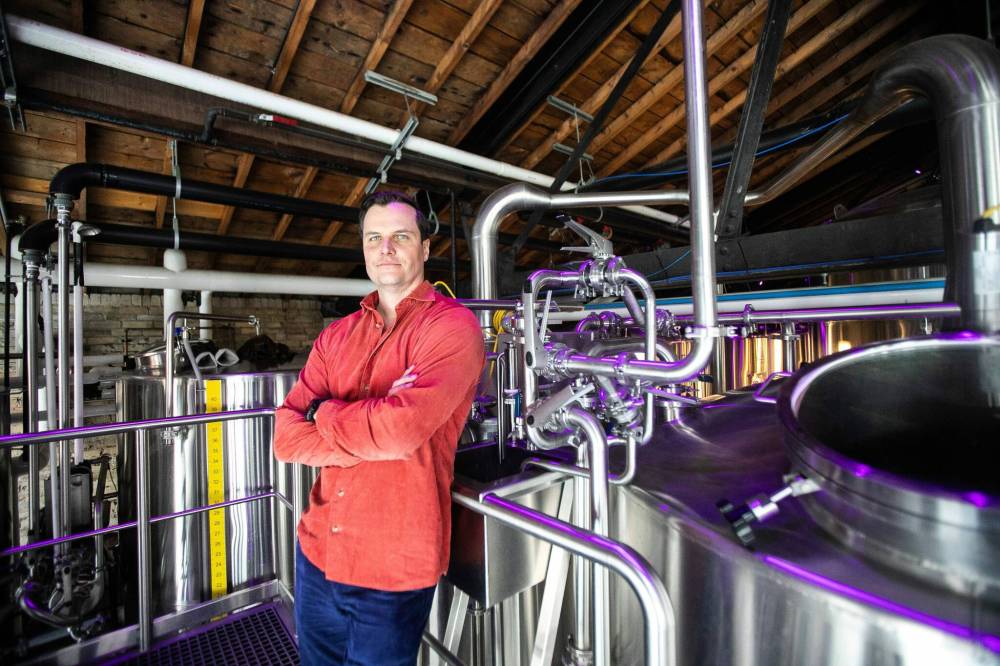
MIKAELA MACKENZIE / FREE PRESS FILES
Kevin Selch of Little Brown Jug wants Liquor and Lotteries to trim the markup on his products.
Delegations may land in Saskatchewan, Alberta, British Columbia or Ontario, a government spokesperson said.
“The barrier to me getting into Ontario or B.C. is not a $600 flight,” said Kevin Selch, president of Little Brown Jug. “We don’t need government to connect us to other liquor monopolies.”
He sells beer in Saskatchewan and Alberta, two provinces with privatized liquor stores. Selling in Kenora and northwestern Ontario is a goal, he said, but it’s much harder because the Liquor Control Board of Ontario owns most outlets.
He’s been in Ontario promoting his drinks.
“It makes me cringe a little bit to think that at this moment, with everything going in the economy, that the answer is these trade missions,” Selch said.
He’s long advocated for the province to reduce its markups, which increase drink prices. Last year, a group of 21 brewery executives signed a letter urging the provincial government to review its beer markups.
The letter argued Manitoba’s prices are restrictive compared to Ontario, British Columbia and Alberta.
“We’ve provided so much information to government around what it takes to develop a new market,” Selch said. “That really comes down to having a home field advantage, where we have competitive markups.
“We can take those resources and grow our business here and push into other markets.”
The current markup is 29.5 per cent for local brews sold in Liquor Marts and beer vendors. There’s no markup for drinks in breweries and farmers markets.
Reducing the fee would have a varying impact for brewers, but it would be “extra money in pockets,” which is good, said Colin Koop, co-owner of Devil May Care Brewing.
He’s eyeing other recently announced government measures, such as short-term tax relief.
Aluminum can and shipping costs have skyrocketed, and customers are pulling back on beer purchases, Koop said.
“Trade missions are interesting,” he said. “I don’t know that they will be a massive help. I’m certainly willing to be proven wrong.”
Lately, he’s been focused on offering customers lower-price products. The future feels “very uneasy, very unstable,” especially as costs keep rising, he said.
Alcohol has been a focal point in the U.S.–Canada trade war as provinces, such as Manitoba, have taken American liquor off shelves.
Business Minister Jamie Moses called local drinks “very topical.” He didn’t answer, when asked, whether the province planned to lower its alcohol markups.
“We know we’re in this time where Canadians are … not using American booze. We want to give them another option,” Moses said.
“We’ll work with breweries and distilleries around the province who want to use (the trade missions), who want to see the best benefit and bang for their buck when it comes to this funding.”
Food & Beverage Manitoba has begun representing Manitoba craft brewers. Many don’t trade interprovincially, said Michael Mikulak, the association’s executive director.
Some businesses haven’t reached that production level. Also, it can be hard to get new customers elsewhere when local beer is typically drunk locally, Mikulak said.
“For the craft brewers, more interprovincial trade isn’t necessarily a solution,” he said. “It might be for some, but for a lot it just won’t be.”

Ultimately, a free trade deal is needed, he said. He called the federal government “smart” for its targeted counter-tariff approach.
“I think the government just needs to be really, really targeted with how it supports (businesses), and I think it is,” he added.
Manitoba has 49 craft liquor manufacturers. The local markup is lower than the 78 per cent a “macro” volume beer faces, a Manitoba Liquor and Lotteries spokesperson wrote in a statement.
One Manitoba brewery has permanently closed in the last seven years; it’s less than the 2.9 per cent decline seen nationally last year, the spokesperson added.
gabrielle.piche@winnipegfreepress.com
Gabrielle Piché reports on business for the Free Press. She interned at the Free Press and worked for its sister outlet, Canstar Community News, before entering the business beat in 2021. Read more about Gabrielle.
Every piece of reporting Gabrielle produces is reviewed by an editing team before it is posted online or published in print — part of the Free Press‘s tradition, since 1872, of producing reliable independent journalism. Read more about Free Press’s history and mandate, and learn how our newsroom operates.
Our newsroom depends on a growing audience of readers to power our journalism. If you are not a paid reader, please consider becoming a subscriber.
Our newsroom depends on its audience of readers to power our journalism. Thank you for your support.
Gabrielle Piché reports on business for the Free Press. She interned at the Free Press and worked for its sister outlet, Canstar Community News, before entering the business beat in 2021. Read more about Gabrielle.
Every piece of reporting Gabrielle produces is reviewed by an editing team before it is posted online or published in print — part of the Free Press‘s tradition, since 1872, of producing reliable independent journalism. Read more about Free Press’s history and mandate, and learn how our newsroom operates.
Our newsroom depends on a growing audience of readers to power our journalism. If you are not a paid reader, please consider becoming a subscriber.
Our newsroom depends on its audience of readers to power our journalism. Thank you for your support.
Advertisement Advertise With Us
Advertisement Advertise With Us