Quebec courts say generative AI cannot replace judges’ reasoning

Advertisement

Advertise with us

MONTREAL - Quebec's courts have issued new guidelines restricting judges' use of generative artificial intelligence, stressing that judging must remain a fundamentally human responsibility.

Read this article for free:


or

Already have an account? Log in here »

To continue reading, please subscribe:

Subscribe and receive a limited-edition Free Press branded hat or tote.

Digital Subscription

One year of digital access for only $205*

  • Enjoy unlimited reading on winnipegfreepress.com
  • Read the E-Edition, our digital replica newspaper
  • Access News Break, our award-winning app
  • Play interactive puzzles

*First annual payment billed as $205.00 + GST for one year. This annual subscription will automatically renew at $233.00 + GST every 52 weeks (10% off the regular annual price of $259.35). Offer available to new and qualified returning subscribers only. Cancel any time.

To continue reading, please subscribe:

Add Free Press access to your Brandon Sun subscription for only an additional

$1 for the first 4 weeks*

  • Enjoy unlimited reading on winnipegfreepress.com
  • Read the E-Edition, our digital replica newspaper
  • Access News Break, our award-winning app
  • Play interactive puzzles
Start now

*Your next Brandon Sun subscription payment will increase by $1.00 and you will be charged $17.95 plus GST for four weeks. After four weeks, your payment will increase to $24.95 plus GST every four weeks.

MONTREAL – Quebec’s courts have issued new guidelines restricting judges’ use of generative artificial intelligence, stressing that judging must remain a fundamentally human responsibility.

The guidelines, jointly adopted by the Quebec Court of Appeal, Superior Court, Court of Quebec and the province’s municipal courts, say generative AI can be used for certain supporting tasks but cannot replace judicial reasoning, the assessment of evidence or deliberation. 

Judging, they say, must remain the exclusive responsibility of judges.
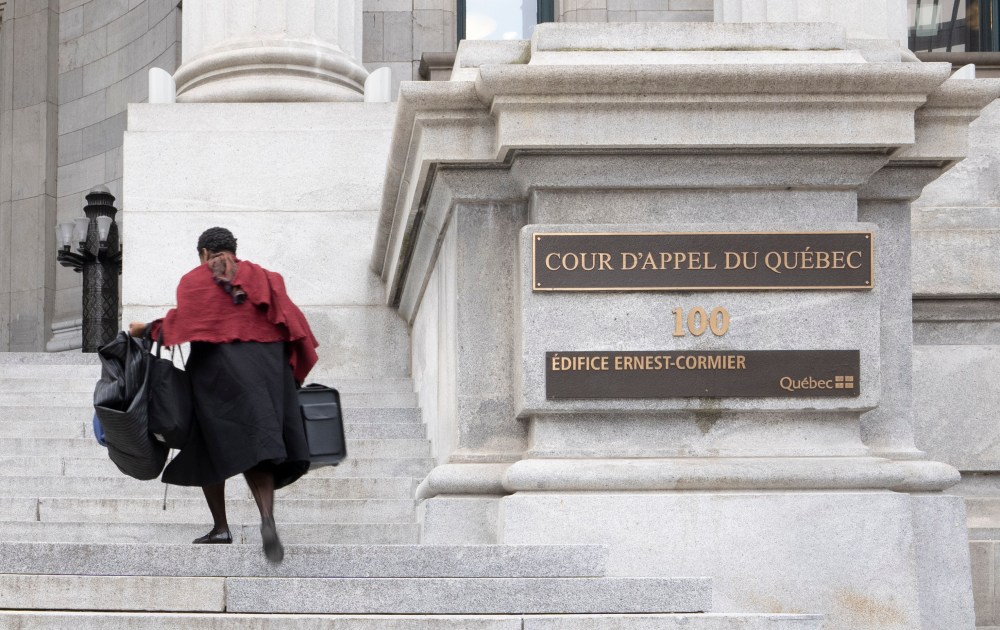
A lawyer runs up the steps of the Quebec Court of Appeal in Montreal on Tuesday, April 21, 2026. THE CANADIAN PRESS/Christinne Muschi

“Generative AI, however sophisticated, possesses neither judgment nor conscience and is not subject to any form of accountability,” states the 10-page document. “It cannot understand the human, social and legal context specific to each case.”

The move comes months after questions were raised about whether a Quebec judge may have used generative AI in preparing a decision.

La Presse reported in March that a decision contained references to case law that did not exist, raising the possibility that generative AI had been used. The episode helped create a sense of urgency within the judiciary as it worked to establish rules for the technology.

The courts say there is currently no approved, secure institutional generative AI tool available to judges. They also warn that existing tools rely on algorithms whose workings remain largely opaque.

“Judging cannot be reduced to a technical exercise,” the guidelines say. “It is an intrinsically human function, based on deliberation, consideration of context, respect for dignity, the requirement of fairness and the exercise of moral responsibility.”

The courts acknowledge that generative AI can be useful, but say it cannot be used as a source of legal authority or reasoning, to assess evidence or to make decisions.

Judges may use it for limited tasks such as correcting, revising, rephrasing or translating text they have already written, certain administrative work, or locating information within specified sources.

Any such use must remain under human control, and AI-generated material must be independently verified.

The guidelines make clear that judges remain fully responsible for their legal reasoning, the contents of their decisions, and the accuracy of the facts, references, quotations and legal authorities they cite.

“No error can be attributed to the tool used,” the document says. “The use of a generative AI tool does not diminish the judge’s obligation to verify or their full responsibility for the final result.”

The guidelines say AI cannot be used for substantive legal reasoning, analyzing or characterizing facts, assessing evidence or credibility, determining the outcome of a dispute, or drafting those parts of a decision.

“If the use of AI has the effect or purpose of determining the legal outcome, assessing credibility or interpreting disputed facts, interpreting the relevance of facts, or formulating the reasons for a decision, it must not be used,” the guidelines say.

The courts also warn judges about confidentiality risks.

Judges should not provide AI tools with draft judgments, notes about ongoing cases or information protected by law or a court order.

Until an authorized institutional system is available, judges using an AI tool for permitted purposes must also ensure its settings prevent information they enter from being used to train or improve the system.

When in doubt, the guidelines recommend judges refrain from using generative AI.

The guidelines are intended to protect principles including judicial independence, impartiality, fairness, human rights and access to justice, while ensuring confidentiality, security and data protection.

This report by The Canadian Press was first published Sept. 5, 2026.

Report Error Submit a Tip

More Stories

Art piece connects viewers to broader national landscape

Allison Gillmor 4 minute read Preview

Art piece connects viewers to broader national landscape

Allison Gillmor 4 minute read Yesterday at 2:01 AM CDT

WHAT IT IS: Copy Paperis a 2014 textile-based piece by Ontario-born, Winnipeg-based artist Kristin Nelson, currently on view at WAG-Qaumajuq as part of the exhibition Terra Cognita/Incognita.

Of the 125 works in the show — which uses historical and contemporary pieces from WAG-Qaumajuq’s permanent collection to explore how artists have represented the landscape over time and across cultures —probably the most attention-getting are the beautiful paintings of Canada’s lakes, plains, forests and mountains.

So, how does this seemingly modest, somewhat enigmatic work connect to Terra Cognita/Incognita’s larger themes?

WHAT IT’S ABOUT: In the middle of the exhibition, an antique desk holds several objects of beauty and utility, and this is where Copy Paper sneaks in, as something both “cognita and incognita,” known and unknown.

Read
Yesterday at 2:01 AM CDT

Canada’s first drive-thru-only McDonald’s opens in Winnipeg

Aaron Epp 4 minute read Preview

Canada’s first drive-thru-only McDonald’s opens in Winnipeg

Aaron Epp 4 minute read Wednesday, Sep. 2, 2026

One Grimace and dozens of smiles were on display Wednesday as McDonald’s staff and supporters celebrated the grand opening of the fast-food chain’s first drive-thru-only restaurant in Canada.

Read
Wednesday, Sep. 2, 2026

Wonderful wines to help welcome autumn

Ben Sigurdson 4 minute read Preview

Wonderful wines to help welcome autumn

Ben Sigurdson 4 minute read Yesterday at 3:00 AM CDT

As we creep ever closer to fall, many wine drinkers will start to think about popping corks (or screwcaps, as it were) on wines that suit cooler temperatures.

But summer’s not quite done yet. Here are six new and/or notable wines ideal for sipping as we make the transition from warmer weather into the first hints of autumn…

Wines of the weekThe Willm NV Blanc de Noirs Crémant d’Alsace Brut (Alsace, France — $28.99, Liquor Marts and beyond) is a French bubbly made from the Pinot Noir grape in the traditional method (secondary fermentation, which creates the bubbles, happens in the bottle rather than in tanks before bottling).

It’s pale gold with a hint of pink, and on the nose offers ripe cherry, cranberry, bread dough and strawberry compote notes. On the palate it’s light-bodied and mainly dry, with an almost-wild herbal component coming with the strawberry, tart peach, cranberry, raspberry and bread dough flavours.

Read
Yesterday at 3:00 AM CDT

A life's story: translator, poet, radio host, actor loved life to the fullest

Tiago Resko 7 minute read Preview

A life's story: translator, poet, radio host, actor loved life to the fullest

Tiago Resko 7 minute read Yesterday at 3:00 AM CDT

Born with an innate sense of curiosity, Charles Leblanc always wanted to understand the world around him. To him, words and theatre weren’t just pastimes. They were means of understanding the human experience and helping others see different perspectives.

The poet, translator, actor and radio host dedicated his life to this practice, founding the Winnipeg International Writers’ Festival, establishing French community radio station Envol — where he hosted a show for 25 years — and acting as a core member of the Association of Translators, Terminologists and Interpreters of Manitoba.

Leblanc’s contributions and dedication to Manitoba’s arts and literary scenes made an impact that continues to be felt by the community.

He died June 26 at the age of 75.

Read
Yesterday at 3:00 AM CDT

Back to school means increased costs for parents, post-secondary students

Joel Schlesinger 6 minute read Preview

Back to school means increased costs for parents, post-secondary students

Joel Schlesinger 6 minute read Yesterday at 2:01 AM CDT

In the words of advice for students from Thornton Melon: “It’s rough out there. Move back in with your parents.”

As comedian Rodney Dangerfield’s character alluded to in the 1986 comedy Back to School, it is indeed a tough financial environment as students head back to the classroom in 2026.

A Capital One Canada survey found families are struggling with costs, with nearly six in 10 parents surveyed stating back-to-school expenses are higher than expected.

It’s not just tuition, new clothes and supplies. Extracurricular activities — like hockey, figure skating, ringette, soccer, dance, etc. — also ramp up, involving tuition-sized payments.

Read
Yesterday at 2:01 AM CDT

Manitoba doctor denies working to revive Carberry ER in response to recruitment lawsuit

Erik Pindera 4 minute read Preview

Manitoba doctor denies working to revive Carberry ER in response to recruitment lawsuit

Erik Pindera 4 minute read 9:40 AM CDT

A Manitoba doctor has denied he was working as a recruiter after an Ontario doctor accused him of misleading him about a position at the Carberry hospital.

Dr. Klevis Iliriani, who worked at the hospital in Carberry from May to August 2024, filed his statement of claim in Court of King’s Bench earlier this year.

Iliriani, who lives in an Ottawa suburb, has alleged recruiters negligently misrepresented the job at the Carberry hospital and breached the terms of his contract, which resulted in less pay than promised.

His court filing names defendants Dr. Dave Maharajh and Barry Banek as the recruiters.

Read
9:40 AM CDT