Quebec school finds creative ways to help students with visual impairments learn
Advertisement
Read this article for free:
or
Already have an account? Log in here »
To continue reading, please subscribe:
Digital Subscription
One year of digital access for only $1.44 a week*
- Enjoy unlimited reading on winnipegfreepress.com
- Read the E-Edition, our digital replica newspaper
- Access News Break, our award-winning app
- Play interactive puzzles
*Billed as $5.77 plus GST every four weeks. After 52 weeks, price increases to the regular rate of $19.95 plus GST every four weeks. Offer available to new and qualified returning subscribers only. Cancel any time.
To continue reading, please subscribe:
Add Free Press access to your Brandon Sun subscription for only an additional
$1 for the first 4 weeks*
- Enjoy unlimited reading on winnipegfreepress.com
- Read the E-Edition, our digital replica newspaper
- Access News Break, our award-winning app
- Play interactive puzzles
*Your next Brandon Sun subscription payment will increase by $1.00 and you will be charged $17.95 plus GST for four weeks. After four weeks, your payment will increase to $24.95 plus GST every four weeks.
Read unlimited articles for free today:
or
Already have an account? Log in here »
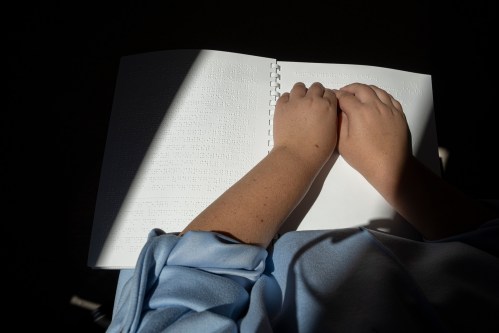
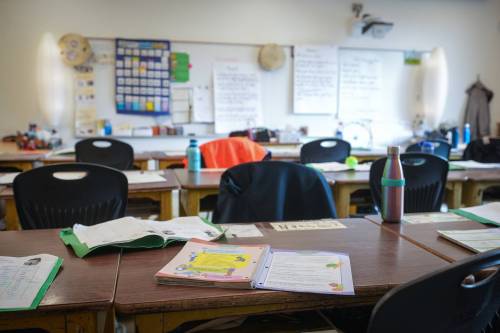
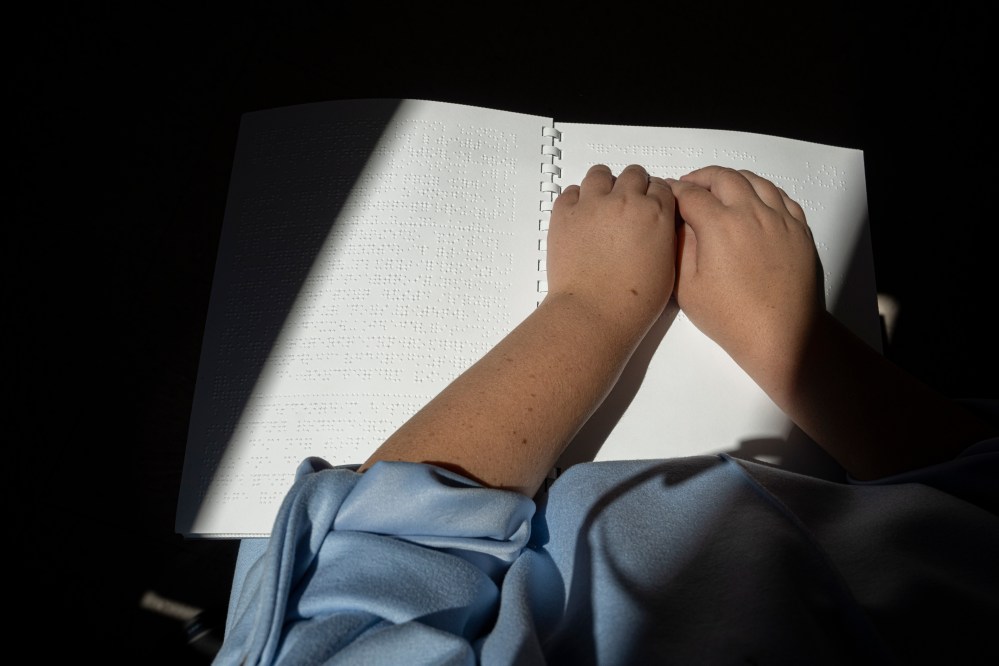
MONTREAL – At Jacques-Ouellette school, learning can mean reading braille, making out large print, or relying on touch — and no two students learn quite the same way.
The hallways of the Longueuil school, just south of Montreal, came back to life last week with the arrival of 55 students between the ages of four and 21.
Funded by Quebec’s Education Department, Jacques-Ouellette is the only French-language school in the province specializing in students with visual impairments.
“Their vision has to be at a certain level to be admitted to our school,” principal Geneviève Blondin said after the start of the school year.
While the school is part of the Marie-Victorin school service centre in the Longueuil area, it also welcomes children from about 10 other school service centres to meet their specialized needs.
“The students follow the Quebec curriculum, but obviously, they do it at their own pace,” teacher Virginie Roy said.
Adaptation is central to the work of the school’s roughly 50 full-time employees and about 10 other staff members.
“It’s case by case all the time,” Blondin said. “One will read braille, another will read print but can see 18-point type, another needs 36-point type to read. Another can only see using a video magnifier.”
A teaching method that works for some students one year may not work the next because new students can have entirely different needs.
“Our students have extremely different profiles, and we try to respond perfectly to each one,” Blondin said. “That’s the main challenge for the team.”
Along with French, mathematics and music, students follow an expanded curriculum. They learn social skills that can be more difficult to pick up through imitation and develop compensatory strategies such as braille and touch.
“We’re not always thinking about the exam at the end of the year,” Blondin said. “We want to help them progress toward the goals we’ve set for them.”
Sometimes that requires unusual creativity. Blondin recalled a student named Cassandra who lacked sensitivity in her fingertips, preventing her from reading braille. She also could not distinguish black from white and could see only spots of colour.
One of her teachers developed a colour-coded communication system specifically for her. “Each colour represented a letter, based on the same principle as braille,” Blondin said.
The teacher spent time every evening colouring rectangles by hand to help Cassandra learn to read.
Realizing that would not be sustainable, the school contacted Microsoft to ask whether it could create a font that would convert her colour-coded system into black-and-white letters on a screen, and vice versa.
After the request was circulated within the company, an employee on the other side of Canada volunteered to create it, making it easier for Cassandra to communicate.
“Every little step, every little victory means something to us, and it’s rewarding for us too,” Blondin said. “We see that we’ve made a difference.”
The school’s library is another example of that effort. While it may look like an ordinary school library, it holds more than 10,000 titles adapted for children with visual impairments.
Novels, children’s books, non-fiction, textbooks and cookbooks are available in full braille, large print and an electronic format that can be read using speech synthesis or a refreshable braille display.
“It’s no different from another library in that sense, because children have the same need: to be able to read independently,” librarian David Choquette said.
The library also serves students outside the school. Quebec’s Education Department has given it a mandate to provide adapted books free of charge to French-speaking students with visual impairments across the province.
Three braille transcription technicians and a graphic arts technician work at the school to adapt material. The school aims to get requested books to students within 30 working days.
Despite the growth of digital tools, Blondin said preserving paper braille remains essential.
“We teach them to write and to read, so paper braille is fundamental for us,” she said. “We don’t want it to disappear for students who are able to use it.”
Choquette said continuing to teach braille also helps preserve the physical skills needed to read it.
“It’s about providing an accessible paper book for free, just as we do for sighted people,” he said. “That helps keep the language alive.”
This report by The Canadian Press was first published Sept. 6, 2026.