

All that glitters … could work here
Advertisement
Read this article for free:
or
Already have an account? Log in here »
To continue reading, please subscribe:

Digital Subscription
One year of digital access for only $205*
- Enjoy unlimited reading on winnipegfreepress.com
- Read the E-Edition, our digital replica newspaper
- Access News Break, our award-winning app
- Play interactive puzzles
*First annual payment billed as $205.00 + GST for one year. This annual subscription will automatically renew at $233.00 + GST every 52 weeks (10% off the regular annual price of $259.35). Offer available to new and qualified returning subscribers only. Cancel any time.
To continue reading, please subscribe:
Add Free Press access to your Brandon Sun subscription for only an additional
$1 for the first 4 weeks*
- Enjoy unlimited reading on winnipegfreepress.com
- Read the E-Edition, our digital replica newspaper
- Access News Break, our award-winning app
- Play interactive puzzles
*Your next Brandon Sun subscription payment will increase by $1.00 and you will be charged $17.95 plus GST for four weeks. After four weeks, your payment will increase to $24.95 plus GST every four weeks.
Read unlimited articles for free today:
or
Already have an account? Log in here »
Sometimes, it’s hard to even suggest a change, because it seems there is always a plethora of people ready to tell you that your idea just won’t work.
But a unique program is working in Portland, Ore. and some version of that program could work in Winnipeg as well. Something that glitters may just be a small nugget of gold.
G.L.I.T.T.E.R. stands for Ground Score Leading Inclusivity Together Through Environmental Recovery.
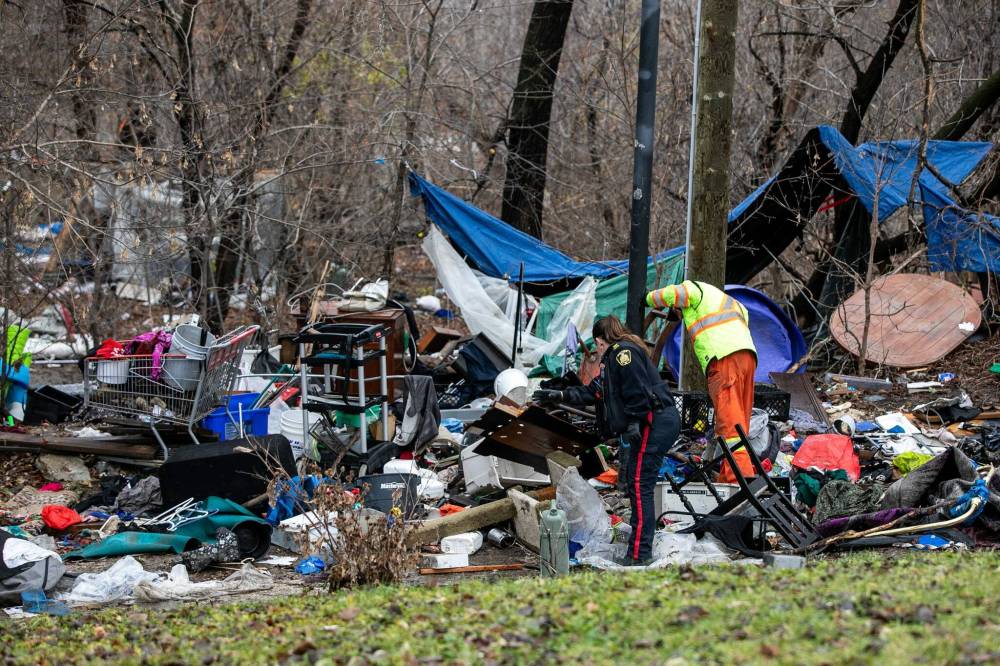
Free Press files
Adopting a cleanup program such as Portland’s G.L.I.T.T.E.R. could be a practical solution to a problem — and maybe a way out of an encampment.
It’s a long handle for a simple concept. Launched in 2021, the program hires people who are either unhoused or have recently been unhoused to do litter collection and tentside garbage collection for homeless encampments in the Portland region.
“GSA currently runs about 36 tentside waste collection routes each week in Old Town, SW downtown, the Central Eastside, North Portland, and East Multnomah County. Collection crews go out on foot or bike and leave materials in designated locations for Ground Score’s e-bike and truck crews to later collect for disposal,” Ground Score says on its website.
“While much of what is discarded at camps is non-recyclable, we are working to establish a more circular economy for many of the materials, particularly metals, batteries and textiles. Clothing waste is taken to Hygiene4All for washing and redistribution and non-reusable clothes are sent for rag-making.”
Its value is more than just the cleanups.
“G.L.I.T.T.E.R. reduces the reliance on harmful practices such as burning and dumping waste. In the broader context, Portland homeless communities burn approximately 552 (pounds) of waste weekly and programs like G.L.I.T.T.E.R. help minimize such practices.”
Participants make US$21.25 an hour and are picked at random at signup sites. They don’t have to provide ID but do fill out forms for income tax on their earnings. When they pick up enough shifts to qualify as payroll employees, they get access to paid time off, vacation time, sick time, pension membership and an employee assistance plan.
And formerly-unhoused people who have found work in G.L.I.T.T.E.R. have also been able to find housing.
“100 per cent of workers that lived in tents during their first pick-up shifts are now in temporary or permanent housing,” a City of Portland review of the program pointed out in 2025. “83 per cent of workers that lived in tents during their first pick-up shifts are now in permanent housing.”
“There is an emphasis on relationship-building with the homeless community that allows workers to collect waste in areas that can be challenging for other waste management program crews to access,” the report points out.
From 2021 to the end of the year in 2024, crews removed 2,590,417 pounds (1,177,462 kg) of trash from encampment areas, including 177,521 sharps and over 110 pounds (50 kg) of cigarette butts — more than 167,300 in all.

The program just won first place in the 2026 Healthy & Sustainable Communities grant program, something that brings US$275,000 into G.L.I.T.T.E.R.
You can almost hear the knee-jerk reactions coming: “It won’t work here.”; “What about legal liability?”; or “They’ll just spend the money on drugs.” (It’s interesting that no one tells you that you can’t use your pay to stop at the liquor store on the way home.)
What we’re doing now obviously isn’t working. An inventive, practical solution that brings employment and support and maybe a way out of an encampment is worth a try.
Not just because other people are trying it and it’s working.
But because throwing up our hands and changing nothing is guaranteed to do just that: nothing.