

The plane truth about a dangerous president
Advertisement
Read this article for free:
or
Already have an account? Log in here »
To continue reading, please subscribe:

Digital Subscription
One year of digital access for only $205*
- Enjoy unlimited reading on winnipegfreepress.com
- Read the E-Edition, our digital replica newspaper
- Access News Break, our award-winning app
- Play interactive puzzles
*First annual payment billed as $205.00 + GST for one year. This annual subscription will automatically renew at $233.00 + GST every 52 weeks (10% off the regular annual price of $259.35). Offer available to new and qualified returning subscribers only. Cancel any time.
To continue reading, please subscribe:
Add Free Press access to your Brandon Sun subscription for only an additional
$1 for the first 4 weeks*
- Enjoy unlimited reading on winnipegfreepress.com
- Read the E-Edition, our digital replica newspaper
- Access News Break, our award-winning app
- Play interactive puzzles
*Your next Brandon Sun subscription payment will increase by $1.00 and you will be charged $17.95 plus GST for four weeks. After four weeks, your payment will increase to $24.95 plus GST every four weeks.
Read unlimited articles for free today:
or
Already have an account? Log in here »
U.S. President Donald Trump has crossed firmly into cutting-off-your-nose-to-spite-your-face territory.
Earlier this week, the president who seems to set policy by spontaneous social-media eruption announced his plans to halt the sales of Bombardier aircraft in the United States, spouting his usual complaints about Canadians and Canadian producers not playing fair.
As usual, the complaint seems to be rooted in the now-usual process: someone close to the emperor whispered in his ear that Canada had treated a Bombardier competitor — Gulfstream — badly, so Trump responded with a pronouncement of broadly agreed doubtful legality. Presidents don’t actually have the power to single out individual companies and ban them from doing business.
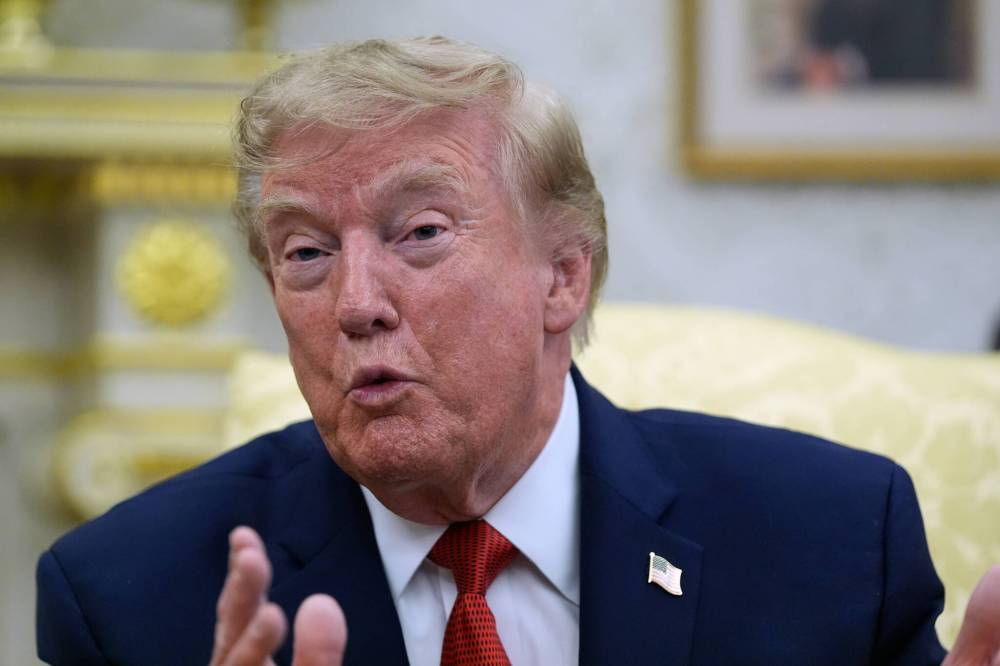
AP Photo / Manuel Balce Ceneta
U.S. President Donald Trump
Nevertheless, the threat alarmed Bombardier executives, customers, employees and government officials.
Not only in Canada — more particularly, in Wichita, Kansas.
That’s where the Canadian-based aircraft manufacturer has more than 1,200 well-paid employees. But not only in Wichita. Bombardier has at least 3,500 U.S. employees, including workers in Texas and Los Angeles who make the wings for Bombardier’s Global 8000 jet.
The company’s largest parts hub is in Chicago — and that’s just part of the company’s U.S. supply chain, including engine maker Pratt and Whitney, which makes the engines used on some Bombardier aircraft in Connecticut.
“Bombardier aircraft create tens of thousands of U.S. jobs through the company’s growing American footprint as well as within its supply chain made up of approximately 2,800 American companies across 47 states. The company spends over $2.5 billion with suppliers each year,” the company pointed out in a statement.
None of that seems to matter to the president.
And it underlines the way things work with the current American government — while the U.S. constitution offers plenty of checks and balances on the roles of the three branches of the American federal government (executive, legislative and judicial), none of those checks and balances matter a whit if no one has the strength to stand up to what is clearly an imperial president.
That’s why, on all things, including aircraft, Canada has to distance itself from the United States as much as it can right now.
Our federal government is currently reviewing its plans to purchase F-35 fighters from U.S. company Lockheed Martin. Canada is committed to buying 16 of the jets and was looking at buying a total of 88. But there are concerns now about whether or not crucial parts of the aircraft’s software will remain under U.S. control.
There’s also a healthy — and cheaper — competitor, Sweden’s Gripen, in a country which has the advantage of not being run by a unpredictable and vindictive president.
Irony of ironies, Lockheed Martin describes its use of Canadian suppliers much the way Bombardier talks about its American suppliers: “Over 110 Canadian companies have contributed to the F-35 supply chain, with C$3.2M in Canadian components in each jet. … Canada’s participation in the F-35 supply chain has strengthened the nation’s defence and aerospace sectors, creating high-quality, skilled jobs and elevating the global competitiveness of Canadian small and medium-sized enterprises.”

But America’s president has spoken. Supply chains don’t matter. Jobs don’t matter. Relationships don’t matter.
Sweden’s Saab says it will build a Gripen assembly line in Canada if the Canadian government picks its aircraft and is promising spinoffs across Canada for everything from parts to future development — plus Canada would get sovereign control over the aircraft’s military software.
Relationships will matter. Supply chains will matter. And Canadian companies — including in Winnipeg — which now work on parts for the F-35 will be valued.
And the same erratic fingertips that now rule America by social media edict won’t be on any of the controls.
Enticing.