Want to lower your risk of dementia? It doesn’t involve a blood test

Advertisement

Advertise with us

WASHINGTON (AP) — New blood tests that might predict Alzheimer’s years before symptoms begin may sound tantalizing for people who worry about later-in-life dementia. But doctors say they aren't quite ready yet — and besides, you don’t need a test before trying to lower your risk.

Read this article for free:


or

Already have an account? Log in here »

To continue reading, please subscribe:

Subscribe and receive a limited-edition Free Press branded hat or tote.

Digital Subscription

One year of digital access for only $205*

  • Enjoy unlimited reading on winnipegfreepress.com
  • Read the E-Edition, our digital replica newspaper
  • Access News Break, our award-winning app
  • Play interactive puzzles

*First annual payment billed as $205.00 + GST for one year. This annual subscription will automatically renew at $233.00 + GST every 52 weeks (10% off the regular annual price of $259.35). Offer available to new and qualified returning subscribers only. Cancel any time.

To continue reading, please subscribe:

Add Free Press access to your Brandon Sun subscription for only an additional

$1 for the first 4 weeks*

  • Enjoy unlimited reading on winnipegfreepress.com
  • Read the E-Edition, our digital replica newspaper
  • Access News Break, our award-winning app
  • Play interactive puzzles
Start now

*Your next Brandon Sun subscription payment will increase by $1.00 and you will be charged $17.95 plus GST for four weeks. After four weeks, your payment will increase to $24.95 plus GST every four weeks.

WASHINGTON (AP) — New blood tests that might predict Alzheimer’s years before symptoms begin may sound tantalizing for people who worry about later-in-life dementia. But doctors say they aren’t quite ready yet — and besides, you don’t need a test before trying to lower your risk.

The U.S. Food and Drug Administration has cleared four blood tests to help doctors diagnose whether Alzheimer’s — not another kind of dementia or something else — is behind someone’s memory problems or other cognitive symptoms. Some laboratories and online services offer their own tests. Faster diagnosis can help people with early-stage Alzheimer’s qualify for drugs that can modestly slow the worsening of their symptoms.

Yet dementia specialists say people without symptoms also seek those tests even though they’re neither approved nor recommended for that population.
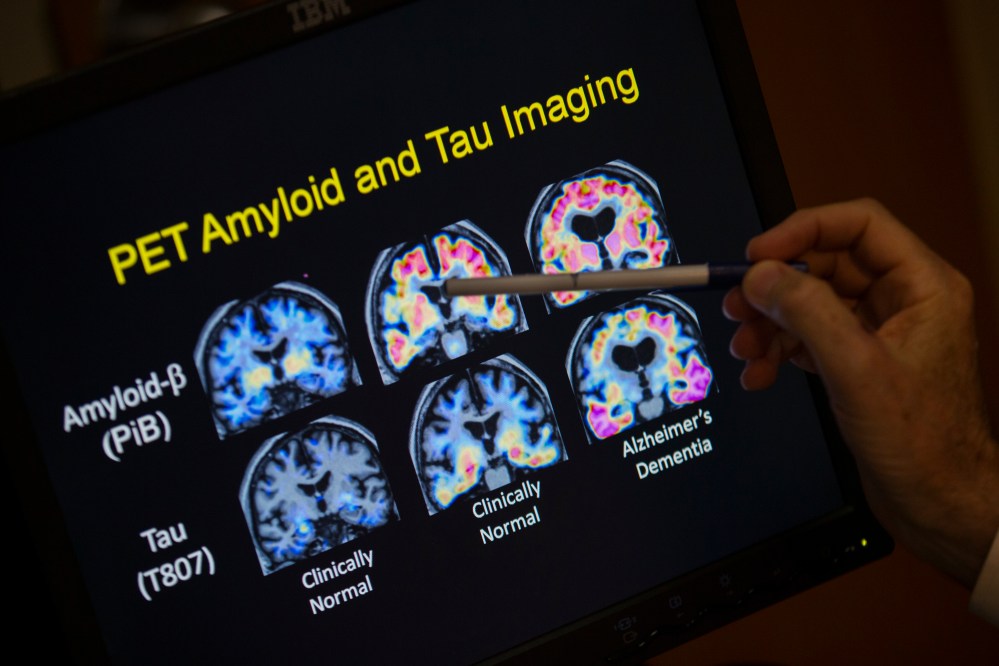
FILE - A doctor points to PET scan results that are part of a study on Alzheimer's disease at Georgetown University Hospital, on Tuesday, May 19, 2015, in Washington. (AP Photo/Evan Vucci, File)

For now, “the worried well should not be getting those tests” outside of a research study, stressed testing expert Nicholas Ashton, of Arizona’s Banner Health.

Instead, focus on addressing potentially preventable brain risks. One large study found people who reached middle age without high blood pressure, diabetes and smoking lived dementia-free for a lot longer — nearly 13 years longer — than people with all three of those common health problems in their 50s.

“Be aggressive,” advised Dr. Josef Coresh of NYU Langone Health, the study’s senior author. Even delaying those risky conditions “has a huge payoff.”

What Alzheimer’s blood tests can and can’t do

Like many people who have watched a loved one succumb to Alzheimer’s, Mark Yost wonders about his own risk even though he doesn’t have symptoms.

“I want to know what my status is,” said Yost, 60, of Phoenix. And if signs of trouble develop, “what I can do about it to either avoid it or slow it down.”

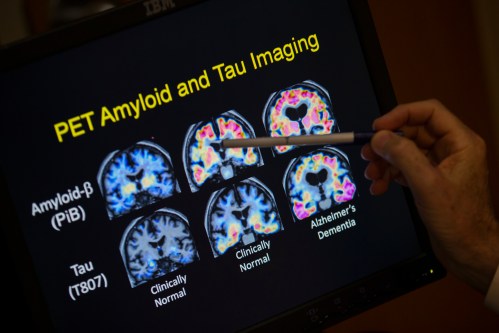
It’s not clear what causes Alzheimer’s, but its telltale markers are abnormal forms of two proteins. Sticky beta-amyloid can build into brain-clogging plaque over decades, eventually spurring neuron-killing tau tangles that lead to symptoms. Blood tests that measure a tau type called p-tau217 seem particularly good at reflecting amyloid buildup in people with symptoms.

As for the symptom-free, a study led by Mass General Brigham researchers found older adults with very high p-tau217 levels had a 38% risk of developing cognitive impairment within five years, and a higher risk over 10 years.

Here’s the rub: A “positive” test result is just a risk factor, not a guarantee someone will later develop Alzheimer’s, Ashton cautioned. Lots of older adults harbor high levels of amyloid but never show cognitive trouble. And while negative test results seem pretty reliable, a positive test sometimes is wrong, a so-called false positive.

Yost volunteered for a Banner blood test study that included cognitively normal people and learned his result was “intermediate,” defined as maybe having some amyloid but not a worrisome “elevated” level.

Yost found the uncertainty “a little disappointing” and something to watch as he gets older, while pursuing brain-healthy steps like exercise and a mentally stimulating genealogy hobby.

What everyone should do for brain health, no test needed

A major trial last year found that healthier habits slowed age-related cognitive decline in older adults who were at increased risk of developing dementia. Among the steps: A half-hour of moderately intense exercise four times a week, twice-weekly resistance training and following the MIND diet, which stresses lots of leafy greens and berries, whole grains, poultry and fish.

Dementia experts also advise getting enough sleep, avoiding social isolation, treating hearing loss and exercising your brain, not just your body. They say middle age is a key time to act.

As for those extra 13 dementia-free years, the NYU study reinforces that what’s good for the heart is good for the brain.

Coresh’s team analyzed health records of more than 12,000 people who had been tracked for decades since they were, on average, age 56. High blood pressure, Type 2 diabetes and smoking can damage blood vessels that feed the brain and fuel inflammation. Those who entered the study without those three problems fared best, but avoiding one or two was helpful. Even people who carry the APOE4 gene, which increases the risk of later-in-life Alzheimer’s, still benefited from a healthier middle age.

Other studies also have shown that aggressively treating high blood pressure helps brain health.

“Be very serious with your physician about the value of lowering it as early as possible for as many years as possible,” Coresh said.

As for those Alzheimer’s blood tests, stay tuned. Clinical trials are underway to tell if drugs now used to treat Alzheimer’s might also help certain people before they develop symptoms — findings that could change testing advice.

—-

The Associated Press’ health and science coverage receives financial support from the AP Fund for Journalism and private foundations. AP is solely responsible for all content. Find AP’s standards for working with philanthropies, a list of supporters and funded coverage areas at AP.org.

Report Error Submit a Tip

More Stories

Former Bombers linebacker Gauthier enjoying career as electrician

Taylor Allen 6 minute read Preview

Former Bombers linebacker Gauthier enjoying career as electrician

Taylor Allen 6 minute read Yesterday at 12:44 PM CDT

Most professional football players don’t ride off into the sunset on their own terms.

Shayne Gauthier was well aware of that, but it didn’t make it sting any less when the Winnipeg Blue Bombers informed the veteran linebacker that they weren’t bringing him back for 2026.

“I was really hoping to play one more (season) because it would have been my 10th season, so, I’d say it didn’t really end the way I wanted,” Gauthier recently told the Free Press.

“It left a little sour taste in my mouth, but that’s part of pro sports. If everybody got the ending that they wanted, then it wouldn’t really work.”

Read
Yesterday at 12:44 PM CDT

Steinbach Credit Union member warns others after scammer steals $10K

Scott Billeck 5 minute read Preview

Steinbach Credit Union member warns others after scammer steals $10K

Scott Billeck 5 minute read Yesterday at 5:19 PM CDT

A Winnipeg single mother whose bank account was drained of nearly $10,000 says Steinbach Credit Union needs to warn its members about what she believes is a broader security problem.

The woman, who is not being named to protect her identity, said a scammer gained access to her account earlier this week after calling SCU’s contact centre, claiming to be her and successfully completing the credit union’s authentication process.

She said she knows of at least six others who have experienced similar incidents in which callers impersonate SCU account holders and pass the authentication checks.

The woman discovered something was wrong when her minor son asked why money had been transferred out of an account they jointly hold.

Read
Yesterday at 5:19 PM CDT

Not falling back means time loop remains unclosed

Jen Zoratti 4 minute read 2:01 AM CDT

I demand restitution. Where’s my hour?

In the traditional fall-back, spring-forward time change set up — you know, ol’ trusty that’s been effect for lo these 63 years — we lost an hour in the spring that we got back in the fall.

That was the social contract: you commit to feeling like you’re on cold medication for a week in March because you know a glorious extra hour of sleep will be returned to you in November. (Unless, of course, you have little kids, but look: we all make our choices.)

Well, that transaction, flawed as it was, isn’t happening this year. That hour you sacrificed to the sun gods in the spring? Gone. Not coming back. We’ve sprung forward and we shan’t be falling back — not in November, and (possibly) not ever. The scale shall remain unbalanced and the loop shall remain unclosed as Manitoba has adopted permanent daylight time.

Grieving child builds backyard rocket ship

Harriet Zaidman 4 minute read 2:01 AM CDT

I Built a Rocket Ship (Kids Can Press, 32 pages, hardcover, $22) by Winnipegger Anna Lazowski is a tender story for children ages 4-8 about a little girl trying to make sense of her mother’s death. The child engages in conversation with her late mom, agreeing and disagreeing about things said as she carries objects (and of course, the cat) to the backyard. There, she is building a rocket ship she will pilot into the skies to find her mom again.

Jennica Lounsbury’s varied perspectives show the range of emotions the little girl experiences.

● ● ●

Northwoods Lullaby by Mary Casanova (University of Minnesota Press, 32 pages, hardover, $25) is a bedtime book for readers up to age eight, perfect to bring a busy, happy day to a close. Just like children who are listening to adults reading the book, all the animal babies are being tucked into their nests and burrows by loving parents: “Thump and scamper,/nimble clover./ Soon it’s time to rest. Baby loon/ nestles in/as Papa floats along.”

Want to lower your risk of dementia? It doesn’t involve a blood test

Lauran Neergaard, The Associated Press 5 minute read Preview

Want to lower your risk of dementia? It doesn’t involve a blood test

Lauran Neergaard, The Associated Press 5 minute read Saturday, Sep. 12, 2026

WASHINGTON (AP) — New blood tests that might predict Alzheimer’s years before symptoms begin may sound tantalizing for people who worry about later-in-life dementia. But doctors say they aren't quite ready yet — and besides, you don’t need a test before trying to lower your risk.

The U.S. Food and Drug Administration has cleared four blood tests to help doctors diagnose whether Alzheimer’s — not another kind of dementia or something else — is behind someone’s memory problems or other cognitive symptoms. Some laboratories and online services offer their own tests. Faster diagnosis can help people with early-stage Alzheimer’s qualify for drugs that can modestly slow the worsening of their symptoms.

Yet dementia specialists say people without symptoms also seek those tests even though they’re neither approved nor recommended for that population.

For now, “the worried well should not be getting those tests” outside of a research study, stressed testing expert Nicholas Ashton, of Arizona’s Banner Health.

Read
Saturday, Sep. 12, 2026

Hellebuyck standoff caused by… Nathan MacKinnon?

Mike McIntyre 6 minute read Preview

Hellebuyck standoff caused by… Nathan MacKinnon?

Mike McIntyre 6 minute read Yesterday at 6:34 PM CDT

Looking for someone to blame in the Connor Hellebuyck fiasco and cast as public enemy No. 1? How about long-time Winnipeg Jets nemesis Nathan MacKinnon?

Allow us to explain as we fire up the time machine and head back to February in Italy.

Oh, what could have been if MacKinnon had been able to score on what appeared to be an open net late in the third period of the men’s gold medal game with Hellebuyck down and seemingly out of position.

Instead, the star forward fired wide, keeping the score deadlocked at 1-1 as the clock ticked down on regulation.

Read
Yesterday at 6:34 PM CDT