Electric mobility brings Africa’s energy transition into the wild
Advertisement
Read this article for free:
or
Already have an account? Log in here »
To continue reading, please subscribe:

Digital Subscription
One year of digital access for only $205*
- Enjoy unlimited reading on winnipegfreepress.com
- Read the E-Edition, our digital replica newspaper
- Access News Break, our award-winning app
- Play interactive puzzles
*First annual payment billed as $205.00 + GST for one year. This annual subscription will automatically renew at $233.00 + GST every 52 weeks (10% off the regular annual price of $259.35). Offer available to new and qualified returning subscribers only. Cancel any time.
To continue reading, please subscribe:
Add Free Press access to your Brandon Sun subscription for only an additional
$1 for the first 4 weeks*
- Enjoy unlimited reading on winnipegfreepress.com
- Read the E-Edition, our digital replica newspaper
- Access News Break, our award-winning app
- Play interactive puzzles
*Your next Brandon Sun subscription payment will increase by $1.00 and you will be charged $17.95 plus GST for four weeks. After four weeks, your payment will increase to $24.95 plus GST every four weeks.
Read unlimited articles for free today:
or
Already have an account? Log in here »
MAASAI MARA, Kenya (AP) — Joshua Kijape eases his motorcycle through the tall grass, listening for movement in the bush. There is no engine rumble, no exhaust and little warning for anything ahead.
That is exactly how the Mara-Siana ranger, attached to Entumoto Safari Camp in Kenya’s Maasai Mara game reserve, wants it.
For the past year, Kijape has patrolled the Mara on an electric motorcycle, using its near-silent motor to approach wildlife and, when necessary, poachers.
“With this bike, I can get closer to the animals without disturbing them,” he said. “And when you are following poachers, they cannot hear you coming.”
Solar energy is deployed in the grasslands
The electric motorcycle is part of a growing effort to bring Africa’s energy transition into wildlife reserves, replacing petrol-powered transport with vehicles charged by the sun. In the Maasai Mara, conservation operators are testing whether electric mobility can reduce fuel use and maintenance costs while limiting noise in one of Africa’s most important ecosystems.
The move comes during one of the Mara’s busiest periods, when the annual wildebeest migration draws huge numbers of animals, tourists and conservation teams onto the grasslands.
Jason Knauf, CEO of The Earthshot Prize, said the development shows how the energy transition is reaching places far beyond conventional urban transport.
“Seeing electric vehicles reach the Maasai Mara during the Great Migration is powerful proof that the energy transition extends far beyond cities,” Knauf said. “The Mara is one of the world’s most demanding environments, and if clean technology can prove reliable, affordable and effective there, it strengthens the case for scaling it across other conservation landscapes and remote communities,” Knauf said.
For ROAM, the Nairobi-based electric motorcycle company behind Kijape’s bike, the Mara is an engineering test of whether an e-bike built in Kenya can handle rough tracks, long patrols and remote conditions.
“Nature is worth protecting, so we think it’s important to put our motorcycles and products out there,” said ROAM CEO Filip Lovstrom. “By eliminating noise associated with petrol bikes, it creates a serene, quiet environment that is beneficial to both the animals and tourists.”
Lovstrom said economics could ultimately drive wider adoption of this approach.
“Instead of shipping petrol all the way from the port of Mombasa out into nature to fuel a bunch of petrol motorcycles, you’re now able to charge them using solar, right where you are contributing positively to the environment,” he said.
Charging stations are still needed
ROAM’s e-bike can travel about 160 kilometers (100 miles) between charges, but longer patrols will require charging stations along the route. Because the bikes can plug into a standard 10-amp socket, Lovstrom said, stations can be built around relatively small solar and battery systems.
“Just as you need access to petrol, which is really difficult today in an area like the Maasai Mara, you now need access to electricity,” he said.
The market also extends beyond conservation. Communities near wildlife areas often rely on motorcycles for transport, especially where roads are poor and alternatives are limited.
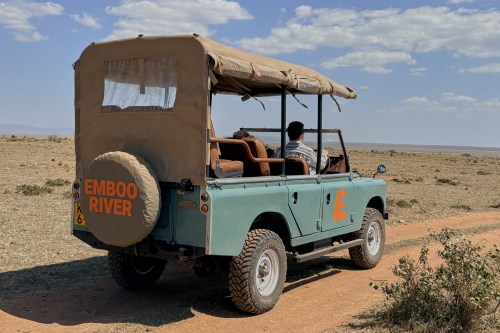
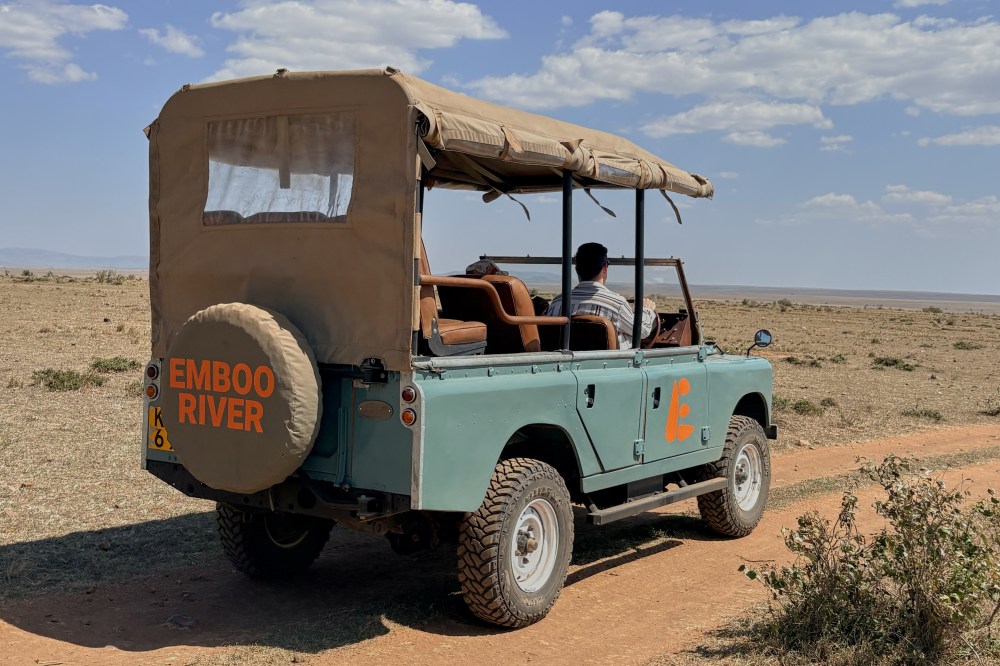
Emboo River Camp in the Maasai Mara has been using electric safari vehicles since 2019. The camp’s co-founder and co-director, Loic Amado, said the vehicles are charged exclusively with solar power.
“It’s an extremely good use case for electric vehicles,” Amado said. “They’re silent, sustainable, environmentally friendly and most importantly economical.”
Use of solar EV bikes is expanding
What began as an experiment has grown, through his other firm EERA LAB, into a broader sustainability operation. Amado said it now supports 25 lodges across East Africa with solar power, wastewater treatment, and electric-vehicle conversions.
“Emboo was really a proof of concept and a test case,” he said. “It was almost like our laboratory. We tried to prove the model there.”
Emboo camp has expanded its EV fleet and more than tripled its solar energy system to meet demand.
Kenya has only a small number of electric safari vehicles in operation, concentrated in the Mara, and a handful of other conservation areas, and the concept is attracting larger safari operators. Amado said Asilia, which runs about 20 lodges across East Africa, now operates its electric fleet.
EERA LAB has developed a dashboard that tracks energy generation and consumption, water levels, recycling and the solar power used to charge vehicles.
“It removes the black box and uncertainty that safari operators have had over the past couple of years,” Amado said.
Converting conventional safari vehicles costs between $35,000 and $45,000, Amado said, but the investment can pay for itself in about two and a half to three years through fuel and maintenance savings.
“It’s all running on sunshine, and we have plenty of it,” he said.
For Amado, the goal is bigger than replacing individual petrol vehicles.
“Our goal is to make the Maasai Mara net zero by 2035,” he said.
___
The Associated Press’ climate and environmental coverage receives financial support from multiple private foundations. AP is solely responsible for all content. Find AP’s standards for working with philanthropies, a list of supporters and funded coverage areas at AP.org.