Writer’s got a type Winnipeg author relies on typewriter collection to punch out manuscripts
Read this article for free:
or
Already have an account? Log in here »
To continue reading, please subscribe:

Digital Subscription
One year of digital access for only $205*
- Enjoy unlimited reading on winnipegfreepress.com
- Read the E-Edition, our digital replica newspaper
- Access News Break, our award-winning app
- Play interactive puzzles
*First annual payment billed as $205.00 + GST for one year. This annual subscription will automatically renew at $233.00 + GST every 52 weeks (10% off the regular annual price of $259.35). Offer available to new and qualified returning subscribers only. Cancel any time.
To continue reading, please subscribe:
Add Free Press access to your Brandon Sun subscription for only an additional
$1 for the first 4 weeks*
- Enjoy unlimited reading on winnipegfreepress.com
- Read the E-Edition, our digital replica newspaper
- Access News Break, our award-winning app
- Play interactive puzzles
*Your next Brandon Sun subscription payment will increase by $1.00 and you will be charged $17.95 plus GST for four weeks. After four weeks, your payment will increase to $24.95 plus GST every four weeks.
Read unlimited articles for free today:
or
Already have an account? Log in here »
Local author Michael Clark has not only taken the words “keep at it” to heart, but repeated them so often that last year, his daughter, 29, suggested the pair get matching tattoos bearing the mantra before her wedding.
The words are inked to appear as though they were punched onto his forearm by a typewriter.
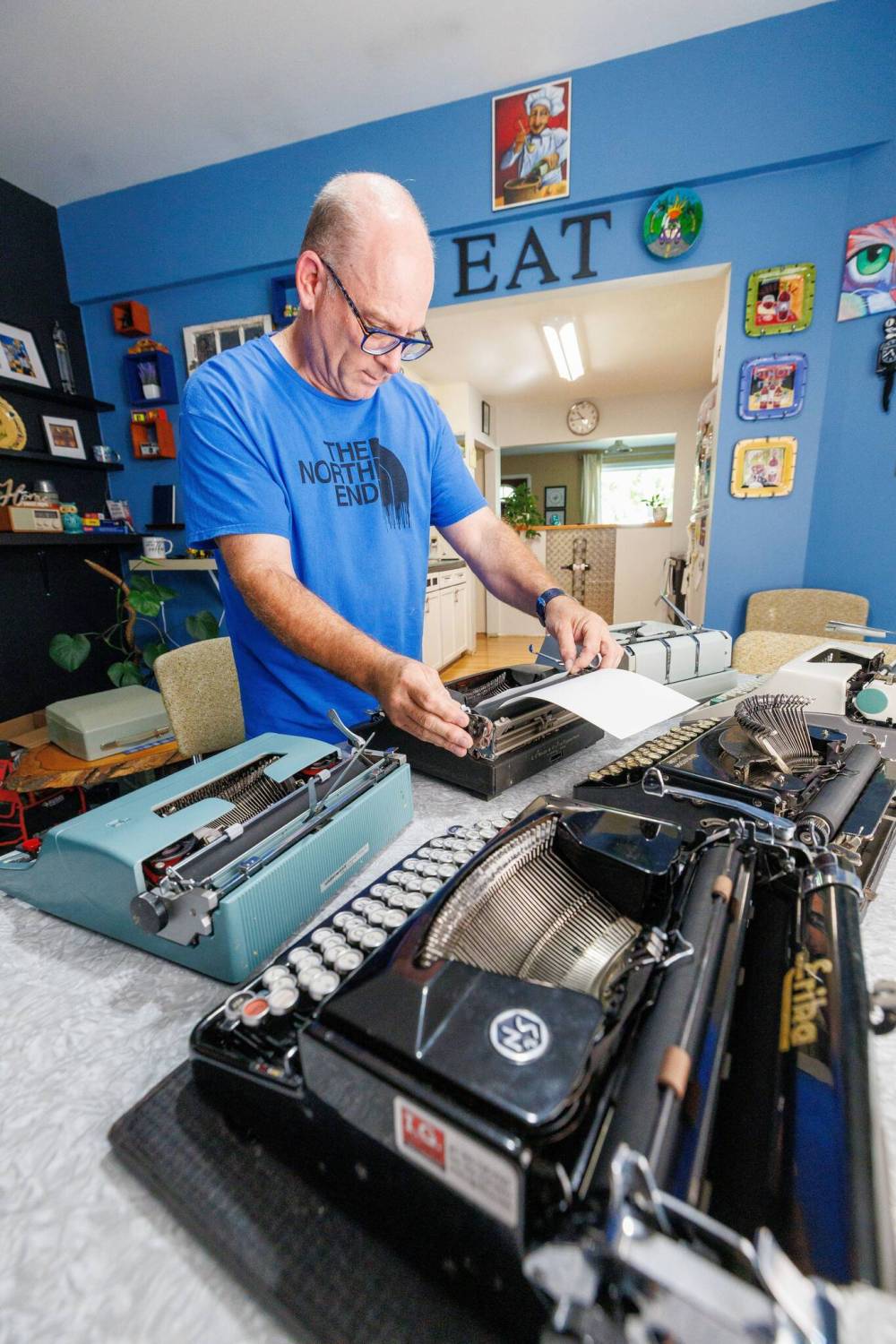
Clark has a thing for typewriters. The award-winning crime fiction author figures he has 50 or more stashed in various nooks and crannies of his St. Vital home.
MIKE DEAL / FREE PRESS
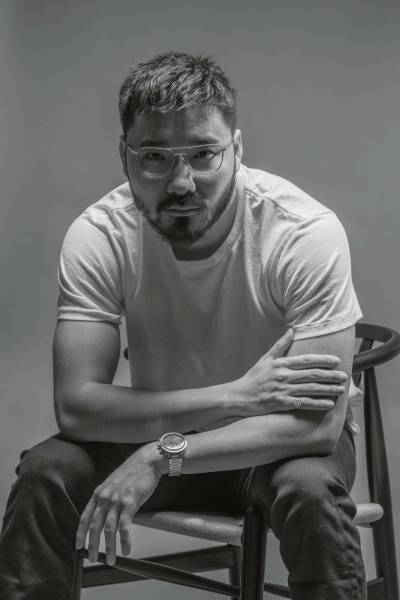
Michael J. Clark is a local suspense/crime author who writes his books using manual typewriters. He began collecting the machines in 2015.
“There’s a joke in the typewriter community: if you leave four typewriters in your car unlocked, when you come back there’ll be three more,” the 57-year-old says with a laugh.
“The good thing about collecting typewriters is you can tuck them into all sorts of places. Sometimes you’ll look at a case and go, what’s in that one? And you open it up and you go, ‘Oh, there you are!’ It’s almost like visiting a friend you haven’t seen in a while.”
Clark grew up using a typewriter, purchasing his last brand-new typewriter — an electric National model — prior to beginning his education at Red River College, and before his career as an automotive journalist with the Winnipeg Sun in 1999. (Clark later wrote for the Free Press from 2000 to 2007, then moved on to CJOB.)
But he really got into collecting typewriters in 2015 after finding a Smith-Corona Electra 220, brand-new in the box, at the MCC thrift store in Steinbach.
“I paid $7 for it,” Clark recalls.
At the time, Clark was writing his first novel, Clean Sweep, which won the Eileen Sykes MacTavish Award in 2019 for best new novel by a Manitoba author.
“I wasn’t always using a typewriter the whole way through, but I would sometimes get inspired and pull out that old Smith-Corona and write some pages and just kind of play with it. (Now) I had this thing that I couldn’t cheat on. I don’t say that anyone using a computer or laptop is cheating, but it’s a machine that is bent on distracting you,” he says.
Clark recently completed his fourth novel, tentatively titled Now You’ve Done It, due out in 2027 on ECW Press, writing exclusively on typewriters from his collection.
“I had one of these moments when the story idea just started percolating and coming to the surface, and something told me to write it on the typewriter — and away I went,” Clark says.

MIKE DEAL / FREE PRESS
A 1958 Triumph Matura.
Alternating between a 1946 Smith-Corona Clipper, a 1959 Royal FP, a 1958 Triumph Matura, a 1971 Hermes 3000, and a 1948 Royal KMM — all manual models – and a 1971 Smith-Corona Office Electric 250 (when his arthritis flared up), Clark typed the manuscript for his fourth novel in just five months.
“You have a piece of paper in front of it. To get to the bottom of it, you have to produce. You have to write.”
In part, he credits the pace at which he was able to crank out 73,000 words over 155 single-spaced pages to the lack of distractions writing with a typewriter entails.
“You have a piece of paper in front of it. To get to the bottom of it, you have to produce. You have to write. You can’t have a whole bunch of blank lines because you decided to go check out on whatever news feed or Facebook messenger. You’re compelled to write,” Clark says.
In other words, it forces you to keep at it.
So much so, he’s already about a third of a way through his next novel, which takes place in Winnipeg during the Apollo 11 lunar landing in July 1969.
“The computer can start to become invasive, but a typewriter is not there to correct you, it is not going to make suggestions or fault your style,” Clark says.
The only advice a typewriter will give you while writing, he adds, is the ding at the end of each line.

MIKE DEAL / FREE PRESS
Clark has a collection of over 50 typewriters.
“It’s freeing.”
Clark then scanned each page using a free app called Text Fairy that uses optical character recognition to render the text into a usable format to submit to his editor at ECW. The process, though relatively simple, wasn’t without its surprises — especially when it came to pages he’d written using the Hermes 3000, a rare model which has a script-style font.
“As impressive as AI is in some areas — it does not understand script. It gets very confused,” Clark says.

The specificity of each individual machine, not to mention how its mechanics wear out over time, is part of what lends typewriters their charm, Clark believes. It can also help spark the imagination.
“This is probably one of the most intricate I’ve ever seen,” Clark says of a Smith-Corona Silent Secretarial that is among his favourites. “It’s nuts. Apparently, it was owned by a Winnipeg homicide detective. Then you start playing as a writer, thinking, is he in here somehow?”
Another favourite of Clark’s, the 1946 Smith-Corona Clipper he bought for $15 and wrote much of his new novel with, has a lot of wear on the top left hand side where the return bar would strike the case if hit hard enough.
“With every single typewriter, even ones that never got used, there’s a story. The story is, it was owned by a union rep. You think of all the challenges and everything unions were facing back then. I sense some anger here in the wear point on the return,” he says.
Others, though, have a much darker provenance.

MIKE DEAL / FREE PRESS
Clark’s 1971 Smith-Corona Office Electric 250.
“It’s amazing what you’ll find in the wild,” Clark says, pulling out an Erica Model M — for Meisterklasse, or “Master Class” — from the 1930s.
“It’s amazing, when you look at the engineering and everything else, but you also remember when this was being made, the Germany it was being made in, and who could have been forced to make it.
“You don’t necessarily think of typewriters as having a dark history, but you kind of have to.”
“You don’t necessarily think of typewriters as having a dark history, but you kind of have to.”
Clark’s passion for typewriters extends beyond their use to the maintenance of the machines, though he is quick to admit he’s far from a pro when it comes to repair. Much of what he’s learned, he’s learned online from a few trusted sources. And when it comes to serious restoration work or repair, there’s only one person in town who can handle the job.
Izu Gephter, 79, is the owner and operator of I.G. Office Nesa Ltd. on Henderson Highway, which services and sells all manner of office supplies. He has been repairing typewriters since he was in his early 20s.
“Right now, I have about five typewriters waiting for me to check them out, if they’re worth repairing or not,” Gephter says. “It’s not as much as before, but (business) is coming back.”
“What he does to a typewriter, it’s perfect,” Clark says of Gephter. “What worries me is that when he’s gone, or doesn’t have capability anymore.”

MIKE DEAL / FREE PRESS
Clark is a big proponent of typewriters and using them in composition
“There’s nobody else, and I don’t know how long I’ll have left,” Gephter says, adding that the closest repair shops he knows of are in Calgary to the west, and southern Ontario to the east.
Clark, for one, has passed on his passion for typewriters to his daughter, gifting her a cherished Smith-Carona as well as an identical “parts machine” before she moved to Nova Scotia to pursue a residency in oncology at Dalhousie University, which she uses to type letters as the pair correspond by way of snail mail.
He would like to see more youngsters take an interest in the fascinating, albeit somewhat archaic, technology.
“I don’t want to reach a point in my life where someone, like my daughter, has to come and clear this all out,” he says of his collection. “If an educator in Winnipeg or surrounding areas were interested, I would give them a typewriter with the understanding that it’s not just for the purposes of an English class to learn writing, but it should also be something that could bring in the shops classes. There are thousands of parts in a typewriter, things that over time stretch or wear out or decay.”
sheldon.birnie@winnipegfreepress.com