Power play

Give-and-take relationship of raucous Roman leaders takes centre stage in gripping historical fiction

Advertisement

Advertise with us

British novelist Robert Harris’s latest work is a reflection on tyranny, corruption and betrayal among all-powerful political leaders.

Read this article for free:


or

Already have an account? Log in here »

To continue reading, please subscribe:

Subscribe and receive a limited-edition Free Press branded hat or tote.

Digital Subscription

One year of digital access for only $205*

  • Enjoy unlimited reading on winnipegfreepress.com
  • Read the E-Edition, our digital replica newspaper
  • Access News Break, our award-winning app
  • Play interactive puzzles

*First annual payment billed as $205.00 + GST for one year. This annual subscription will automatically renew at $233.00 + GST every 52 weeks (10% off the regular annual price of $259.35). Offer available to new and qualified returning subscribers only. Cancel any time.

To continue reading, please subscribe:

Add Free Press access to your Brandon Sun subscription for only an additional

$1 for the first 4 weeks*

  • Enjoy unlimited reading on winnipegfreepress.com
  • Read the E-Edition, our digital replica newspaper
  • Access News Break, our award-winning app
  • Play interactive puzzles
Start now

*Your next Brandon Sun subscription payment will increase by $1.00 and you will be charged $17.95 plus GST for four weeks. After four weeks, your payment will increase to $24.95 plus GST every four weeks.

British novelist Robert Harris’s latest work is a reflection on tyranny, corruption and betrayal among all-powerful political leaders.

You might be forgiven for thinking it’s a contemporary thriller — it’s actually historical fiction set in ancient Rome.

A former BBC journalist, Harris debuted as a novelist in 1992 with Fatherland, an alternative history where Nazi Germany won the Second World War.
Agrippa

Agrippa

Since then, the prolific author has become best-known for his works of historical fiction, especially his ancient Rome trilogy released from 2006-2015 and the novel Conclave, which was published in 2016 and was made into the film of the same name in 2024.

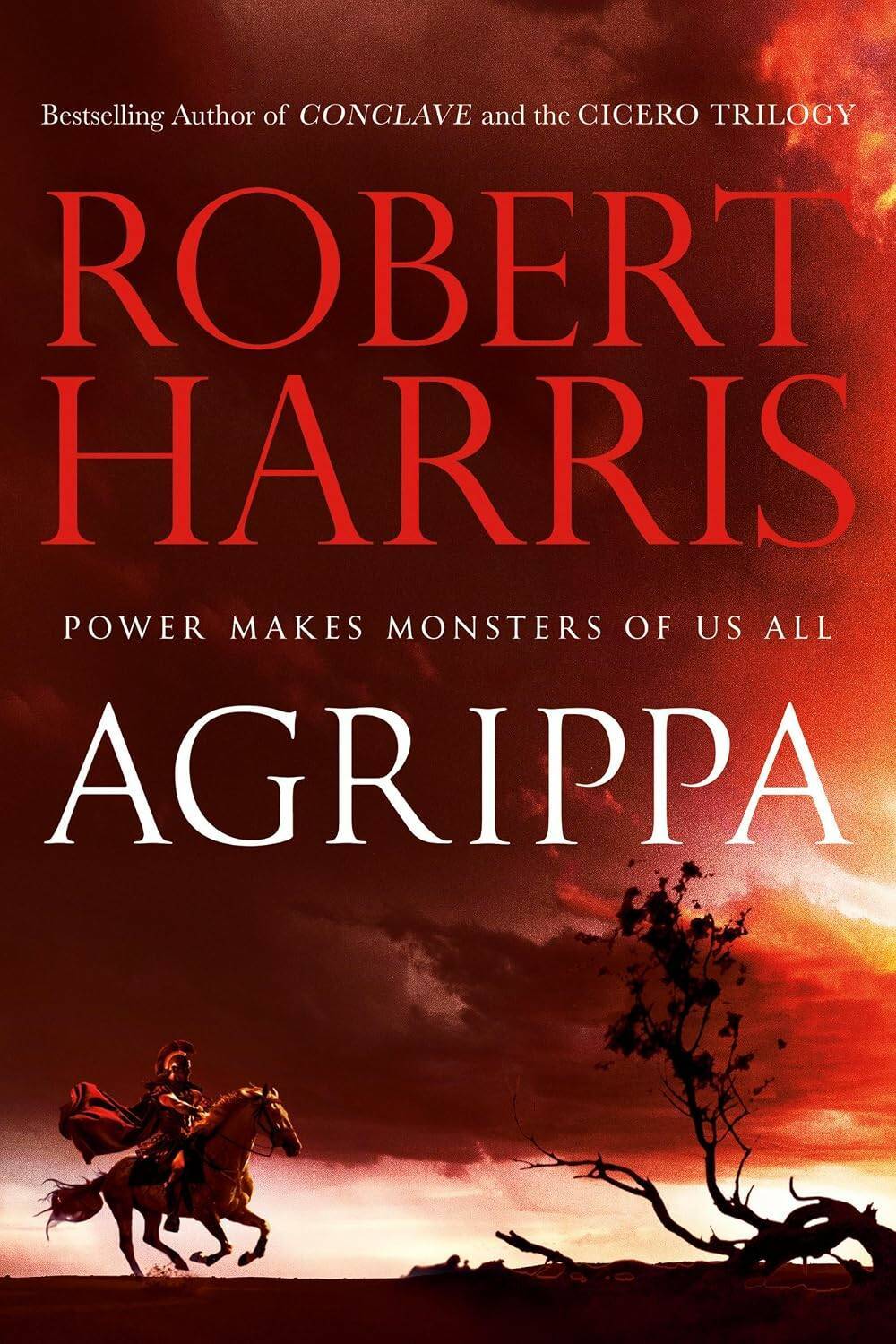
His latest, Agrippa, returns to Rome, exploring the life of the titular general and engineer, Marcus Vipsanius, known in life and legend by the nickname Agrippa.

The novel opens in 12 BC, with the sickly Agrippa returning wearily from yet another battle, determined to complete his memoirs.

“Over the years, my reputation has grown and hardened like armour around me,” Agrippa tells us. “And it is this reputation that has led me, by an unexpected turn of events, at the age of fifty, to begin setting down my memories.”

Narrating in the first person, Agrippa tells us that he was born a plebeian, or commoner, in Rome, but gets sent to an elite school thanks to a secret benefactor.

Here, Agrippa befriends the weakly outcast Octavius, soon finding out that Octavius’s uncle is the despised dictator Julius Caesar.

Agrippa comes to admire Caesar, who in turn appreciates Agrippa’s loyalty to him and to Octavius.

When Julius Caesar is assassinated, Octavius is named as Caesar’s heir but has to fight to be recognized — with Agrippa to help him.

But while Octavius succeeds in taking over Rome, Agrippa becomes one of the biggest power players behind the scenes.

Harris skilfully depicts the give-and-take relationship between Octavius and Agrippa.

Octavius values Agrippa’s military and political expertise, but keeps the credit for himself.

Meanwhile, Agrippa accepts Octavius’s arrogance, cruelty and greed since Agrippa still benefits from their relationship.

Agrippa even agrees to divorce his beloved wife and remarry Octavius’s niece to cement a political alliance. “(T)here were things I wanted to do — to avoid more wars if possible, and to build: to leave behind great construction projects in Rome and throughout the empire for the benefit of future generations. If that meant giving up my marriage, then so be it,” he admits.

Nick Gregan photo 
                                Robert Harris’s journalistic background shows in his direct, accessible prose, simplifying the complexities of ancient Roman politics for readers.

Nick Gregan photo

Robert Harris’s journalistic background shows in his direct, accessible prose, simplifying the complexities of ancient Roman politics for readers.

Along with recounting Agrippa’s military triumphs, Harris covers his storied engineering career, especially his constructing the original Roman Parthenon.

Harris’s journalistic background shows in his direct, readable prose, simplifying the complexities of ancient Roman politics for readers.

However, readers unfamiliar with Roman history may have trouble keeping track of characters, especially those with similar names to the main characters.

Some historical fiction novelists, such as Sharon Kay Penman and Bernard Cornwell, seem to take particular pleasure in describing gory battle and torture scenes.

Harris does include plenty of historical cruelties, such as the Roman practice of proscription — strategically picking wealthy but innocent citizens to be executed so the government can steal their fortunes.

However, he recounts them matter-of-factly and kindly spares readers the details.

He also adds a few sly modern commentaries, such as when Agrippa notes, “I had seen how much the poor suffered, in peacetime as well as war, and how often our soldiers had gone hungry. Let the rich who ordered them about now have a taste of it.”

Agreed.

Kathryne Cardwell is a writer in Treaty One territory.

Report Error Submit a Tip

More Stories

Puzzles Palace

1 minute read Monday, Jul. 27, 2026

To solve our puzzles, please subscribe with this special offer: |

Not falling back means time loop remains unclosed

Jen Zoratti 4 minute read 2:01 AM CDT

I demand restitution. Where’s my hour?

In the traditional fall-back, spring-forward time change set up — you know, ol’ trusty that’s been effect for lo these 63 years — we lost an hour in the spring that we got back in the fall.

That was the social contract: you commit to feeling like you’re on cold medication for a week in March because you know a glorious extra hour of sleep will be returned to you in November. (Unless, of course, you have little kids, but look: we all make our choices.)

Well, that transaction, flawed as it was, isn’t happening this year. That hour you sacrificed to the sun gods in the spring? Gone. Not coming back. We’ve sprung forward and we shan’t be falling back — not in November, and (possibly) not ever. The scale shall remain unbalanced and the loop shall remain unclosed as Manitoba has adopted permanent daylight time.

United Way, other charities fight for dollars as donor base shrinks

Scott Billeck 8 minute read Preview

United Way, other charities fight for dollars as donor base shrinks

Scott Billeck 8 minute read Yesterday at 2:00 AM CDT

Winnipeg’s charitable sector is being squeezed from both sides: demand for help is growing while the pool of donors to meet that need is shrinking.

The imbalance is increasingly being carried by a relatively small group of deep-pocketed donors. Last year, 600 people — about three per cent of United Way Winnipeg’s individual donors — accounted for roughly $8 million, or 55 per cent of individual donations.

The fundraising pitch isn’t getting any easier.

Homelessness and public drug use have become increasingly visible, household budgets remain strained and the problems charities are trying to address can seem so entrenched that donors may reasonably wonder what difference another contribution can make.

Read
Yesterday at 2:00 AM CDT

Near-future U.S. the setting for surreal dual-world storyline

Reviewed by Morley Walker 4 minute read Preview

Near-future U.S. the setting for surreal dual-world storyline

Reviewed by Morley Walker 4 minute read 2:01 AM CDT

It’s not every day you encounter a seriously intended literary novel that attempts to dramatize a mind-bending physics theory like quantum entanglement.

But then the B.C.-born-and-raised Emily St. John Mandel is not your everyday Canadian literary writer.

In her late 40s, she has lived in the U.S. for her entire writing career. She is best known for her 2014 dystopian novel Station Eleven, about a Shakespearean acting troupe navigating a pandemic-ravaged America.

Her new outing, her seventh, Exit Party, shares DNA with detective and sci-fi genres more than with conventional literary fiction.

Read
2:01 AM CDT

Siloam Mission, WFPS discussing on-site paramedic to reduce staggering number of emergency calls

Scott Billeck 4 minute read Preview

Siloam Mission, WFPS discussing on-site paramedic to reduce staggering number of emergency calls

Scott Billeck 4 minute read Yesterday at 2:00 AM CDT

Winnipeg’s fire-paramedic service and its largest homeless-serving organization are discussing what it would look like to station at least one paramedic at Siloam Mission, as emergency calls to the downtown facility surge.

The ongoing discussions come as Winnipeg Fire Paramedic Service crews were dispatched 1,771 times during the first eight months of the year to the two adjacent Siloam properties at 303 Stanley St. and 300 Princess St.

WFPS said most of the calls were related to overdoses or other consequences of substance use, with the total nearly double the 854 calls recorded over the same period last year. By comparison, there were 831 calls during the same span in 2024, and 591 in 2023.

“The number of emergency calls isn’t sustainable for us as a service, but it’s certainly not sustainable for them as an agency trying to provide services,” WFPS chief Ryan Sneath told the Free Press. “And they recognize that they’re impacting emergency services, not them specifically, but the site in a significant way.”

Read
Yesterday at 2:00 AM CDT

A quick look at where provinces and territories stand on time changes

The Canadian Press 2 minute read Preview

A quick look at where provinces and territories stand on time changes

The Canadian Press 2 minute read Updated: Yesterday at 6:28 AM CDT

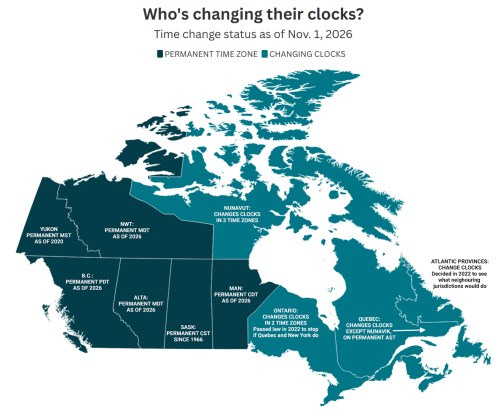
WINNIPEG - Manitoba's government said Thursday the province will be sticking with daylight time year-round, making it the latest jurisdiction to move away from twice-annual time changes. Here's a look at where things stand across Canada:

British Columbia said in March that it was moving to permanent Pacific daylight time. The change also means that parts of northeastern B.C., which have been on mountain standard time year round, are now in alignment with the rest of the province.

Alberta also switched to permanent daylight time this year in what it calls Alberta time. The change means it now has the same time as Saskatchewan year round.

Saskatchewan has been on permanent central standard time since 1966.

Read
Updated: Yesterday at 6:28 AM CDT