

Alberta NDP files court challenge over province’s new restricted voter list rules
Advertisement
Read this article for free:
or
Already have an account? Log in here »
To continue reading, please subscribe:

Digital Subscription
One year of digital access for only $205*
- Enjoy unlimited reading on winnipegfreepress.com
- Read the E-Edition, our digital replica newspaper
- Access News Break, our award-winning app
- Play interactive puzzles
*First annual payment billed as $205.00 + GST for one year. This annual subscription will automatically renew at $233.00 + GST every 52 weeks (10% off the regular annual price of $259.35). Offer available to new and qualified returning subscribers only. Cancel any time.
To continue reading, please subscribe:
Add Free Press access to your Brandon Sun subscription for only an additional
$1 for the first 4 weeks*
- Enjoy unlimited reading on winnipegfreepress.com
- Read the E-Edition, our digital replica newspaper
- Access News Break, our award-winning app
- Play interactive puzzles
*Your next Brandon Sun subscription payment will increase by $1.00 and you will be charged $17.95 plus GST for four weeks. After four weeks, your payment will increase to $24.95 plus GST every four weeks.
Read unlimited articles for free today:
or
Already have an account? Log in here »
EDMONTON – Alberta’s Opposition NDP is challenging the legality of new government rules that severely restrict the amount of voter information elections officials can share with provincial political parties.
In a court application filed Thursday in Edmonton, the NDP argue the new regulation undermines the purpose of having a voter list as laid out in provincial law. It’s also arguing the changes are beyond what the government has the authority to do when issuing regulations through orders-in-council.
The NDP, which has said its concerned the government could be opening the door to voter fraud in next month’s referendum, is asking the courts to strike the regulation.
The new rules, published last week, say Elections Alberta can only provide political parties with copies of the voter list containing the number of voters in each voting area and municipality.
It’s a major change, as parties were previously provided first and last names, addresses and postal codes, phone numbers and unique identification numbers of voters.
Justice Minister Mickey Amery’s office said last week that the policy was temporary — it’s set to expire at the end of the year — and that the intention is to keep Albertans’ private information more secure.
It comes after a major privacy breach this past spring involving a separatist group. Elections officials have said the group, called the Centurion Project, published a database that was traced back to a copy of the voter list that had been lawfully provided to the pro-independence Republican Party of Alberta.
The leak remains under investigation, and Elections Alberta has said thousands of people may have viewed the list. The Republican Party of Alberta has denied any wrongdoing.
The NDP has said the new voter list restrictions could open the door to voter fraud in the Oct. 19 referendum as scrutineers overseeing the ballot count won’t have the information needed to make sure people aren’t voting multiple times.
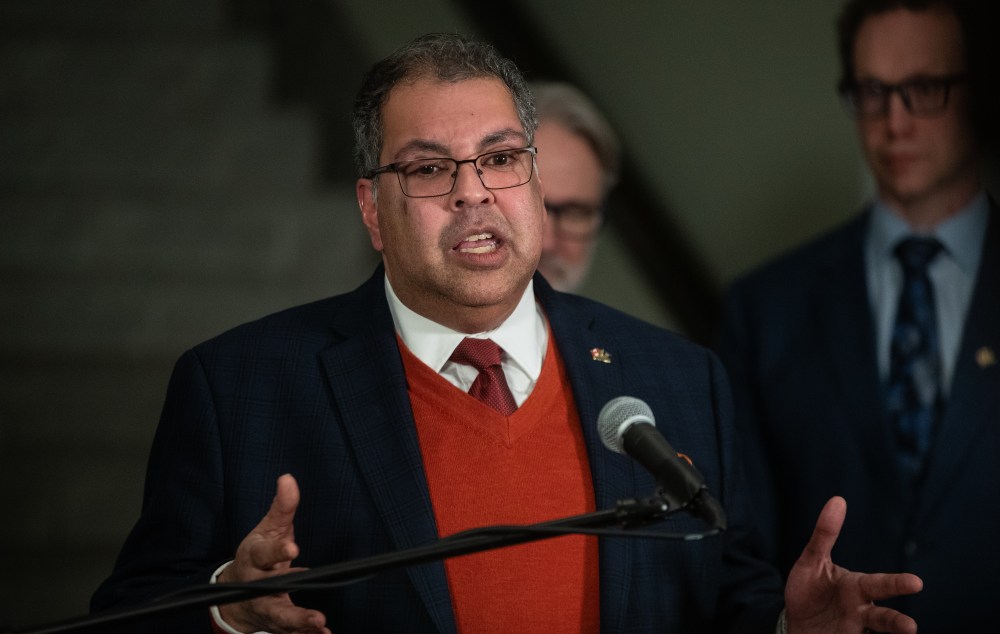
Leader Naheed Nenshi repeated the concern Friday, and called the new policy an “attack on our democratic system.”
“Parties like ours must have all the data to properly scrutinize the vote. That is a fundamental part of our democracy,” he said in a statement.
Nenshi also dismissed the government’s argument that the new rules were needed to protect voter privacy.
“The (United Conservative Party) did nothing and waived off concerns about the data breach when it happened,” he said.
“They can’t now use this as an excuse to gut democracy.”
Amery, in a statement Friday, repeated that the regulation was in response to the privacy breach and said that it had come to the government’s attention that the Republican Party could seek an updated version of the list.
The minister said there was no mechanism for Elections Alberta to withhold the voters list from registered political parties, “including those that may be under investigation for misuse of the list of electors.”
“The purpose of the temporary (voters list rules) is to protect Albertans’ personal information following concerns about the alleged unauthorized disclosure of the list of electors,” Amery said.
“The regulation expires on Dec. 31, 2026. In the meantime, legislative options are being considered to ensure more robust protections going forward.”
The NDP, as part of its legal challenge, is asking for a judicial order to force Elections Alberta to provide new copies of the detailed voter list to all entitled political parties.
An affidavit filed by Alberta NDP executive director Heather Wilson says the party requested an updated copy of the provincewide voter list in August, as well as a copy of the list that was specific to the riding of Calgary-Shaw, where a byelection took place earlier this month.
The affidavit says Elections Alberta provided the Calgary-Shaw list, but not the provincewide list. The party says it last received a copy of that list in June 2025, and that as many as 100,000 new voters could be residing in the province.
Wilson’s affidavit also says that if the NDP’s court challenge is denied, the party should still be provided with a new provincewide list because it was requested before the new restrictions took affect.
Elections Alberta, which is listed as a respondent in the NDP’s challenge, said the byelection was an active event and, therefore, was considered a priority, but didn’t say why it didn’t provide a copy of the provincewide list to the NDP.
A spokesperson said the matter was now before the courts and deferred questions about the regulation to the government.
Amery also said he couldn’t comment further because the matter is before the courts. The minister did point to calls from Alberta’s chief electoral officer for legal changes to voters list rules after the privacy breach, and how the changes needed to be implemented “before the list of electors is shared again with political parties.”
“Albertans must have confidence that their personal information is being protected,” Amery said.
The agency said last week that it will still be using the detailed voter list to manage and keep track of voters to ensure the integrity of the referendum.
A hearing for the NDP’s challenge has not been scheduled.
Albertans will vote on 10 questions in the referendum, including whether they want to remain in Canada or hold a second, binding vote on quitting Confederation.
This report by The Canadian Press was first published Sept. 25, 2026.