

Average asking rents fall 4.2% in September, marking 24 months of decreases
Advertisement
Read this article for free:
or
Already have an account? Log in here »
To continue reading, please subscribe:

Digital Subscription
One year of digital access for only $205*
- Enjoy unlimited reading on winnipegfreepress.com
- Read the E-Edition, our digital replica newspaper
- Access News Break, our award-winning app
- Play interactive puzzles
*First annual payment billed as $205.00 + GST for one year. This annual subscription will automatically renew at $233.00 + GST every 52 weeks (10% off the regular annual price of $259.35). Offer available to new and qualified returning subscribers only. Cancel any time.
To continue reading, please subscribe:
Add Free Press access to your Brandon Sun subscription for only an additional
$1 for the first 4 weeks*
- Enjoy unlimited reading on winnipegfreepress.com
- Read the E-Edition, our digital replica newspaper
- Access News Break, our award-winning app
- Play interactive puzzles
*Your next Brandon Sun subscription payment will increase by $1.00 and you will be charged $17.95 plus GST for four weeks. After four weeks, your payment will increase to $24.95 plus GST every four weeks.
Read unlimited articles for free today:
or
Already have an account? Log in here »
The average asking price for a rental unit in September was $2,034, down 4.2 per cent compared with a year ago.
A monthly report from Rentals.ca and Urbanation said the figures mark two full years of annual declines, the longest downturn the Canadian rental market has experienced in recent history.
Average asking rent prices in September were down 7.3 per cent over the past two years and 9.2 per cent below the peak of $2,202 in May 2024. The report also highlighted figures from Statistics Canada that show average weekly earnings have risen 19.4 per cent over the past five years, signifying a general improvement in rental affordability.
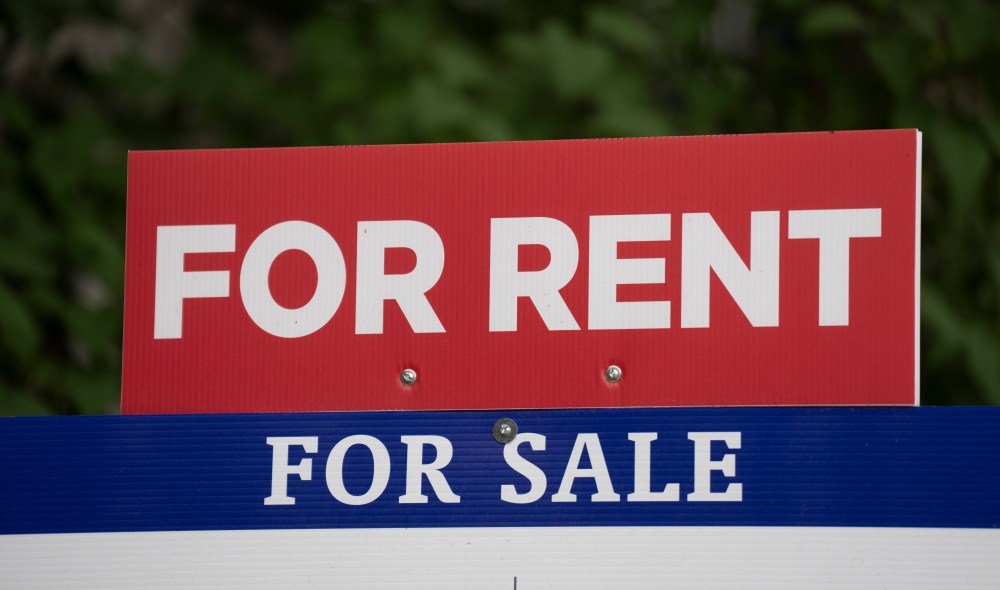
Rents edged slightly lower on a monthly basis, down by $1 compared with $2,035 in August, a second consecutive monthly decrease. The report said this is part of a typical seasonal pattern where demand rises in the spring and summer and begins to ease in the fall.
Across the provinces, average rents for all property segments were down 4.8 per cent year-over-year in Ontario, 2.9 per cent in B.C., 2.6 per cent in Alberta and 1.7 per cent in Quebec. In contrast, other provinces saw increases, including 1.4 per cent rises in both Nova Scotia and Saskatchewan.
On a square foot basis, average asking rents in Canada’s six largest markets came in at $2.48, falling 1.5 per cent from September 2025.
Asking rents for purpose-built apartments fell 2.7 per cent on an annual basis to an average of $2,036 in September, while asking rents for condominium apartments decreased 7.8 per cent to $2,052. Rental prices for purpose-built apartments saw the smallest annual decline across all property types.
Condo rents saw the steepest declines, led by a 9.6 per cent drop in studio condo rents. Other secondary market units like houses and townhomes fell 7.4 per cent year-over-year to $2,016.
The report said rental markets in Toronto and Vancouver are showing signs of stability though after rents hit their lowest level in five years.

“Our research shows supply has been the main driver of this correction, and in key markets like Toronto and Vancouver, new supply is moving past its peak,” Urbanation president Shaun Hildebrand said in a news release.
“Rents in both cities have trended higher over the past six months, and annual declines have narrowed significantly as renters come off the sidelines. Where Toronto and Vancouver go, the rest of the country follows.”
A few factors support an “upcoming return to positive rent growth” in those cities, the report said. This includes the fact that construction inventory has peaked, data revisions show a modest increase in populations, and both cities are relatively less exposed to tariffs across their respective labour markets.
“In the near term, more affordable rents and move-in incentives are releasing pent-up demand from delayed household formation, as higher rents in previous years led to prospective renters living with parents or roommates for longer,” the report said.
This report by The Canadian Press was first published Oct. 7, 2026.