

Rising oil prices, falling technology stocks and reversing bond yields shake Wall Street
Advertisement
Read this article for free:
or
Already have an account? Log in here »
To continue reading, please subscribe:

Digital Subscription
One year of digital access for only $205*
- Enjoy unlimited reading on winnipegfreepress.com
- Read the E-Edition, our digital replica newspaper
- Access News Break, our award-winning app
- Play interactive puzzles
*First annual payment billed as $205.00 + GST for one year. This annual subscription will automatically renew at $233.00 + GST every 52 weeks (10% off the regular annual price of $259.35). Offer available to new and qualified returning subscribers only. Cancel any time.
To continue reading, please subscribe:
Add Free Press access to your Brandon Sun subscription for only an additional
$1 for the first 4 weeks*
- Enjoy unlimited reading on winnipegfreepress.com
- Read the E-Edition, our digital replica newspaper
- Access News Break, our award-winning app
- Play interactive puzzles
*Your next Brandon Sun subscription payment will increase by $1.00 and you will be charged $17.95 plus GST for four weeks. After four weeks, your payment will increase to $24.95 plus GST every four weeks.
Read unlimited articles for free today:
or
Already have an account? Log in here »
NEW YORK (AP) — Some sharp reversals are keeping financial markets unsteady on Thursday, as oil prices rise and U.S. stock indexes swing.
The S&P 500 fell 0.6% and was heading for a second straight loss after setting its all-time high. The Dow Jones Industrial Average was down 15 points, or less than 0.1%, as of 2:45 p.m. Eastern time, after flipping between gains and losses through the day. The Nasdaq composite fell 1.4% as technology stocks took particularly hard hits.
Stocks felt pressure from a 4.3% rise in the price for a barrel of Brent crude oil, the international standard, to $104.49. It’s been pinballing between $96 and nearly $110 over the last month on uncertainty about when the war with Iran will allow the global energy industry to return to normal.
Brent got to nearly $106 in the morning before President Donald Trump sent its price veering again after saying “productive discussions” are happening with Iran and that the U.S. military would not attack it before the upcoming U.S. elections in November. That briefly sent Brent toward $103 before it eventually turned back upward.
Even sharper swings shook the bond market, where yields have been jumping worldwide to their highest levels in years or even decades, which threaten to slow the economy.
The 10-year Treasury yield initially rose with oil prices, going from 5.28% late Wednesday to 5.35% early Thursday morning. But it then fell all the way back to 5.23%.
It dropped after the U.S. government said that it sold $22 billion in 30-year Treasury bonds at an auction with a high yield of 5.618%. That helped bring the 30-year Treasury yield down to 5.61% from 5.73% in the morning, which is a notable move for the bond market.
A day earlier, an auction of 10-year Treasurys also helped bring down yields. Strong demand in the auction showed that investors are still willing to buy U.S. government debt, even though their prices have fallen sharply this year because of worries about high inflation, big government debt loads and other factors.
“Higher U.S. Treasury yields are starting to create their own demand, buyers are showing up for the right price,” said Tony Miano, global investment strategy analyst at Wells Fargo Investment Institute.
On Wall Street, the ease in Treasury yields helped the majority of U.S. stocks rise, including two out of every three in the S&P 500 index.
PepsiCo climbed 2.7% after the snack and drink company reported stronger profit and revenue for the latest quarter than analysts expected, thanks in part to strength outside of North America.
But drops for several influential technology stocks overshadowed such gains.
Nvidia, the chip company that’s ridden the tidal wave of demand created by artificial-intelligence technology, fell 3.1%. Because it is the largest stock by value on Wall Street, it was the day’s single heaviest weight on the S&P 500 even though other stocks had larger losses.
That included drops for other AI-related stocks, including Broadcom’s 4.7% fall and Micron Technology’s 4.5% slide.
The losses came even though a bellwether for the chip industry, Taiwan Semiconductor Manufacturing Co., reported growth for September that suggested its revenue for the latest quarter was strong enough to top analysts’ expectations. TSMC’s stock that trades in the United States fell 3.5%.

AI stocks are under heavy pressure to report big growth to justify how high their stock prices have soared in recent years because of the AI frenzy.
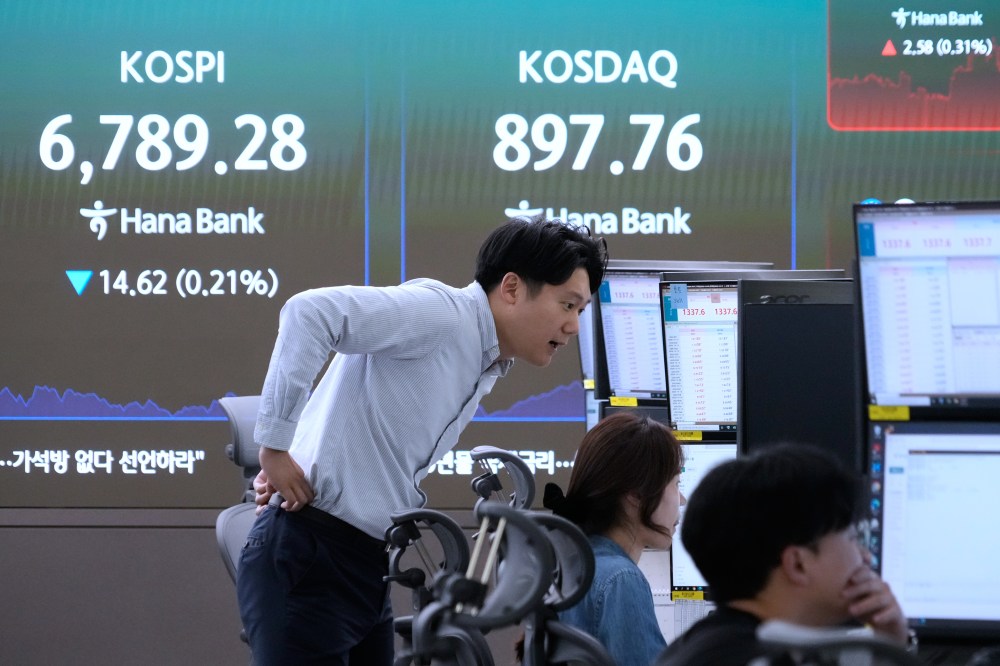
In South Korea’s stock market, Samsung Electronics dropped 2.4% to help drag the Kospi index down 2.6%. The tech giant said its operating profit for the latest quarter likely soared to $107.4 trillion Korean won (roughly $80 billion) from $12.17 trillion won a year earlier, but that wasn’t enough to satisfy investors.
In other stock markets abroad, indexes fell across much of the rest of Asia and Europe.
___
AP Business Writers Chan Ho-him and Michelle Chapman contributed to this report.