

Toronto cyclists ask Canada’s top court to weigh in on Ford’s bike lane removal plan
Advertisement
Read this article for free:
or
Already have an account? Log in here »
To continue reading, please subscribe:
Digital Subscription
One year of digital access for only $1.44 a week*
- Enjoy unlimited reading on winnipegfreepress.com
- Read the E-Edition, our digital replica newspaper
- Access News Break, our award-winning app
- Play interactive puzzles
*Billed as $5.77 plus GST every four weeks. After 52 weeks, price increases to the regular rate of $19.95 plus GST every four weeks. Offer available to new and qualified returning subscribers only. Cancel any time.
To continue reading, please subscribe:
Add Free Press access to your Brandon Sun subscription for only an additional
$1 for the first 4 weeks*
- Enjoy unlimited reading on winnipegfreepress.com
- Read the E-Edition, our digital replica newspaper
- Access News Break, our award-winning app
- Play interactive puzzles
*Your next Brandon Sun subscription payment will increase by $1.00 and you will be charged $17.95 plus GST for four weeks. After four weeks, your payment will increase to $24.95 plus GST every four weeks.
Read unlimited articles for free today:
or
Already have an account? Log in here »
TORONTO – Cyclists challenging Ontario’s plan to tear up Toronto bike lanes will ask the Supreme Court of Canada to weigh in, the groups backing the case said Tuesday, as more removal work was slated to begin.
The groups say a recent Appeal Court decision in their case goes beyond bike lanes and raises the question of under what circumstances a government can pursue life-risking policies.
“The facts are clear: bike lanes do not cause traffic congestion, ripping them out will put people’s lives at risk, and no network of side streets can replace the 19 (kilometres) of protected bike lanes on Bloor, Yonge, and University,” said Michael Longfield, executive director of Cycle Toronto, an advocacy group that brought the case.
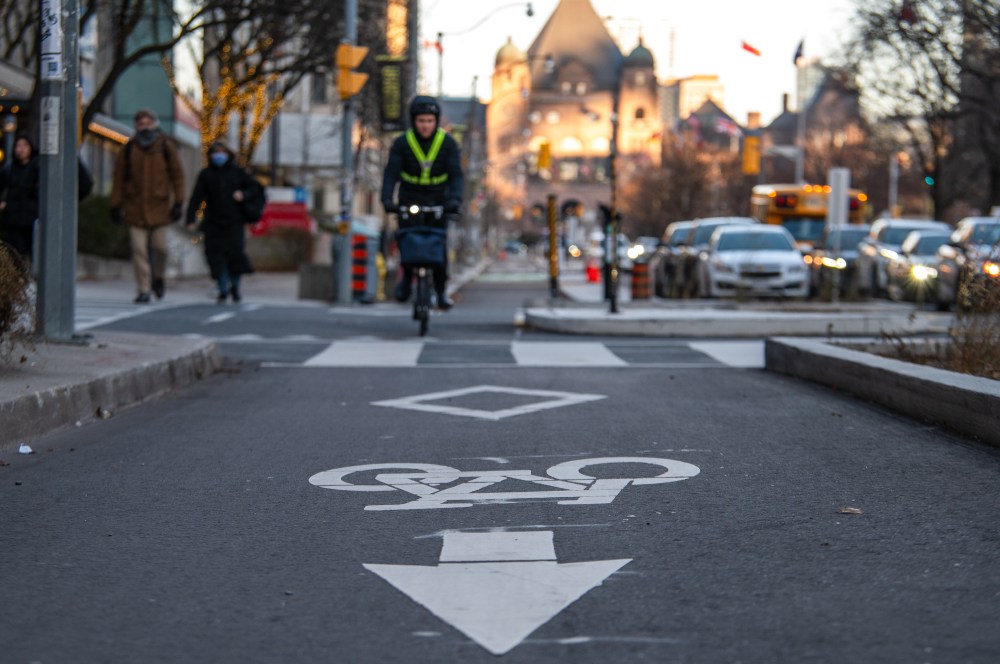
Work was scheduled to begin Tuesday to start removing bike lanes along a stretch of Bloor Street West, the province said. A spokesperson for Transportation Minister Prabmeet Sarkaria did not immediately respond to emailed questions about where the work was taking place, how long it would last, or at what cost.
“The people of Ontario gave our government a clear mandate to tackle the traffic that is costing our economy over $56 billion a year by removing the bike lanes on some of Toronto’s busiest streets,” Dakota Brasier wrote.
The request for Canada’s top court to weigh in is the latest chapter in a legal case over a 2024 law empowering the province to take out bikes lanes on those three major Toronto roads, a move framed by the province as a bid to cut down on traffic congestion. The legislation also required municipalities to seek approval to install new bike lanes that cut into traffic.
A spokesperson for Mayor Olivia Chow said the city repeatedly shared with the province designs that keep both vehicle and bike lanes intact. Work has already been completed to restore a car lane and keep the bike lane on a short stretch of Bloor Street between Kipling and Islington subway stations.
The Toronto bike lane removal plan was initially blocked by a lower court judge who found it to be an unconstitutional risk to cyclist safety. The judge ruled the government pursued the plan despite its own advisers finding it would not accomplish its stated goal to reduce traffic congestion, and could possibly make it worse. Even accepting that goal at face value, the judge found it to be way of step with the law’s intent.
But that decision was overturned by the Ontario Court of Appeal in August.
In a strongly worded ruling, a panel of three judges said the lower court had effectively created a right to bike lanes where none existed. The trial judge, they found, had not only misapplied the law, but improperly strayed into the legislature’s domain of policy-making and political considerations.
Anyone who receives a judgment from a top provincial or territorial court can seek leave to appeal to the Supreme Court of Canada. The Supreme Court only hears a fraction of those cases, which typically must involve a key constitutional question, conflicting lower court decisions or a new issue of law.
“This case is about the scope of the protections provided by Section 7 of the Charter to everyone’s rights to life and security of the person. We’re asking the Supreme Court to hear this appeal to bring clarity to this broader legal question,” said Bronwyn Roe of Ecojustice, an environmental law charity backing the case.
This report by The Canadian Press was first published Oct. 13, 2026.