Resilient tale
Author’s Exit Party a story of hope in dark times

Advertisement
Read this article for free:
or
Already have an account? Log in here »
To continue reading, please subscribe:
Digital Subscription
One year of digital access for only $1.44 a week*
- Enjoy unlimited reading on winnipegfreepress.com
- Read the E-Edition, our digital replica newspaper
- Access News Break, our award-winning app
- Play interactive puzzles
*Billed as $5.77 plus GST every four weeks. After 52 weeks, price increases to the regular rate of $19.95 plus GST every four weeks. Offer available to new and qualified returning subscribers only. Cancel any time.
To continue reading, please subscribe:
Add Free Press access to your Brandon Sun subscription for only an additional
$1 for the first 4 weeks*
- Enjoy unlimited reading on winnipegfreepress.com
- Read the E-Edition, our digital replica newspaper
- Access News Break, our award-winning app
- Play interactive puzzles
*Your next Brandon Sun subscription payment will increase by $1.00 and you will be charged $17.95 plus GST for four weeks. After four weeks, your payment will increase to $24.95 plus GST every four weeks.
Read unlimited articles for free today:
or
Already have an account? Log in here »
If Emily St. John Mandel’s new novel Exit Party is in any way prophetic, Americans should be worried.
The B.C.-born, New York-based author’s bestselling fourth novel, 2014’s Station Eleven, chronicled a performing troupe in a post-pandemic world. The novel experienced a second wave of popularity when the COVID-19 pandemic took hold, and when HBO’s Station Eleven miniseries premièred in late 2021.
Mandel launches Exit Party, her seventh novel, at McNally Robinson Booksellers’ Grant Park location tonight, where she’ll be joined in conversation by Winnipeg novelist Joan Thomas.

Matt Licari/Invision
Emily St. John Mandel
Published in September by HarperCollins, Exit Party sees Mandel once again working in the near future, in this case in a novel that features two timelines — one (dubbed the A-side in the novel) where the U.S. has fractured into a number of small countries following a civil war, and another (the B-side) where a singular, autocratic surveillance state has tightened its grip over its citizens.
When doppelgängers of characters from one timeline end up in the other, they’re forced to adapt to their surroundings, questioning the nature of who they are and mustering up resilience and hope in the face of adversity.
Mandel began writing her latest speculative fiction while in Los Angeles between TV writing gigs in 2022, shortly after the release of her novel Sea of Tranquility.
“I was thinking about the incredible level of political division in the United States; it’s obviously much worse now, but it was already bad in 2022,” she says during a phone interview.
“I thought it would be interesting to consider the worst-case scenario: where could that kind of fracturing lead? The worst-case scenario is a second civil war. I thought it would be interesting to consider life in the aftermath of that kind of event.”
As a New Yorker, the 47-year-old Mandel found L.A. to be a captivating setting for starting a new novel.
“I’ve been living in New York City since my early 20s, and something that’s become obvious to me over the years is the way the U.S. has never really felt like one country. I was in L.A., and it felt kind of foreign to me. And I was just sort of learning a new city. I found it really beautiful; there are flowers everywhere. After a couple of weeks, I realized I was really in love with the city, kind of unexpectedly, so I wanted to set something there,” she says.
The book opens at a party in L.A., where doubles of some of the characters begin to mysteriously appear, and the host vanishes. Ari, one of the main characters of the book’s A-side, is at the party and witnesses the appearance of these doubles.
She first appeared in Mandel’s 2010 novel The Singer’s Gun (although one needn’t have read that book before picking up Exit Party).
“She was a character I’d just been thinking about just over all these years. She was interesting to me, even though she was such a villain in that earlier novel. She has this kind of bent toward criminality, and I thought it would be interesting to place a character like that in this unfortunately only slightly speculative world I was thinking about,” Mandel says.
Putting versions of the same characters in both timelines allowed Mandel to explore how the decisions we make (or don’t make) are impacted by our environment.
“It was interesting in the context of this book to think of essentialism — like what makes you you. That’s something that I’ve written about a little bit over the years,” she says.
“I’ve been thinking about that counter life idea, in terms of agency and choice. Like you chose to marry a different person, you chose to take a different job. But what about the things that just happened to you to start with? What about the impact of growing up in the culture of one country versus another? Those have really profound effects on us — we’re so influenced by our environment and by the people around us.”
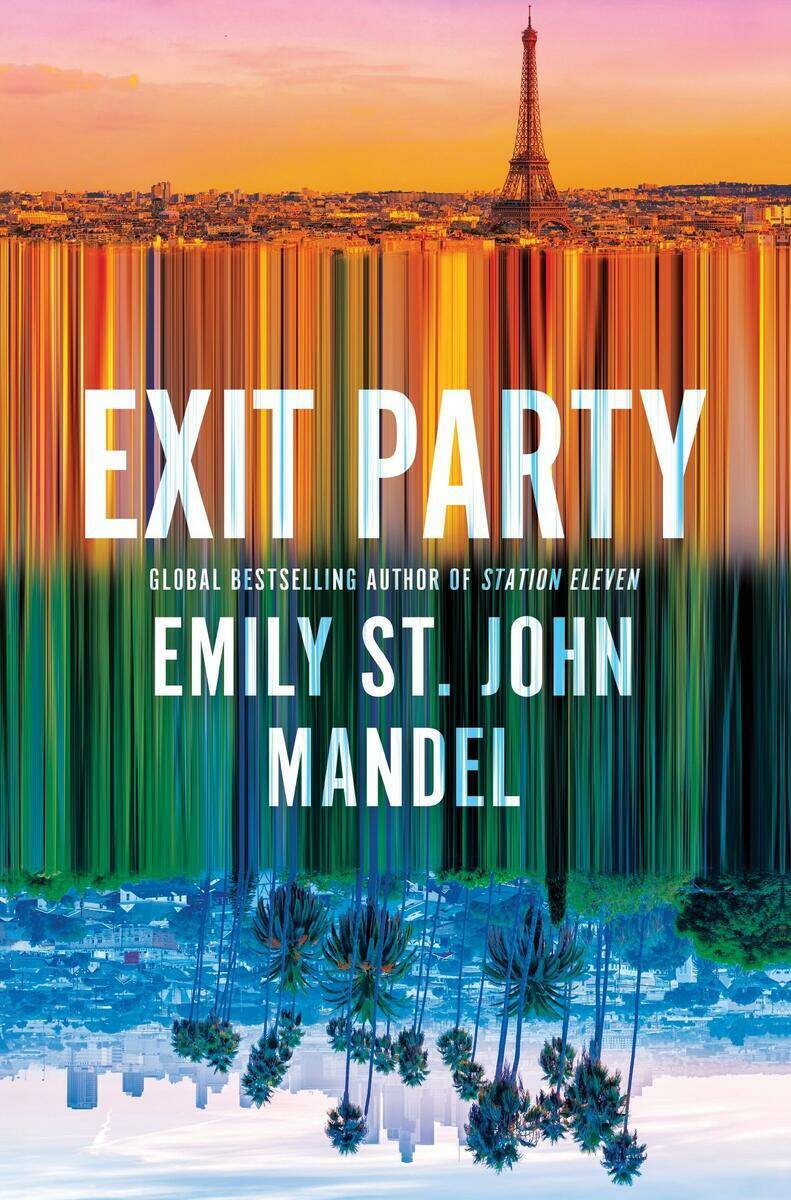
Exit Party
Case and point: in Exit Party’s A-side, Ari has recently finished an 18-year prison sentence for trying to have her cousin murdered — and on the B-side, her doppelgänger Ibari is a detective working for the state.
“She’s always had this touch of corruption, and in our world, as I saw it, that character flaw manifests in her just becoming a criminal. But then I thought, what if that same person, growing up in a very different environment, had that same kind of pull toward crime? I wonder if that same person might become the police,” Mandel says
The current state of affairs in the U.S. indicates things are trending more in the direction of Exit Party’s B-side, which made writing that half of the book a challenge for Mandel as the real-life goal posts kept being moved.
“It’s a problem I had writing this book — originally I had the A-side, the side where the United States has collapsed, new countries are being formed out of that chaos. It’s a hopeful and dangerous and interesting time. I thought that that was our current world, just extrapolated forward by a few years, and with some fairly pessimistic forecasting,” Mandel says.

“By the time I finished writing the novel, which is to say finished writing the B-side, where I have this authoritarian state, and citizens are disappeared by masked police officers in black SUVs, that was literally the news cycle. That was Minneapolis, that was L.A.”
And while the setting may be bleak in both timelines, throughout Exit Party’s dual storylines characters are able to reinvent themselves — and in doing so retain a sense of hope in dark times.
“I see it as a book about resilience in the face of cataclysmic change. I think it has more universality than just this country where I live. Maybe it’s just a function of getting older, but you start to realize at a certain point in your life that nothing lasts forever. On the one hand, there’s such obvious grief and loss attached to that idea. I’m thinking, well, the people I love most in the world aren’t immortal. The places I love the most won’t remain unchanged,” Mandel says.
“But on the other hand, that means that the darkest moment, either of your life or of your country’s life, will pass, and something else will come afterwards.”
ben.sigurdson@winnipegfreepress.com
Ben Sigurdson
Literary editor, drinks writer
Ben Sigurdson is the Free Press‘s literary editor and drinks writer. He graduated with a master of arts degree in English from the University of Manitoba in 2005, the same year he began writing Uncorked, the weekly Free Press drinks column. He joined the Free Press full time in 2013 as a copy editor before being appointed literary editor in 2014. Read more about Ben.
In addition to providing opinions and analysis on wine and drinks, Ben oversees a team of freelance book reviewers and produces content for the arts and life section, all of which is reviewed by the Free Press’s editing team before being posted online or published in print. It’s part of the Free Press‘s tradition, since 1872, of producing reliable independent journalism. Read more about Free Press’s history and mandate, and learn how our newsroom operates.
Our newsroom depends on a growing audience of readers to power our journalism. If you are not a paid reader, please consider becoming a subscriber.
Our newsroom depends on its audience of readers to power our journalism. Thank you for your support.
Book launch preview
An evening with Emily St. John Mandel
In conversation with Joan Thomas
McNally Robinson Booksellers, Grant Park (1120 Grant Ave.)
Tonight, 7 p.m.
Free
Ben Sigurdson
Literary editor, drinks writer
Ben Sigurdson is the Free Press‘s literary editor and drinks writer. He graduated with a master of arts degree in English from the University of Manitoba in 2005, the same year he began writing Uncorked, the weekly Free Press drinks column. He joined the Free Press full time in 2013 as a copy editor before being appointed literary editor in 2014. Read more about Ben.
In addition to providing opinions and analysis on wine and drinks, Ben oversees a team of freelance book reviewers and produces content for the arts and life section, all of which is reviewed by the Free Press’s editing team before being posted online or published in print. It’s part of the Free Press‘s tradition, since 1872, of producing reliable independent journalism. Read more about Free Press’s history and mandate, and learn how our newsroom operates.
Our newsroom depends on a growing audience of readers to power our journalism. If you are not a paid reader, please consider becoming a subscriber.
Our newsroom depends on its audience of readers to power our journalism. Thank you for your support.
Advertisement Advertise With Us
Advertisement Advertise With Us