CFB Wainwright fire highlights long, painful process of burn recovery, specialists say
Advertisement
Read this article for free:
or
Already have an account? Log in here »
To continue reading, please subscribe:
Digital Subscription
One year of digital access for only $1.44 a week*
- Enjoy unlimited reading on winnipegfreepress.com
- Read the E-Edition, our digital replica newspaper
- Access News Break, our award-winning app
- Play interactive puzzles
*Billed as $5.77 plus GST every four weeks. After 52 weeks, price increases to the regular rate of $19.95 plus GST every four weeks. Offer available to new and qualified returning subscribers only. Cancel any time.
To continue reading, please subscribe:
Add Free Press access to your Brandon Sun subscription for only an additional
$1 for the first 4 weeks*
- Enjoy unlimited reading on winnipegfreepress.com
- Read the E-Edition, our digital replica newspaper
- Access News Break, our award-winning app
- Play interactive puzzles
*Your next Brandon Sun subscription payment will increase by $1.00 and you will be charged $17.95 plus GST for four weeks. After four weeks, your payment will increase to $24.95 plus GST every four weeks.
Read unlimited articles for free today:
or
Already have an account? Log in here »
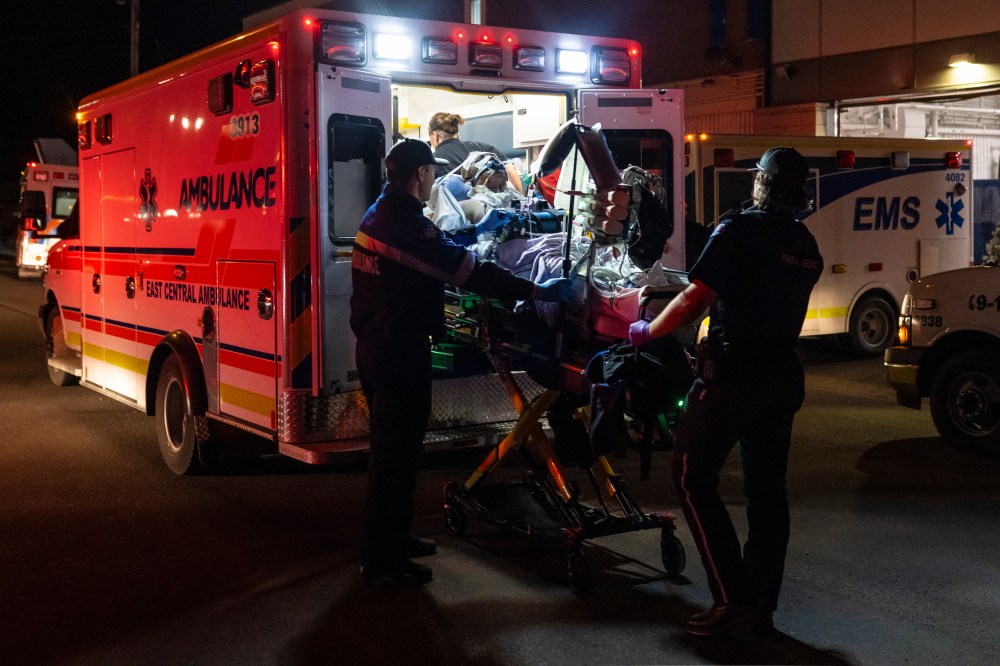
TORONTO – The coming days and weeks will be critical for patients with severe burns from Saturday’s devastating fire at a military base in central Alberta as they face life-threatening risks of infection and a long, painful road to recovery, burn specialists say.
Dr. Vincent Gabriel, medical director at Calgary Firefighters Burn Treatment Centre at Foothills Medical Centre, said Monday that there are several variables in how a patient recovers, including age, the percentage of the body that’s burned and any complications that may arise.
But for serious cases in general, “we would count recovery from burn injury not in days or weeks … but in months and in years, with the hope that a burn survivor returns to their pre-injury role,” Gabriel said, stressing that he was not giving details about any of the specific patients involved in the fire at CFB Wainwright.
“Unfortunately, there are times where there’s permanent impairment, so it’s a long process,” he said.
Four people died in the fast-moving fire at CFB Wainwright, about 200 kilometres southeast of Edmonton, and 39 were hospitalized, officials said. Nineteen patients were in critical condition as of Sunday.
Gabriel said Alberta is fortunate to have two hospital-based burn centres — one in Calgary and one in Edmonton — and that each had eight beds.
He noted that the burn team can also provide care to patients in other areas of the hospital if the burn unit is full.
Other hospitals, including in Red Deer, Alta., are treating some of the injured.
Burn facilities elsewhere in Canada, including the Ross Tilley Burn Centre at Sunnybrook Health Sciences Centre in Toronto and the burn program at Hamilton Health Sciences Centre, said they are ready to support their Alberta colleagues in any way needed — including receiving patients.
Dr. Alan Rogers, a burn surgeon and intensive care specialist at Sunnybrook, said the hospital could also send temporary skin frozen in its tissue bank.
The skin in the bank comes from the cadavers of people who donated their skin when they died and is used to cover areas where a patient’s skin has burned off, he said.
It’s an interim measure until the patient is stable enough to receive grafts of skin from non-affected parts of their body.
“It acts a bit like your own skin for a while. That’s usually about two weeks, Rogers said. “The reason we can’t use it permanently (is) it gets rejected.”
But because losing their natural skin barrier compromises the patient’s immune system, their body doesn’t reject the donated skin right away.
It also means that burn patients are highly susceptible to infections.
“For those patients who survive long enough to get to the burn centre, infection would be the leading cause of death,” Rogers said.
“The sooner we can restore good quality skin coverage, the risk reduces. But that can take many, many weeks. So, in the interim, they are at risk for infection until their skin is healed.”
Seriously burned patients need to be in isolation rooms to protect them. Those rooms also require temperature control because patients’ ability to regulate their own body heat is compromised.
Another danger to patients is an “overwhelming” inflammatory and hypermetabolic response that extensive burns trigger, which strains the patient’s organs, he said.
Dr. Marc Jeschke, director of the burn program at Hamilton Health Sciences Centre, said burn patients “are the sickest patients in the hospital.”
“It is (a) severe injury that causes significant burden to the patients, to the families, to the loved ones, to everybody,” Jeschke said.
“It is not over like a fracture when you walk out a couple of days later. This is something that will affect their lives forever.”
Rogers said severely burned patients must endure multiple surgeries over weeks or even months — first to remove the burned tissue and cover the areas with the cadaver skin or skin substitutes — then later to get their own skin grafted on.
Those skin graft procedures are among the most painful parts of the process, he said, creating additional wounds that need to heal.
For the most severe patients, burn centres can take a piece of their skin and send it to a lab to grow it, but the process takes about six weeks and is expensive.
The burn team prioritizes areas of the body to be covered, including the face and hands, he said.
They can use techniques such as expanding the skin grafts to cover more exposed areas on other parts of the body. But that’s not something they do on the face or hands because they require more elasticity in the skin.
The length of time a patient will need to stay in hospital is roughly one to two days for every one per cent of the body that is burned, Rogers said.
That means someone with 20 per cent of their body burned would need to be in hospital for three or four weeks, he said.
It’s possible for younger healthy adults to survive burns to 80 per cent of their body, although other injuries, including smoke inhalation, are also factors in survival, he said.
Anesthesiologists, nurses, dietitians, occupational therapist, and mental health professionals all play a critical role in patient recovery, the burn specialists all say.
Burn centres bring in psychologists, psychiatrists and social workers from the time the patient is admitted to help them, along with their loved ones, deal with the enormous toll of treatment, and an often life-changing injury.

Daily wound care, keeping patients moving their limbs, controlling their pain, and making sure they get enough vitamins and nutrition to sustain the long healing process are also essential parts of the process.
“It is almost like running a marathon and even more, not just for two hours,” Jeschke said.
“It is running a marathon for days and weeks and months.”
This report by The Canadian Press was first published Oct. 19, 2026.
Canadian Press health coverage receives support through a partnership with the Canadian Medical Association. CP is solely responsible for this content.
Related Articles
'Heartbreaking': Wainwright mourns after fire during military training claims lives
Advertisement Advertise With Us
Advertisement Advertise With Us