

Pooling northern resources, goals
Assini Group seeks to bring more mining opportunities to 10 participating First Nations

Advertisement
Read this article for free:
or
Already have an account? Log in here »
To continue reading, please subscribe:
Digital Subscription
One year of digital access for only $1.44 a week*
- Enjoy unlimited reading on winnipegfreepress.com
- Read the E-Edition, our digital replica newspaper
- Access News Break, our award-winning app
- Play interactive puzzles
*Billed as $5.77 plus GST every four weeks. After 52 weeks, price increases to the regular rate of $19.95 plus GST every four weeks. Offer available to new and qualified returning subscribers only. Cancel any time.
To continue reading, please subscribe:
Add Free Press access to your Brandon Sun subscription for only an additional
$1 for the first 4 weeks*
- Enjoy unlimited reading on winnipegfreepress.com
- Read the E-Edition, our digital replica newspaper
- Access News Break, our award-winning app
- Play interactive puzzles
*Your next Brandon Sun subscription payment will increase by $1.00 and you will be charged $17.95 plus GST for four weeks. After four weeks, your payment will increase to $24.95 plus GST every four weeks.
Read unlimited articles for free today:
or
Already have an account? Log in here »
A group of Treaty 5 First Nations have partnered to boost their role in mineral development.
“People want jobs. People want to work. People want to make a living,” said Chemawawin Cree Nation Chief Clarence Easter. He’s also president of the Assini Group.
The company, which incorporated in 2015, encompasses 10 First Nations spanning northern Manitoba. The Assini Group hasn’t inked many deals with other firms.
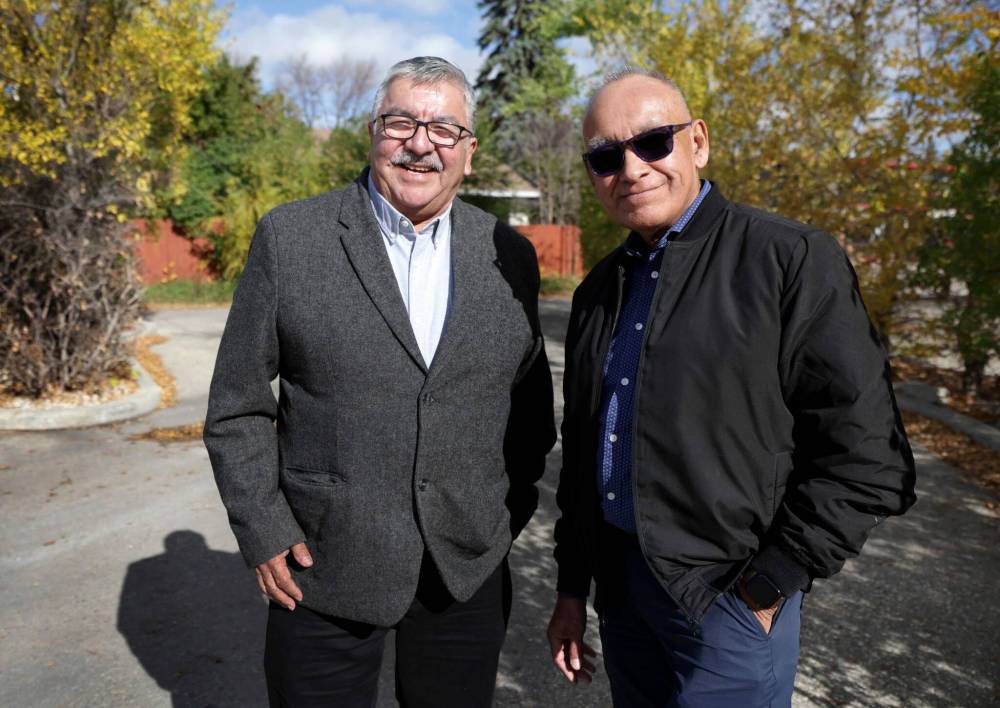
Ruth Bonneville / Free Press
Chemawawin Cree Nation Chief Clarence Easter (left) and Ron Evans, former grand chief of the Assembly of Manitoba Chiefs, are part of the Assini Group leadership team.
However, as the provincial government aims to triple mining in five years, Assini Group leads are ramping up operations.
It is creating leadership training for First Nations members with Booth University College. It is also signing an agreement with the Manitoba Prospectors and Developers Association for further training and sector-specific resources.
Ron Evans, a former Assembly of Manitoba Chiefs grand chief, said he’s been tapped as an adviser to “capitalize” on mining opportunities as federal and provincial governments prioritize projects.
“When they talk about the Churchill port — if you’re going to run a pipeline or railroad … it all touches on these communities,” Evans said.
Several Assini Group members are also part of Arctic Gateway Group, which owns and operates the Port of Churchill and Hudson Bay Railway.
“We just want to make sure that we are organized,” Evans said. “That way, others can work with us. It’s hard to work with an individual.”
He and Easter said Assini Group members have critical mineral development potential. Marcel Colomb First Nation is a member; it has a revenue-sharing agreement with Alamos Gold on a Lynn Lake gold mine.
Opaskwayak, Bunibonibee, Nisichawayasihk, Norway House, Mosakahiken, Fox Lake and Pukatawagan Cree Nations, and God’s Lake First Nation, are also members.
Evans estimated the communities represent 50,000 people, both on and off reserve.
“We all can’t have hospitals, we all can’t have big educational institutions,” Evans said. “So we (will) create ones where it can actually service the smaller populated … communities.”
He and Easter relayed a vision of more retail stores, nursing stations and other resources in their communities — all through inking mining deals and taking ownership roles.
The Assini Group has a deal to transport lime to tailing ponds for the provincial government via its company Piwapisk Hauling, said Ed Buller, Assini Group executive director.
The company doesn’t have trucks or trained personnel, so it uses Saskatoon-based Northern Resource Trucking and splits the profits.
Assini Group is bidding on more contracts, Buller said.
Trucking is how the Assini Group has funded itself for years, he added.
The group’s leaders aim to make similar regional procurement deals with companies, with the goal of training community members to do the work. They’re also hoping to meet with firms before any local exploration or mining permit is filed to government.
“Let’s both go to government,” Evans said. “That would be ideal.”
This way, First Nations leadership would be able to communicate plans early to members — in their languages — and work out agreements with businesses, Evans and Easter said during an interview at Wyndham Garden Winnipeg Airport hotel, owned by Long Plain First Nation.
Early collaboration also “gives us some time so we can train our people,” said Evans, a former Norway House chief. “Don’t put us in a position where we don’t have … trained people.”
For now, the Assini Group is talking about goals. It’s seeking funding to open an office and to produce a leadership course with Booth University College.
Talks have been ongoing for two years, said Rob Fringer, the Winnipeg post-secondary’s president.
Booth has leadership programs in its school of continuing studies. It’s modifying content based on Assini Group’s needs, Fringer said.
The finalized program might be a part-time, two-year commitment. Booth instructors would teach via video; a community leader would be in class to facilitate.
“It’s still very early stages,” Fringer said. “It’s all done in communication, partnership, collaboration with each other.”
If funding comes, leaders aim to launch a pilot next fall.
“It just means better communication and a stronger avenue for relationship with resource development in Manitoba,” Renee Greyeyes, chief executive of the Manitoba Prospectors and Developers Association, said of the Assini Group.
The prospectors association has a draft memorandum of understanding with the entity, Greyeyes said, in part to share information on the critical mineral development process.
“First Nations need the resources to assess opportunities on their own terms,” Greyeyes said. “They also need to know what each nation has.”
It can take many years, and millions of dollars, before a mining operation begins — if one starts at all, Greyeyes noted.
She’s hoping for more “economic development zones” similar to what the Assini Group has created.
“That’s going to be a quicker process for negotiating, for building relationship, for understanding procurement opportunities… even for training,” she said.

The Mining Association of Manitoba Inc. encourages companies to build relationships with First Nations “early on,” said John Morris, the association’s co-director.
“If there’s an opportunity for Indigenous-owned companies to become engaged in various elements of the mining industry, that’s welcomed.”
Mining Minister Jamie Moses’s department has worked with the Assini Group. It’s part of the government’s efforts to “develop Manitoba’s resources in a good way,” a statement attributed to Moses says.
The provincial government hasn’t provided the Assini Group a contract above $10,000, a public contract disclosure database shows.
gabrielle.piche@winnipegfreepress.com
Gabrielle Piché reports on business for the Free Press. She interned at the Free Press and worked for its sister outlet, Canstar Community News, before entering the business beat in 2021. Read more about Gabrielle.
Every piece of reporting Gabrielle produces is reviewed by an editing team before it is posted online or published in print — part of the Free Press‘s tradition, since 1872, of producing reliable independent journalism. Read more about Free Press’s history and mandate, and learn how our newsroom operates.
Our newsroom depends on a growing audience of readers to power our journalism. If you are not a paid reader, please consider becoming a subscriber.
Our newsroom depends on its audience of readers to power our journalism. Thank you for your support.
Advertisement Advertise With Us
Advertisement Advertise With Us