

His turn to confront mortality
Third-generation funeral director Bardal nears his end
Advertisement
Read this article for free:
or
Already have an account? Log in here »
To continue reading, please subscribe:
Digital Subscription
One year of digital access for only $1.44 a week*
- Enjoy unlimited reading on winnipegfreepress.com
- Read the E-Edition, our digital replica newspaper
- Access News Break, our award-winning app
- Play interactive puzzles
*Billed as $5.77 plus GST every four weeks. After 52 weeks, price increases to the regular rate of $19.95 plus GST every four weeks. Offer available to new and qualified returning subscribers only. Cancel any time.
To continue reading, please subscribe:
Add Free Press access to your Brandon Sun subscription for only an additional
$1 for the first 4 weeks*
- Enjoy unlimited reading on winnipegfreepress.com
- Read the E-Edition, our digital replica newspaper
- Access News Break, our award-winning app
- Play interactive puzzles
*Your next Brandon Sun subscription payment will increase by $1.00 and you will be charged $17.95 plus GST for four weeks. After four weeks, your payment will increase to $24.95 plus GST every four weeks.
Read unlimited articles for free today:
or
Already have an account? Log in here »
Hey there, time traveller!
This article was published 07/11/2009 (6045 days ago), so information in it may no longer be current.
You’d think Neil Bardal would be prepared for death.
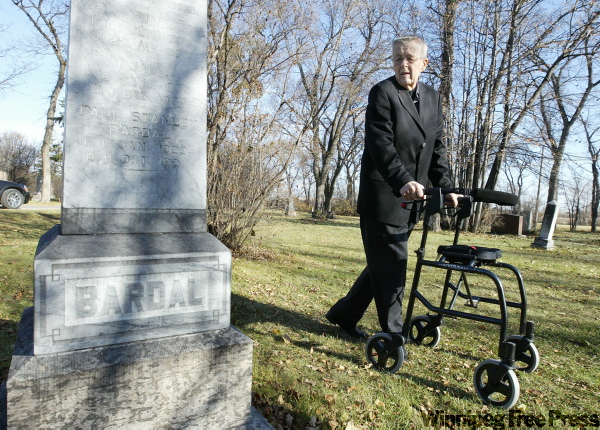
The third-generation funeral director has lived with death at his door every day of his life. The day he was born, his twin sister was born dead.
As a child he grew up in an apartment above the family funeral home that could have been the inspiration for the quirky HBO TV series Six Feet Under.

But it’s only now, as he nears 70, and after planning thousands of funerals, he’s finally planning his own.
My friend Neil Bardal is dying.
As I was saying, you would think he would be prepared. He was when it came to the business, because his 39-year-old eldest son, Eirik, will take over Neil Bardal Inc.
What Neil wasn’t prepared for was death.
"ö "ö "ö
Life is about relationships.
Death can be, too.
The Bardal family’s relationship with Winnipeg and funerals goes back more than 100 years, to his grandfather, A. S. Bardal. My relationship with Neil goes back 25 years, to a column I wrote that graphically described the cremation process that got us both into trouble. Me with angry readers who didn’t want to know, but kept reading anyway. Him with potential clients.
It all worked out.
Eventually the column — by popular request — became one of the few I’ve reprinted. Neil Bardal Inc. became identified with what would become the growing trend toward cremation.
And our friendship survived.
Then, last weekend, I heard Neil had been telling people his doctor had given him six to eight months to live. The prostate cancer Neil thought they had caught in time five years ago was now in his bones.
So I called him this week and arranged to meet at his $2.5-million dream-come-true funeral facility he opened last year across from Brookside Cemetery.
It’s where he has lived since he found out he was dying. And where he wants to die.
Neil Bardal is famous among his friends for his sense of humour.
But, for anyone who looks closely, there also seems to be a certain sadness there that goes deeper than being in a business where sadness walks in the door every day.
And it has nothing to do with having so little time left.
Actually, he seems remarkably upbeat. At least, he does now.
I ask him if there’s anything about helping thousands of people with their deaths that has helped him with his own.
Emotionally, I mean.
"No," he says.
After his doctor gave him the news, Neil spent the first two days alone at the funeral home.
Eirik learned his father was dying from his mother.
With the three of us together, Neil tells me he went there to be alone because he wanted to reflect on being grateful for his life, especially the fact he lived long enough to build the funeral home.
It’s what he’d dreamed about since 1979, when he sold his share of the original Bardal Funeral Home on Sherbrook Street to his partner and, a year later, created Neil Bardal Inc.
He went to be alone there for other reasons, too. I wonder if one of them was because he didn’t want anyone to see him cry.
"Yes," he says.
"I don’t," he begins to explain, then stops. And starts again. "I’m very, very protective of my emotions, because when you’re emotional you’re vulnerable. You’re terribly vulnerable."
Funeral directors aren’t supposed to show emotion, granted. But that doesn’t sound like the product of his profession.
"I’ve never seen you cry," Eirik tells his father.
Not even when Eirik was in his early teens and his grandmother died.
"My mother died," Neil recalls, "and it was in the middle of the night and I’m gathering everybody and I’m being quite stoic about this because I need to do it.
"Eirik comes roaring up to me and he says, ‘You’re not crying’ and I said, ‘No, I’ll cry another time.’ And he says, ‘She’s your mother, you know.’ "
Neil only recalls crying at the death of a close cousin eight years ago, and when his father Neil Sr. died.
It was his father who signed him up for mortuary school in Toronto. Neil had wanted to be a Lutheran minister.
When it was the fourth generation’s turn to make a decision, Eirik would go off and work the slopes of Whistler, B.C., try construction and spend four years as a fisherman in Gimli before taking up his father’s invitation to join the family business.
Soon he will be left to carry on alone, unless his younger brother, Jon, decides to join him later.
I ask Eirik what he’ll miss most about his dad.
"Advice," he says. Then he adds this:
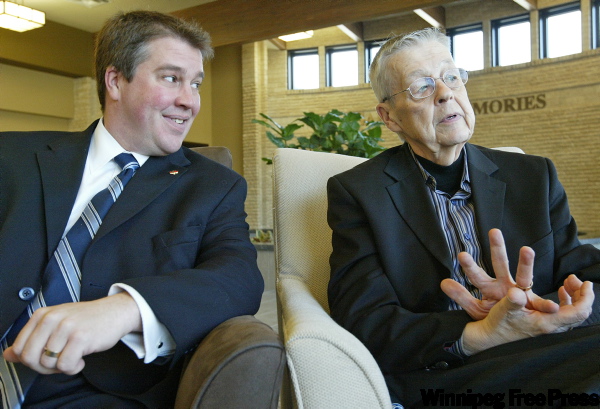
"Our fights. Because we got into the best fights. You know, the immovable object hitting the irresistible force. The jokes, the laughs. I can get him to laugh better than anybody."
Neil Bardal is laughing again.
"I’ve never seen anybody go through the stages as quick," Eirik said when his dad wasn’t there. "He went through all of them. The anger, the denial, the self-pity, all that within a one-week period. And now he’s at acceptance."
That time alone helped him deal with death in a way most of us will have to deal with some day.
Alone.
"At the end of the two days, what I came up with is I’d like to escape this very painful body of mine. And once I freed myself up to do that I’ve had a marvellous time."
"ö "ö "ö
When we’re alone, Eirik talks about when it’s his time. When he’s left alone.
Alone to look after his father’s body.
"What I’m going to be doing is, when the time comes, I’m going to pick him up, I’m going to bring him here."
It sounds as if he’s envisioned it,

I ask how he feels about doing that.
"I don’t know what it’s going to be like, actually. I’ve dealt with hundreds and hundreds of families and I can give advice at an arm’s-length distance… but when it comes down to dealing with my own father… what he’s taught me all my life is I’m going to be with him. He’s going to have somebody who loves him with him. Right until the end."
As Eirik says that, I notice something his dad hasn’t taught him. Or maybe he has.
Eirik’s eyes are welling.
gordon.sinclair@freepress,mb.ca
Related Articles
Neil Bardal succumbs to cancer
Advertisement Advertise With Us
Advertisement Advertise With Us