Playwright planted prairie populism at PTE
Advertisement
Read this article for free:
or
Already have an account? Log in here »
To continue reading, please subscribe:

Digital Subscription
One year of digital access for only $205*
- Enjoy unlimited reading on winnipegfreepress.com
- Read the E-Edition, our digital replica newspaper
- Access News Break, our award-winning app
- Play interactive puzzles
*First annual payment billed as $205.00 + GST for one year. This annual subscription will automatically renew at $233.00 + GST every 52 weeks (10% off the regular annual price of $259.35). Offer available to new and qualified returning subscribers only. Cancel any time.
To continue reading, please subscribe:
Add Free Press access to your Brandon Sun subscription for only an additional
$1 for the first 4 weeks*
- Enjoy unlimited reading on winnipegfreepress.com
- Read the E-Edition, our digital replica newspaper
- Access News Break, our award-winning app
- Play interactive puzzles
*Your next Brandon Sun subscription payment will increase by $1.00 and you will be charged $17.95 plus GST for four weeks. After four weeks, your payment will increase to $24.95 plus GST every four weeks.
Read unlimited articles for free today:
or
Already have an account? Log in here »
Hey there, time traveller!
This article was published 12/11/2009 (6099 days ago), so information in it may no longer be current.
One of the playwrights who first put the prairie in Prairie Theatre Exchange was Alberta-born Kelly Rebar.
The Rebar name has long faded from contemporary Canadian playwriting except in the memory of those longtime PTE patrons who remember with fondness the flowering of prairie populism on the makeshift stage of the company’s funky digs on Princess Street. Rebar, now 52, was one of the theatre’s early successes, owing to a trio of wholesome plays about common folk and their simple, small-town lives.
Her debut 1984 work here Checkin’ Out — about a stifled checkout girl anxious to escape her poky hamlet for the neon lights of the big city of Edmonton — set the early PTE attendance record. That led to her hiring as 1986-87 PTE playwright-in-residence and her followup 1987 comedy Bordertown Café, a coming-of-age story about a teen who must decide whether to follow his dad to a new life in the United States or stay with his mom at the family’s roadside café, perched on the Alberta-Montana border. Cornflower Blue, based on the lives of four friends growing up in rural Alberta, followed in 1991.
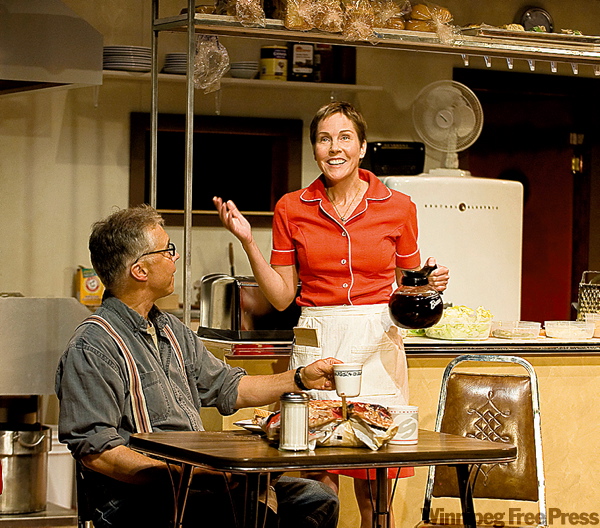
In a rare move at PTE, Bordertown Café is being revived beginning tonight. This is only the second time the Portage Place-based theatre is honouring a play with an encore (Wendy Lill’s The Fighting Days was presented in 1984, 1985 and 1990). Usually Canadian plays are not deemed worthy of a second look.
"It’s time and it deserves to be seen again," says PTE artistic director Robert Metcalfe. "I think you’ll see this happening more and more."
Bordertown Café played the Belfry Theatre in Victoria in September before the cast of Jamie Spilchuk, Jillian Fargey, Janet-Laine Greene and Paul Stephen headed to Winnipeg. Ontario’s Blyth Festival, which commissioned it, is also bringing it back next summer.
"I don’t think there’s been a season when it hasn’t been done at least once," says Rebar over the telephone from her home in Nelson, B.C.
When Bordertown Café opened, it was during the Free Trade talks with the United States, when many Canadians worried the country was risking too much if it led to American access to our cultural industries and energy. The young protagonist, Jimmy, had to decide which country offered him the better future. That question and many other border issues have tipped more in Canada’s favour in the last 20 years.But that’s not what is at the heart of the play’s enduring popularity.
"It’s about family and the inability for this particular family to say what they mean and communicate a genuine concern and love they have for each other," says Rebar, who lived in Osborne Village for six months in 1987 before heading to Kenora. "Perhaps that dynamic is in a lot of people’s families. Many of us are unable to express how we feel to parents."
After her last major play, Cornflower Blue, Rebar focused her writing for film and television. She penned the screenplay for Bordertown Café, which was shot near Warren in 1991. The movie version starred Nicholas Campbell and Janet Wright, who performed the stage version in London and Vancouver and won a Genie for her big-screen performance.
Rebar was caught off-guard last spring when Metcalfe called to tell her that Bordertown Café would be part of the 2009-10 PTE playbill.
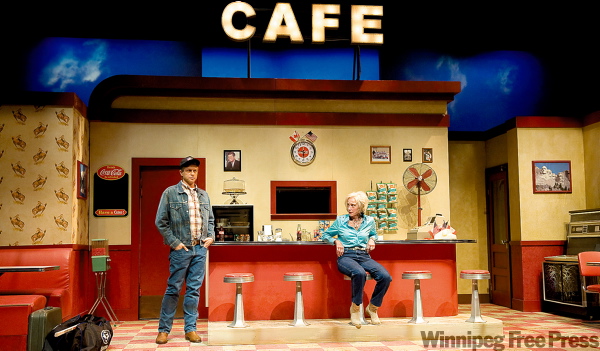
"I was emotional about it when I got off the phone, that something I wrote way back then could still affect people," she recalls.
Her fans are not typically desperate to see the latest import from New York or London.
"I write plays that the average theatregoer doesn’t go to," says Rebar, who stopped writing plays for 15 years while bringing up her two children but is at work on two new scripts.
"I don’t know how many times people have said to me, ‘I wish I could get my husband to watch this because he would like it, although he doesn’t like theatre.’ Wives haul their husbands in to see my plays all the time."
kevin.prokosh@freepress.mb.ca
If you value coverage of Manitoba’s arts scene, help us do more.
Your contribution of $10, $25 or more will allow the Free Press to deepen our reporting on theatre, dance, music and galleries while also ensuring the broadest possible audience can access our arts journalism.
BECOME AN ARTS JOURNALISM SUPPORTER
Click here to learn more about the project.