Canadian image rests on new faces, not old ideas
Advertisement
Read this article for free:
or
Already have an account? Log in here »
To continue reading, please subscribe:

Digital Subscription
One year of digital access for only $205*
- Enjoy unlimited reading on winnipegfreepress.com
- Read the E-Edition, our digital replica newspaper
- Access News Break, our award-winning app
- Play interactive puzzles
*First annual payment billed as $205.00 + GST for one year. This annual subscription will automatically renew at $233.00 + GST every 52 weeks (10% off the regular annual price of $259.35). Offer available to new and qualified returning subscribers only. Cancel any time.
To continue reading, please subscribe:
Add Free Press access to your Brandon Sun subscription for only an additional
$1 for the first 4 weeks*
- Enjoy unlimited reading on winnipegfreepress.com
- Read the E-Edition, our digital replica newspaper
- Access News Break, our award-winning app
- Play interactive puzzles
*Your next Brandon Sun subscription payment will increase by $1.00 and you will be charged $17.95 plus GST for four weeks. After four weeks, your payment will increase to $24.95 plus GST every four weeks.
Read unlimited articles for free today:
or
Already have an account? Log in here »
Hey there, time traveller!
This article was published 19/12/2009 (6097 days ago), so information in it may no longer be current.
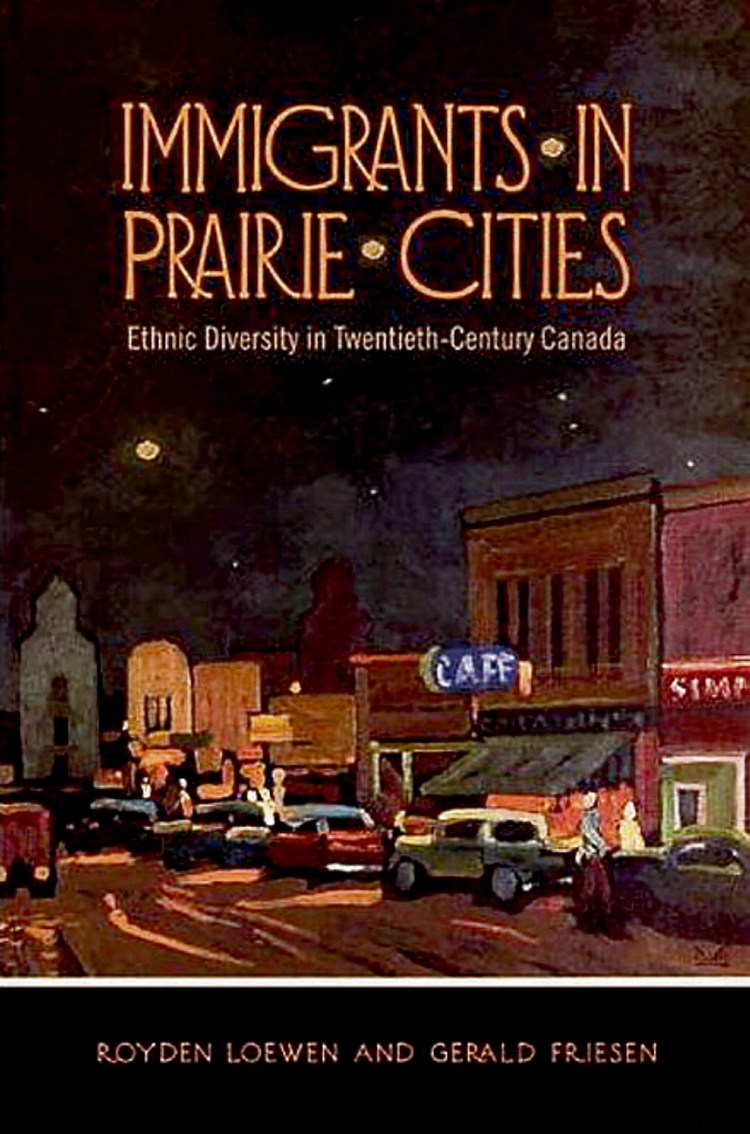
Immigrants in Prairie Cities
Ethnic Diversity in Twentieth-Century Canada
By Royden Loewen and Gerald Friesen

University of Toronto Press, 246 pages
Royden Loewen and Gerald Friesen are accomplished Winnipeg-based historians, and one of their purposes in this book is to offer a very different account of what it is we are all about.
So much of what rattles around in the minds of us Prairie folk about our identity has to do with the settling of the agricultural West and the traumas of the early immigrants in the North End of Winnipeg.
Traditionally our story has been all about doughty farmers building sod huts or exploited workers enduring frigid winters in ill-appointed tenements. The problem with this is that such memories derive from long ago. Our world has changed.
Loewen and Friesen’s claim is that since the Second World War the Prairies have become an urban community and that it is primarily in the cities that the most important struggles and accommodations among our diverse peoples are and will be worked out.
It is an impressive book that sums up a multitude of small articles, theses and essays. It is, of course, an academic work.
Loewen, who teaches at the University of Winnipeg, is more technical and specialist in his language and Freisen, from the University of Manitoba, less so in the chapters he writes.
Altogether the book is not something to give indiscriminately to your favourite Icelandic or Ukrainian uncle for Christmas. However, it will delight students of history and society and it does have something very instructive to say to the policy community of social workers and volunteers, politicians in general and those who work with newly landed immigrants.
The first wave of immigrants between 1900 and 1930 did indeed settle the West and they gave the Prairies its first multi-ethnic, industrial city in Winnipeg.
But then came a new wave of immigrants after 1945, from wartorn Europe and later on others fleeing from communism. There was an internal migration too of farmers’ children leaving the land and coming to the cities. Edmonton and Calgary grew rapidly and came to exceed Winnipeg in size.
After 1970 there came further migrations, of Italians, Greeks and people from the global south: Chinese, Filpinos, West Indians, Sikhs and so on. Again, internal migration has been at work in recent times with many aboriginals coming from northern reserves to cities in the Prairie south.
The overall thesis of the book is that Prairie people have become more accepting of foreigners and outsiders and the differences they bring.
Loewen and Friesen believe that after difficult early times —- mainly up until the Second World War when there was extensive racism and ethnic stereotyping and segregating, there took place a general shift of attitude among the leaderships of Prairie cities about meeting the newcomers half way.
The latter in turn proved themselves open to integration and adaptation but they learned to negotiate these with the host society on terms that ensured the survival of their established identities, or at least identities that they, the new arrivals, regarded as having developed themselves.
The mutual interaction of host and newcomer has produced a commendably hybrid culture on both sides. The authors are very fond of the idea of hybridity as the dominant pattern of contemporary identity.
A two-way process of accommodation has brought tolerance, acceptance and an important measure of mutual respect and recognition. In this outcome intelligent initiatives by activists in organizations like the International Centre and Folk Arts Council have had a large and beneficial effect.

Loewen and Friesen are not unmindful of the continuing racism that is regularly meted out to aboriginals in Prairie cities and they make special mention of the French language crisis in Manitoba in 1983-84 as a particularly nasty instance of nagging antipathies that are capable of getting obscenely out of hand. But their overall prognostications are very positive.
Prairie people have learned important lessons and they have found successful ways to act intelligently. Our cities are now more dynamic, more integrated, yet more pluralistic and generally more convivial.
All of this will sound Pollyannish to Somalis and Sudanese living on Central Park or aboriginals on Langside Street, but what Loewen and Friesen demonstrate very effectively is that seen in a long historical view we have come a long way in civic tolerance towards immigrants.
Allen Mills teaches politics at the University of Winnipeg.