System must allow broken banks to fail

Advertisement

Advertise with us

After the Fall

Read this article for free:


or

Already have an account? Log in here »

To continue reading, please subscribe:

Subscribe and receive a limited-edition Free Press branded hat or tote.

Digital Subscription

One year of digital access for only $205*

  • Enjoy unlimited reading on winnipegfreepress.com
  • Read the E-Edition, our digital replica newspaper
  • Access News Break, our award-winning app
  • Play interactive puzzles

*First annual payment billed as $205.00 + GST for one year. This annual subscription will automatically renew at $233.00 + GST every 52 weeks (10% off the regular annual price of $259.35). Offer available to new and qualified returning subscribers only. Cancel any time.

To continue reading, please subscribe:

Add Free Press access to your Brandon Sun subscription for only an additional

$1 for the first 4 weeks*

  • Enjoy unlimited reading on winnipegfreepress.com
  • Read the E-Edition, our digital replica newspaper
  • Access News Break, our award-winning app
  • Play interactive puzzles
Start now

*Your next Brandon Sun subscription payment will increase by $1.00 and you will be charged $17.95 plus GST for four weeks. After four weeks, your payment will increase to $24.95 plus GST every four weeks.

Opinion

Hey there, time traveller!
This article was published 20/02/2010 (6017 days ago), so information in it may no longer be current.

After the Fall

Saving Capitalism from Wall Street — and Washington

By Nicole Gelinas

Encounter Books, 228 pages, $33


The credit crisis that precipitated the current global recession is often blamed on bankers’ incompetence, with a healthy dose of greed thrown in.

Nicole Gelinas, a research fellow at the Manhattan Institute, argues in her first book that the flaws undermining American financial institutions are an unintended consequence of decades of poor oversight.

In a refreshing divergence from the conventional wisdom, Gelinas makes the case that market interference from right-of-centre governments insulated banks from the consequences of their actions, and unwittingly promoted irresponsible practices.

Republican presidents Ronald Reagan and both George Bushes all paid lip service to the notion that markets should and could regulate themselves, as did Democrat Bill Clinton, a "third way" moderate.

But all of them helped to create and grow a safety net for bankers and traders, which these actors used to take ever greater risks, secure in the knowledge that if they failed, the U.S. government would rescue them — they had grown "too big to fail." And this, in practice, translated into an exemption from market discipline.

Until fairly recently, Gelinas explains, companies that performed poorly, whether by taking too many risks or too few to compete, were penalized by the market.

Banks before the 1930s were no different, but when account holders rushed to withdraw their balances at the start of the Great Depression, the collapse of finance helped to worsen and entrench economic failures.

In response to this, stringent controls were placed on speculation and lending, with rules about disclosure, and deposit insurance. Taken together, these measures made bank failures less likely, and also protected deposits, meaning that a run on banks would no longer follow reports — or rumours — of losses.

These reforms worked for half a century. As the world of finance evolved, though, oversight didn’t. While straightforward lending transactions were regulated, bankers and traders developed innovations that allowed them to turn long-term debt, such as bonds and mortgages, into securities, further leveraging their investments.

Derivatives, a form of investment based on anticipating fluctuations in currencies and interest rates, grew in the space of a decade into a $95-trillion market.

The health of banks, insurance companies and investment became increasingly linked with speculation, and it was clear that, like banks before the Depression, the failure of finance industry giants could bring down an economy.

Rather than increase oversight, or tighten regulations about leverage and speculation, a series of bail-outs signalled Washington’s new strategy: protecting finance from its own mistakes.

Wall Street took note of this. Soon, all major industries, not simply those in the financial sector, came to depend on securities and derivatives to keep their balance sheets looking healthy. Beginning in 2008, most taxpayers realized for the first time the consequences of the free insurance they had been unknowingly providing for the financial, energy and manufacturing sectors.

The bail-outs and debt-relief measures in the U.S., mirrored to a lesser extent in Canada, are effectively the bill coming due.

"When financial markets are too free," Gelinas writes, "they will eventually destroy themselves and damage everything around them."

Gelinas presents a history of financial regulation, a subject that could easily put readers to sleep, in a readable and accessible manner. She explains the causes of volatility and uncertainty in the housing and stock markets without relying on industry jargon or endless acronyms.

After the Fall doesn’t explain how we can make an easy transition from "too big to fail" to "too broken to be fixed."

It does make clear, though, that this is a reckoning that must take place, and Gelinas sketches the outlines of how a rehabilitated system might succeed in the future.


Rebecca Walberg is the president of Winnipeg’s Wakefield Centre for Policy Research.
Report Error Submit a Tip

More Stories

Fun drop-in last chance to mentor grads of inner-city school with excellent track record

Maggie Macintosh 5 minute read Preview

Fun drop-in last chance to mentor grads of inner-city school with excellent track record

Maggie Macintosh 5 minute read 2:00 AM CDT

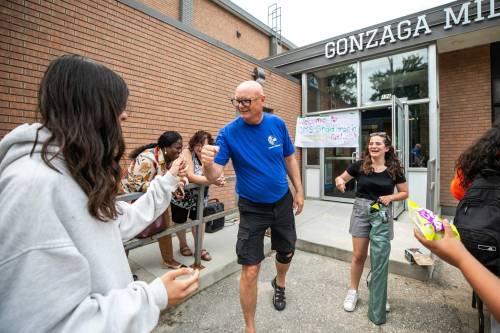
Summer break may be in full swing, but Gonzaga Middle School invited graduates back to the building for water balloon fights and academic, employment and support services this week.

Roughly 30 alumni, including teenagers and twentysomethings, stopped by the grades 6-8 school in North Point Douglas on Tuesday afternoon. They were greeted with slime-making kits, ice cream sundaes and staff ready to answer questions.

The initiative — the final grad drop-in organized this summer — is a new extension of the mentorship and holistic programming baked into the funded independent school’s mandate.

“We have 22- and 23-year-olds coming back and checking in and asking for help on their university papers,” principal Rex Ferguson-Baird said.

Read
2:00 AM CDT

Signs the Carney approach is working

Editorial 4 minute read Preview

Signs the Carney approach is working

Editorial 4 minute read 2:00 AM CDT

It was, if nothing else, a glowing review in trying times.

Matt Winkler, the editor in chief emeritus of Bloomberg News, spoke last week on Bloomberg Business News Daily about a recent Bloomberg analysis of the performance of the Canadian economy, and this country as a target for investment

“This is one of the greatest periods for overseas investment in Canada that we’ve seen in the century, and it may be unprecedented, because we have to wait for the rest of the year. … Money is pouring into Canada like we have not seen from everywhere. Stocks and bonds are the obvious beneficiaries,” Winkler said. He argued that Canada is both liked and seen as reasonable.

“The point is… Canada since Mark Carney became prime minister in 2025, has outperformed everyone in America and also the Eurozone and anywhere in the world. The 10 largest stock markets in the world, Canada appreciated the most, more than 40 per cent. … Its bond market is also doing great, partially because the inflation rate in Canada, unlike the Eurozone or America, is actually trending lower, and is outperforming both the Eurozone and the U.S.”

Read
2:00 AM CDT

Jarvis brings Stanley Cup to where it all began

Grace Penner 5 minute read Preview

Jarvis brings Stanley Cup to where it all began

Grace Penner 5 minute read Monday, Aug. 10, 2026

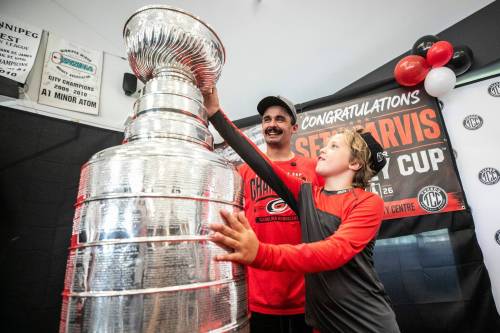
Seth Jarvis and Lord Stanley had quite the homecoming celebration with thousands of fans lining up for their arrival — some even before the sun graced the sky.

The Winnipeg community showed up to cheer on one of their own, wearing memorabilia of all of Jarvis’s achievements, with Tuxedo Lightning, Team Canada, and Carolina Hurricane jerseys aplenty in the crowd.

The Tuxedo Community Centre — where Jarvis’s storied career all began — had fans from all walks of life lined up, circling the building and fields, for the opportunity to meet the Stanley Cup champion and touch the trophy themselves.

Throughout the line, lawn chairs were assembled, picnic blankets were spread out, and umbrellas were opened — all prepared for the long wait ahead of them.

Read
Monday, Aug. 10, 2026

Killer apologizes to family of 16-year-old he shot in 2024 before judge delivers 18-year manslaughter sentence

Dean Pritchard 5 minute read Preview

Killer apologizes to family of 16-year-old he shot in 2024 before judge delivers 18-year manslaughter sentence

Dean Pritchard 5 minute read Yesterday at 4:26 PM CDT

Sharon Basarowich’s voice quaked with emotion as she told a court Tuesday of the never-ending pain her family has been left with after her 16-year-old grandson was gunned down outside a Boyd Avenue drug house.

“We have a void that will never be filled,” said Basarowich, whose grandson Trey Basarowich, a talented hockey player and youth mentor, was fatally shot Oct. 5, 2024.

“When Trey died, a part of us died, too,” she said.

Devin Evans, 20, was originally charged with second-degree murder in the killing but in a plea bargain admitted to the lesser offence of manslaughter and was sentenced Tuesday to 18 years in prison.

Read
Yesterday at 4:26 PM CDT

Long-awaited supervised drug consumption site opens quietly after months of loud opposition

Malak Abas 11 minute read Preview

Long-awaited supervised drug consumption site opens quietly after months of loud opposition

Malak Abas 11 minute read Updated: Yesterday at 5:57 PM CDT

After three years of planning, delays and constant controversy, Manitoba’s first supervised drug consumption site quietly opened its doors Tuesday morning.

Read
Updated: Yesterday at 5:57 PM CDT

AI bio-weapons loom

Gwynne Dyer 4 minute read 2:00 AM CDT

‘Artificial intelligence’ based on large language models is shaping up to be the most efficient destroyer of value since the South Sea Bubble. After “the Crash”, which is inevitably coming, some specific functions of AI will eventually turn out to be genuinely revenue-generating, and a lot of jobs will duly disappear. But the biggest winner (and potentially biggest loser) is medical science.

Dr. Brian Hie, a chemical engineer at Stanford University in California, has just revealed that his team has made the first viruses designed by artificial intelligence. They are ‘bacteriophages’, viruses that only infect bacteria and are widely used to treat people with infections that resist other treatments.

However, natural bacteriophages sometimes fail, so Dr. Hie used generative AI to design new ones that might do the job. The AI generated thousands of designs for new genomes that more or less fit the bill, and he chose around 300 of them to build in the lab. It’s hard work, not magic, but he ended up with 16 ‘novel’ bacteriophages that might work.

He applied them to petri dishes containing two harmful strains of E. coli, a common bacteria that lives in the human gut, and they killed the bacteria off. It’s still early days, but if it is truly becoming possible to tailor-make bacteriophages that target specific bacteria, then we may be getting a major new weapon in the struggle against antibiotic resistance.