

Too little dough, too little time
Conservatives will need help from lady luck to find way back to black

Advertisement
Read this article for free:
or
Already have an account? Log in here »
To continue reading, please subscribe:

Digital Subscription
One year of digital access for only $205*
- Enjoy unlimited reading on winnipegfreepress.com
- Read the E-Edition, our digital replica newspaper
- Access News Break, our award-winning app
- Play interactive puzzles
*First annual payment billed as $205.00 + GST for one year. This annual subscription will automatically renew at $233.00 + GST every 52 weeks (10% off the regular annual price of $259.35). Offer available to new and qualified returning subscribers only. Cancel any time.
To continue reading, please subscribe:
Add Free Press access to your Brandon Sun subscription for only an additional
$1 for the first 4 weeks*
- Enjoy unlimited reading on winnipegfreepress.com
- Read the E-Edition, our digital replica newspaper
- Access News Break, our award-winning app
- Play interactive puzzles
*Your next Brandon Sun subscription payment will increase by $1.00 and you will be charged $17.95 plus GST for four weeks. After four weeks, your payment will increase to $24.95 plus GST every four weeks.
Read unlimited articles for free today:
or
Already have an account? Log in here »
Hey there, time traveller!
This article was published 05/03/2010 (5976 days ago), so information in it may no longer be current.
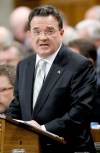
It is often said that you cannot have your cake and eat it too. Over the next five years, Finance Minister Jim Flaherty will try to prove that, despite facing some long odds, it is possible.
Flaherty unveiled a budget Thursday that is, ideology aside, a triumph in restrained, balanced fiscal management. Transfers to provinces and individuals are protected. There are no layoffs or immediate pay cuts, or increases in taxes. Stimulus spending will continue for one more year. There will be spending cuts — with defence and foreign aid taking the brunt of the reductions — but nothing crazy or precipitous.
If Ottawa was not hobbled by a $50-billion deficit last year, and the prospect of another $50-billion deficit this year, restrained and balanced might be the consensus strategy. The real concern here is that the budget is adopting reasonable measures at a time when radical steps might be needed.

As such, this isn’t a stand-pat budget. It’s a treading-water budget, and it’s not clear yet whether Prime Minister Stephen Harper’s government is going to be able to keep its head above water.
The one thing we can all celebrate today is that the debate over the severity of Ottawa’s fiscal predicament is less reliant on hyperbole. The budget contained updated hard numbers to replace the forecasts and estimates. However, if anyone was holding out hope the hard budget numbers were going be more hopeful than the forecasts, they were sadly disappointed.
This budget validates the fears of Kevin Page, the feisty parliamentary budget officer, who has been locked in a testy showdown with Flaherty. Page is not alone in his concern that without deep spending cuts or tax increases Ottawa has no chance of overcoming a "structural deficit" of some $20 billion.
Page based his analysis on the fact that once you take away transfers to provinces and individuals, and core spending on things like justice and defence, you’re left with a pretty small pie from which you can cut a wedge to ease the deficit.
Page and a growing list of economists have prescribed tax increases but that is a matter of policy and unfortunately for Page, it is the policy of this government that taxes will not rise.
And therein lies the real concern; without tax cuts, Flaherty has bet the government on extremely optimistic growth and revenue forecasts.
The finance minister is estimating an annual average growth in federal revenues of about seven per cent. That is extremely optimistic given the fact the federal treasury just doesn’t generate revenue the way it used to. Deep, broad tax cuts initiated in the first two years of Tory minority government have significantly reduced the tax draw. That puts this government in a bind not faced by other governments.
In the mid-1990s, a Liberal government slashed both transfers and the federal bureaucracy to fight the deficit. However, cuts alone would not have erased the deficit. The Grits also enjoyed a period of unparalleled economic growth.
Without going into detail about the long-term impacts of the spending cuts — we’re still trying to catch up to the cuts in health care and education — history shows the Liberals went from deficit to surplus in a matter of three years.
That would have been impossible unless the Grits abandoned their pledge to cut the GST. Although there was some political blowback from this decision, reneging kept sales tax revenue growing at a time when they needed it the most. The Liberals also resisted the temptation to cut other forms of taxes until it was clear the deficit was dead. This allowed the Grits to reap the biggest bang for their bucks from economic growth.
Even if the economy grows at a rate higher than currently forecast, it is unlikely it will produce the kind of revenue surge needed to create a surplus. The best-case scenario for 2010 is five per cent economic growth. That will help, but the federal treasury just doesn’t reap the benefits of strong growth the way it used to.

Consider that in 2005-06, the last year the Liberals brought in a budget, Ottawa collected more than $46 billion in GST and other special levies. By 2008-09, that number had dropped to just $40 billion. Although a shrinking economy is partly to blame for the drop, tax cuts have resulted in tens of billions of dollars in lost revenues since the first one-point reduction was enacted in July 2006. (Remember as well that Harper cut the GST to five per cent in 2007, four years earlier than he promised in the 2006 federal election.)
The most disappointing element in the budget is the $4-billion cut to foreign aid. Austerity is definitely necessary, but at a time when developing countries are struggling to find their place in the global economy, dusting off a tired and cynical tactic like this is not a hopeful sign.
In theory, if the Tories hold the line on discretionary spending, allow modest increases in transfers and avoid unforeseen crises — like a spike in interest rates or a double-dip into recession — then it is possible to grow out of deficit. But it will require more than five years and a lot of luck.
With his measured strategy, Flaherty is baking a cake that will take five years to come out of the oven. Whether he will have anything left to eat is anyone’s guess.
dan.lett@freepress.mb.ca
Dan Lett is a columnist for the Free Press, providing opinion and commentary on politics in Winnipeg and beyond. Born and raised in Toronto, Dan joined the Free Press in 1986. Read more about Dan.
Dan’s columns are built on facts and reactions, but offer his personal views through arguments and analysis. The Free Press’ editing team reviews Dan’s columns before they are posted online or published in print — part of the our tradition, since 1872, of producing reliable independent journalism. Read more about Free Press’s history and mandate, and learn how our newsroom operates.
Our newsroom depends on a growing audience of readers to power our journalism. If you are not a paid reader, please consider becoming a subscriber.
Our newsroom depends on its audience of readers to power our journalism. Thank you for your support.
Dan Lett is a columnist for the Free Press, providing opinion and commentary on politics in Winnipeg and beyond. Born and raised in Toronto, Dan joined the Free Press in 1986. Read more about Dan.
Dan’s columns are built on facts and reactions, but offer his personal views through arguments and analysis. The Free Press’ editing team reviews Dan’s columns before they are posted online or published in print — part of the our tradition, since 1872, of producing reliable independent journalism. Read more about Free Press’s history and mandate, and learn how our newsroom operates.
Our newsroom depends on a growing audience of readers to power our journalism. If you are not a paid reader, please consider becoming a subscriber.
Our newsroom depends on its audience of readers to power our journalism. Thank you for your support.
Advertisement Advertise With Us
Advertisement Advertise With Us