

Red River log home built to last
Advertisement
Read this article for free:
or
Already have an account? Log in here »
To continue reading, please subscribe:
Digital Subscription
One year of digital access for only $75*
- Enjoy unlimited reading on winnipegfreepress.com
- Read the E-Edition, our digital replica newspaper
- Access News Break, our award-winning app
- Play interactive puzzles
*Billed as $5.77 plus GST every four weeks. After 52 weeks, price increases to the regular rate of $19.95 plus GST every four weeks. Offer available to new and qualified returning subscribers only. Cancel any time.
Monthly Digital Subscription
$4.99/week*
- Enjoy unlimited reading on winnipegfreepress.com
- Read the E-Edition, our digital replica newspaper
- Access News Break, our award-winning app
- Play interactive puzzles
*Billed as $19.95 plus GST every four weeks. Cancel any time.
To continue reading, please subscribe:
Add Free Press access to your Brandon Sun subscription for only an additional
$1 for the first 4 weeks*
- Enjoy unlimited reading on winnipegfreepress.com
- Read the E-Edition, our digital replica newspaper
- Access News Break, our award-winning app
- Play interactive puzzles
*Your next Brandon Sun subscription payment will increase by $1.00 and you will be charged $17.95 plus GST for four weeks. After four weeks, your payment will increase to $24.95 plus GST every four weeks.
Read unlimited articles for free today:
or
Already have an account? Log in here »
Hey there, time traveller!
This article was published 05/04/2010 (5888 days ago), so information in it may no longer be current.
EAST SELKIRK — Robert Cox didn’t have to wait for a bus or commute in his car in traffic to get to work as a carpenter at Lower Fort Garry in 1862.
He just hopped in a canoe and paddled the two kilometres down the Red River from his log home.
He was a pretty good carpenter, too. We know this because the log house he built still stands today, almost 150 years later.
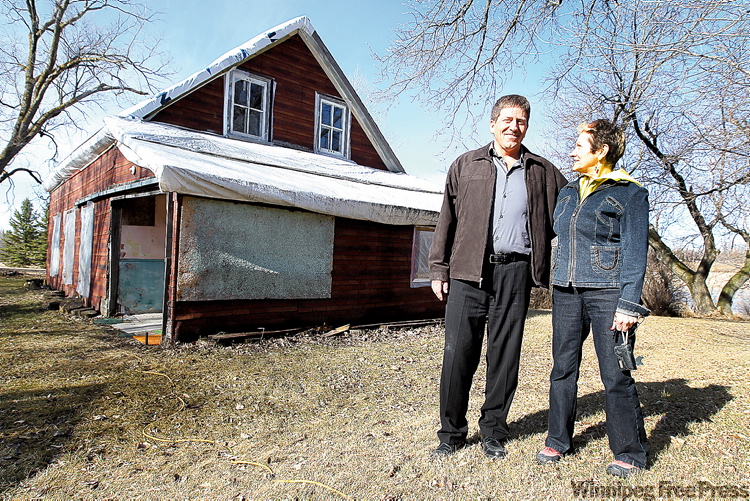
"It’s one of only two Red River construction houses on its original site, the other being Riel House" in St. Vital, said Brock Perchotte, who is restoring the house with his father, Marcel.
Just as you can drive down a street today and find all the homes are the same style, so it was with Selkirk settlers two centuries ago.
Folks who were better off lived in stone houses, but the common people like the Coxes lived in log homes built in an architectural style known as Red River frame construction.
An estimated 500 such log homes were built in the Selkirk settlement, and as many schools, stores,and other buildings. The style continued from 1812 to 1870. Then light lumber took over and log homes became passé — the dwellings of the poor and transient.
You can still pull horse hair from between the logs of the Cox home where it was stuffed for insulation. Perchotte believes the two-storey house originally had a mud floor because the existing floor isn’t attached to anything. There were two wood-burning stoves, one on each end, and ducts running throughout the upstairs and main floor that gave off radiant heat.
The building is designated a provincial heritage house.
"It’s one of only a handful of Red River frame construction buildings left. That was the ubiquitous method of construction for so many buildings from the Red River settlement era," said David Butterfield, provincial architectural historian.
The Cox family were Métis, complete with treaty numbers. Robert was No. 914 and his wife Mary Sanderson was No. 4319. Robert’s father was born in Scotland’s Orkneys, and his mother was from the Northwest Territories.
Ownership of the house remained in the Cox family until 1969. Robert and Mary Cox subdivided the property — a two-mile-long strip off the river that was three 66-foot chains wide — among their 11 children. The smallest lot went to the son regarded as the laziest — too lazy to even plant a garden.
The Cox home went to their seventh child, Roderick, because he didn’t marry. Roderick lived there alone well into his middle years, then had a housekeeper named Bridgette brought over from England.
After a time, despite a huge gap in their ages, they married, but had no children.
After Roderick died, Bridgette kept the house and remarried a man named Chorney. She sold the home to Marcel and Geneviève Perchotte in 1969. The Perchottes obtained much of the family history from her, including that Robert was a carpenter at Lower Fort Garry.
Red River construction houses are very plain and fit together like Lego. They were built using very few nails.
First, Cox and his father chiselled a slot a couple of inches wide and at least an inch deep down the sides of the upright posts. Then they cut out tongues on each end of the horizontal logs and slid them down the slots between two posts. The Cox house is 12 logs high from floor to roof line.
The construction method made putting on additions easy. You just channeled the outer post and repeated the process.

Early settlers usually covered up the logs with siding "so it wouldn’t look primitive," said Butterfield. Today, of course, the logs of modern cabins are celebrated.
The Perchottes initially used the old house as a cottage. After several years, they built a permanent modern home beside it and still live there. It’s in a lovely spot on the inside of a river bend.
The restoration is a huge task, but it’s a labour of love, said Geneviève. "Marcel retires in June, and they’re both workaholics. So when they go at it, they really go."
The family can access matching dollars from various heritage grants, but aren’t sure to what maximum.
bill.redekop@freepress.mb.ca