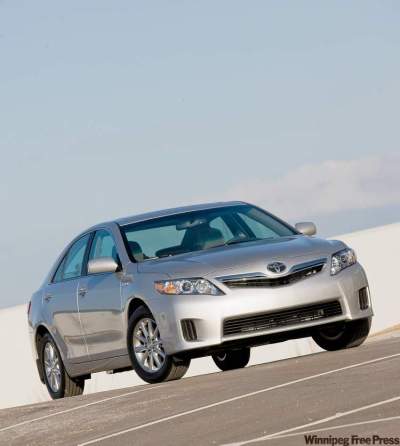
2010 TOYOTA CAMRY HYBRID: Pain-free GREEN
No sacrifices
Advertisement
Read this article for free:
or
Already have an account? Log in here »
To continue reading, please subscribe:

Digital Subscription
One year of digital access for only $205*
- Enjoy unlimited reading on winnipegfreepress.com
- Read the E-Edition, our digital replica newspaper
- Access News Break, our award-winning app
- Play interactive puzzles
*First annual payment billed as $205.00 + GST for one year. This annual subscription will automatically renew at $233.00 + GST every 52 weeks (10% off the regular annual price of $259.35). Offer available to new and qualified returning subscribers only. Cancel any time.
To continue reading, please subscribe:
Add Free Press access to your Brandon Sun subscription for only an additional
$1 for the first 4 weeks*
- Enjoy unlimited reading on winnipegfreepress.com
- Read the E-Edition, our digital replica newspaper
- Access News Break, our award-winning app
- Play interactive puzzles
*Your next Brandon Sun subscription payment will increase by $1.00 and you will be charged $17.95 plus GST for four weeks. After four weeks, your payment will increase to $24.95 plus GST every four weeks.
Read unlimited articles for free today:
or
Already have an account? Log in here »
Hey there, time traveller!
This article was published 25/06/2010 (5904 days ago), so information in it may no longer be current.
If the increasing numbers of hybrid and electric vehicle introductions at the major international auto shows are any indication, on top of the announced timetable for the reduction of tailpipe emissions by the U.S. and Canadian governments, it is conceivable to imagine a time — maybe in a generation or two — when the purely gasoline-powered automobile becomes a distinct minority on dealership lots.
As a dedicated car guy, I have conflicting thoughts on this possible scenario. The panicky side views this as a dystopian nightmare, providing the excuse to drive every 500-plus-horsepower sports car, sports coupe and sport-ute I can get my hands on before they disappear like dinosaurs in the aftermath of a meteor strike.
The more rational side views hybrids as a necessary evolution of personal transportation as a consequence of pollution and the inevitable decrease in easy-to-get-at (read cheap) petroleum reserves.
I am heartened to see automakers such as Porsche, Ferrari and Lotus developing hybrid powertrains that still emphasize the performance aspects of their exotic wheels. (As a kid, I had a poster of a Lamborghini Countach on my bedroom wall; I now have a screen saver of a Porsche 911 GT3R Hybrid on my computer.) Still, as with the vast majority of consumers out there — and one who is slowly coming around to the green side — I would be looking at more mainstream gasoline/electric products as future daily transport.
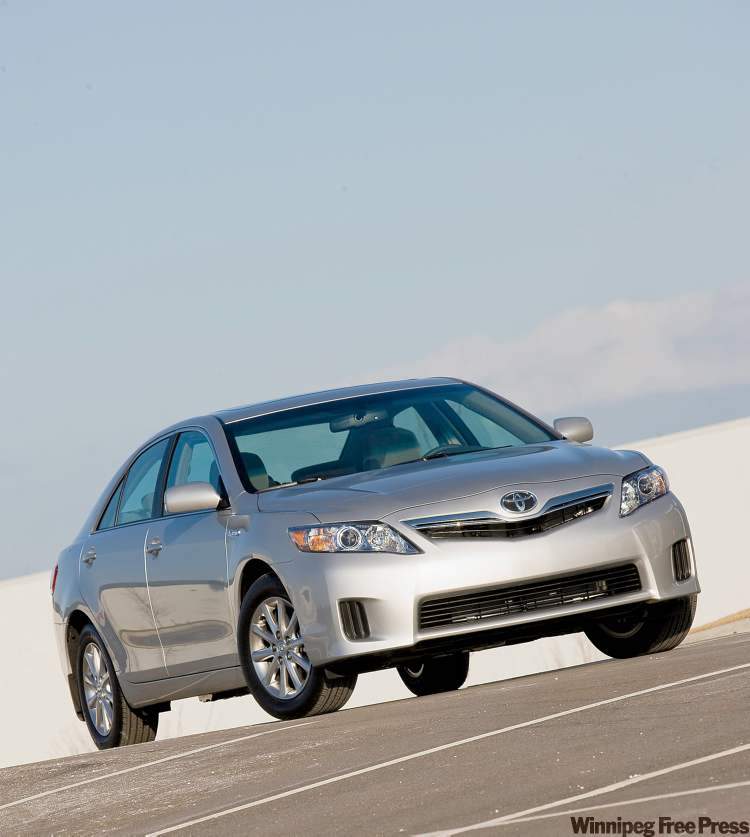
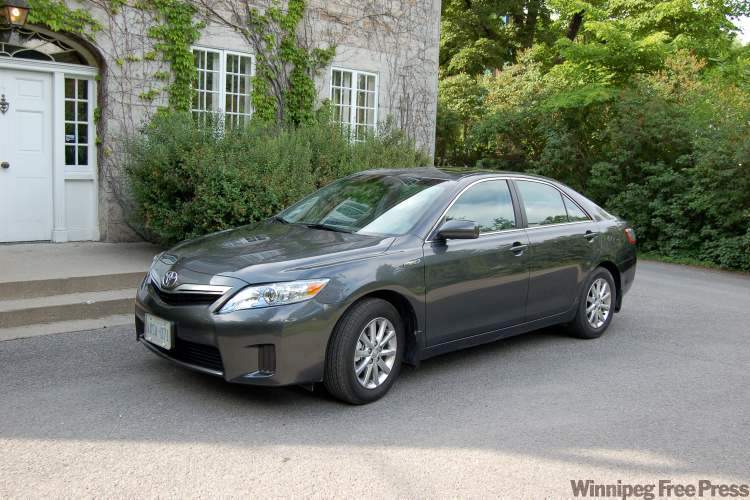
Helping lower my reluctance threshold is Toyota’s Camry Hybrid, the very definition of the word non-threatening. Unlike the Prius or Honda’s Insight, there’s nothing overtly strange or exotic about the green Camry on first or even second impression.
It doesn’t have outré styling to make it stand out as a hybrid. Except for a couple of discreet badges advertising its alternative powertrain, it looks like any other Camry. This is no hardship — Toyota’s stalwart family sedan is flat-out good-looking (finally), the 2010 models seeing a new grille and front-bumper design.
The Camry Hybrid is powered by Toyota’s Hybrid Synergy Drive system, which the automaker calls the most proven gasoline-electric full hybrid system on the planet, having been installed in more than one million hybrid vehicles since its introduction in 1997.
Under the sedan’s sheet metal is a 2.4-litre four-cylinder engine mated to a high-torque electric motor/generator and powerful storage battery that delivers the equivalent of up to 187 horsepower. Admittedly, that’s not much more than the 169-hp, 2.5L gas-powered four that’s found in the LE, SE and XLE models, but the beauty of the Synergy Drive system is its electric motor, which delivers maximum torque (199 pound-feet from zero to 1,500 r.p.m.) instantly. (A gasoline engine only delivers maximum torque at higher engine r.p.m.)
Under normal driving conditions, the car never lacked the power to accelerate to speed — zero to 100 kilometres an hour takes about 8.5 seconds — the system allowing the gas engine and electric motor to work independently or together as needed.
Sure, there are a few things to get used to, the primary one being the absence of an engine turning over when poking the push-button start — for the first few seconds, the Hybrid is powered only by its electric motor. Then the four-cylinder kicks in to supplement the electric power to the wheels and to charge the battery.
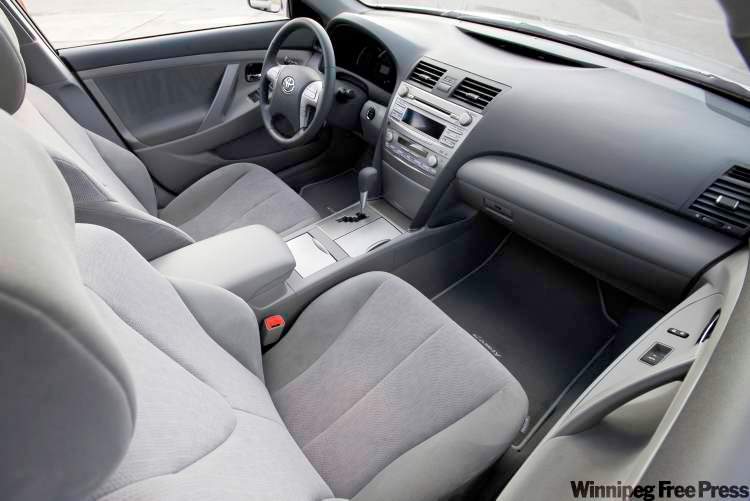
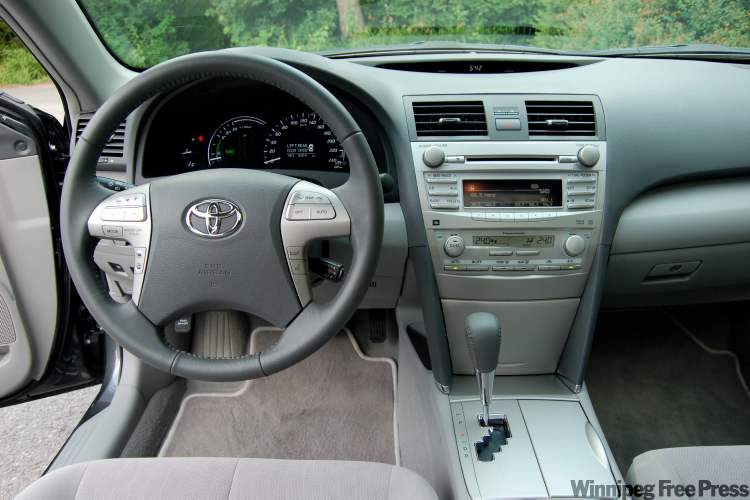
Unlike the HS 250h and Prius, which have weird, video game-like shifters on their upper dash panels, the Camry Hybrid has a familiar gear lever located in the centre console to activate the continuously variable transmission.
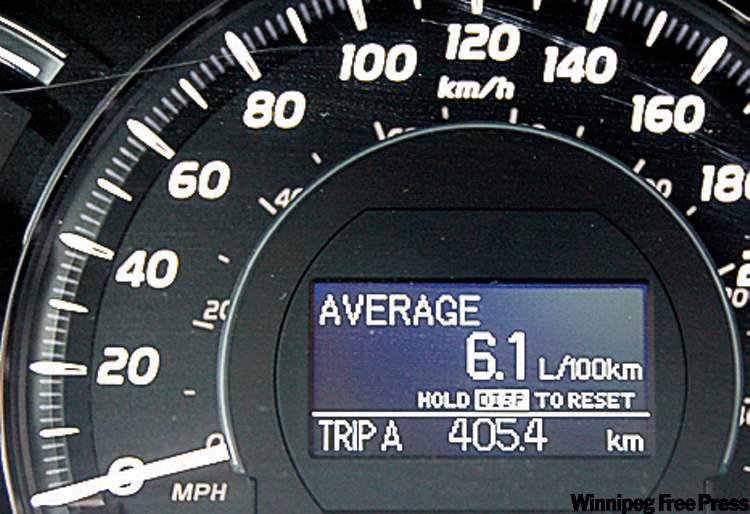
As for fuel economy, I averaged 7.6 litres per 100 kilometres during my week with the tester, a superior number for a 1,650-kilogram, five-passenger, mid-sized sedan, although not nearly as lofty as the 5.7L/100 km combined highway/city rating Transport Canada achieved. If I used the Eco mode more — which conserves fuel by reducing energy used by the heating/air conditioning system — I could probably do better.
The car’s regenerative braking system is the one area that needs work. When decelerating or braking, the gas engine shuts off and resistance from the braking system provides energy to charge the battery. As with a number of hybrids I’ve driven over the years, it’s more difficult to modulate the brakes to get a smooth stop — initial pedal feel seems soft, then suddenly transitions to very grabby.
It takes practice to keep things smooth and, according to my wife, who dislikes anything herky-jerky, I haven’t mastered it.
The rest of the Hybrid rides and drives more or less like any other Camry.
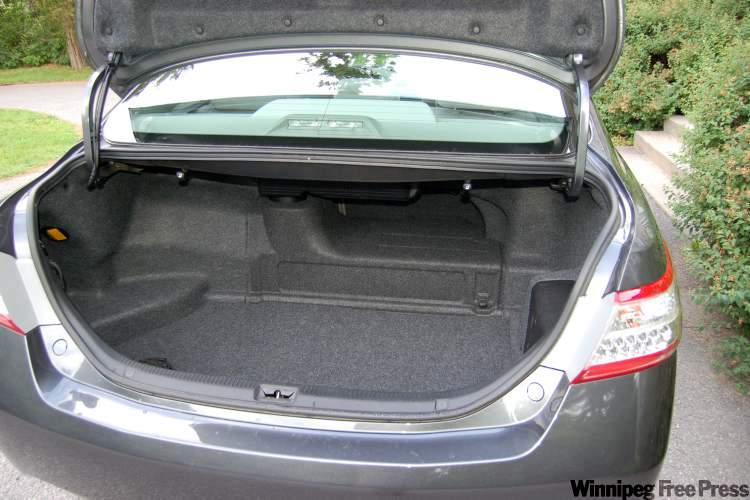
The other primary mechanical differences are the aforementioned continuously variable transmission rather than a six-speed automatic and the addition of electric rack-and-pinion power steering. Because of the car’s battery pack, trunk space takes a hit, with only 10.6 cubic feet versus 15 cu. ft. for the rest of the Camry line.
Inside, the cabin is nicely laid out and reasonably roomy, with the silver instrument panel accents complementing the tester’s dove-grey interior. The Hybrid gets a few unique displays, including the energy monitor, which shows the car’s energy flow, and the Eco Drive Level, showing current fuel economy. At $31,310 for the 2011 model, the Camry Hybrid is by no means outrageously priced. At the very least, one gets a solid and well-executed four-door family sedan that just happens to be frugal. Whether the car will pay for its technology through fuel savings is doubtful. But it does serve to prove that being kinder to the environment doesn’t require any huge sacrifice.
— Canwest News Service
THE SPECS
Type of vehicle: Front-wheel-drive mid-sized sedan hybrid.
Engine: 2.4L DOHC four-cylinder with Toyota (two-motor) Hybrid Drive.
Net power: 187 hp combined; 138 lb-ft of torque, 4,400 r.p.m. (gas engine only).
Transmission: Continuously variable.
Brakes: Four-wheel disc with ABS.
Tires: P215/60R16.

Price: base/as tested: $31,310/same.
Destination charge: $1,420.
Transport Canada fuel economy L/100 km: 5.7 city, 5.7 hwy.
Standard features: Dual-zone automatic climate control with cabin air filter and ionizer, AM/FM/CD/MP3/WMA audio system with six-disc CD changer, satellite radio, eight speakers and steering wheel audio controls, eight-way power driver’s seat, power door locks and windows, dual heated power mirrors, instantaneous fuel economy meter, multi-information display, auto-dimming rear-view mirror with compass, tilt and telescopic leather-wrapped steering wheel, push-button start, Smart key system, cruise control, garage door opener.