

Kingmaker or dream-killer: St. Andrews’ No. 17
Advertisement
Read this article for free:
or
Already have an account? Log in here »
To continue reading, please subscribe:

Digital Subscription
One year of digital access for only $205*
- Enjoy unlimited reading on winnipegfreepress.com
- Read the E-Edition, our digital replica newspaper
- Access News Break, our award-winning app
- Play interactive puzzles
*First annual payment billed as $205.00 + GST for one year. This annual subscription will automatically renew at $233.00 + GST every 52 weeks (10% off the regular annual price of $259.35). Offer available to new and qualified returning subscribers only. Cancel any time.
To continue reading, please subscribe:
Add Free Press access to your Brandon Sun subscription for only an additional
$1 for the first 4 weeks*
- Enjoy unlimited reading on winnipegfreepress.com
- Read the E-Edition, our digital replica newspaper
- Access News Break, our award-winning app
- Play interactive puzzles
*Your next Brandon Sun subscription payment will increase by $1.00 and you will be charged $17.95 plus GST for four weeks. After four weeks, your payment will increase to $24.95 plus GST every four weeks.
Read unlimited articles for free today:
or
Already have an account? Log in here »
Hey there, time traveller!
This article was published 13/07/2010 (5854 days ago), so information in it may no longer be current.
ST. ANDREWS, Scotland — The new teeing ground for the most famous par 4 in golf — the Road Hole, No. 17 at the Old Course — is now located, technically speaking, out of bounds to the right of the 16th green, on land appropriated from the practice range.
In moving it back 40 yards to restore the hole to its proper values — a driver or three-wood off the tee, a mid-iron approach — the guardians of the St. Andrews Golf Trust were careful to maintain exactly the same angle for the tee shot, meaning it still had to launch over a green-painted shed bearing the white-lettered words ‘St. Andrews Old Course Hotel’ and beneath that, ‘Golf Resort and Spa.’
Over the ‘O’ in Course, to be precise, some say.
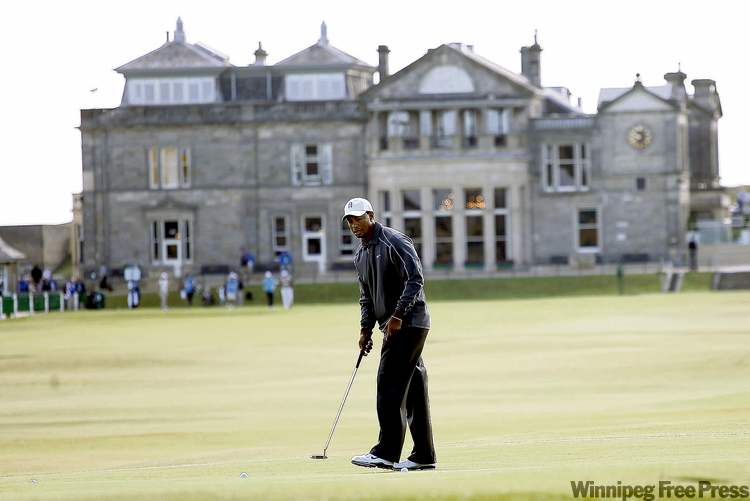
The posh hotel itself looms perilously close to the firing line along most of the inward side of the 495-yard, right-turning dogleg, whose fairway is hidden from the tee.
Considering the first British Open was played 150 years ago at Prestwick, over on the other side of the island, you might think a little of the lustre would have worn off golf’s most egalitarian championship by now, but it is quite the opposite whenever the Open returns to St. Andrews.
They call it the home of golf, and to be sure, golf in general and the Open in particular feel right at home here in one of its friendliest, and most familiar, settings — the quirky Old Course, framed by the sandy sweep of beach along St. Andrews Bay on one side and the Auld Gray Toon on the other, its stone buildings and church spires providing aiming lines for the inward holes.
All the way out to the north the links runs along the sea, makes a loop at the far end, and then runs all the way back, on the inland side, naked to whatever wind direction might alter its entire character on a given day. It opens and closes with what must be the world’s widest fairway, shared by the first and 18th holes, albeit with out-of-bounds fences on the right side of each, and has seven double greens — only the first, ninth, 17th and 18th have their own.
For most of the course, give or take the occasional thicket of gorse, the wayward tee shot headed left can work out nicely. Right, however, is almost always dead.
And as you walk it or play it, or just use it as a public park, which the locals are entitled to do, you are struck by the magnificent commonness of the place, by how ordinary a stage it is for one with so much history, so much . . . well, magic.
The magic has manifested itself in the quality of champions crowned during 28 previous placings of the Open here, including J.H. Taylor, James Braid, Jack Nicklaus and Tiger Woods each winning twice, and others like Bobby Jones, Sam Snead, Peter Thomson, Seve Ballesteros and Nick Faldo solidifying their places in history on this ancient links.
Perhaps that antiquity is why so much fuss and bother has accompanied the alteration of the Road Hole, as if a work of art has been defaced.
"You do realize they used to play this course from the greens to the tees," Padraig Harrington, the 2007 and ’08 Open champion, said Monday, dismissing the criticism.
"You look at those sheds, they’re different. The hotel was different. A whole wing of that hotel didn’t exist 10 years ago.
"So it’s evolving all the time."
What hasn’t changed, and won’t this time, is that No. 17 will test everyone’s game and be a vexation to many, and that’s as it should be, Harrington said.
The hole has simply made so most players hit driver, and forced it to be accurate, in order to keep from having to hit a long, running iron shot into a wide, shallow, angling green guarded by the deep, sod-faced Road Hole bunker, where many an Open bid has perished.
"I hit two drives there yesterday that were not that dissimilar. I wouldn’t have been surprised to see them lying five yards from one another," Harrington said. "One was a long way down the right side of the fairway. The other was out of bounds."
During practice rounds, he likes to test the right-hand limits of the tee shot, to see how far right is too far.
But even if they all do that, wind and pressure change everything. Always have — and in golf terms, in St. Andrews, always dates back 436 years.
The first Open here? A mere 137 years ago.

"Nobody wants to see someone win a major without being pushed to the limit right at the end," Harrington said.
"Nobody’s going to get through 17 without thinking about it for 16 holes… for four days."
And maybe, over a mournful pint, for a long while after that.
— Canwest News Service
Related Articles
Bettencourt wins for first time on Tour San Diego charger roars back
Advertisement Advertise With Us
Advertisement Advertise With Us