

80-million-year-old fish story
Morden discovery centre unearths bones of marine predator

Advertisement
Read this article for free:
or
Already have an account? Log in here »
To continue reading, please subscribe:

Digital Subscription
One year of digital access for only $205*
- Enjoy unlimited reading on winnipegfreepress.com
- Read the E-Edition, our digital replica newspaper
- Access News Break, our award-winning app
- Play interactive puzzles
*First annual payment billed as $205.00 + GST for one year. This annual subscription will automatically renew at $233.00 + GST every 52 weeks (10% off the regular annual price of $259.35). Offer available to new and qualified returning subscribers only. Cancel any time.
To continue reading, please subscribe:
Add Free Press access to your Brandon Sun subscription for only an additional
$1 for the first 4 weeks*
- Enjoy unlimited reading on winnipegfreepress.com
- Read the E-Edition, our digital replica newspaper
- Access News Break, our award-winning app
- Play interactive puzzles
*Your next Brandon Sun subscription payment will increase by $1.00 and you will be charged $17.95 plus GST for four weeks. After four weeks, your payment will increase to $24.95 plus GST every four weeks.
Read unlimited articles for free today:
or
Already have an account? Log in here »
Hey there, time traveller!
This article was published 17/07/2010 (5844 days ago), so information in it may no longer be current.
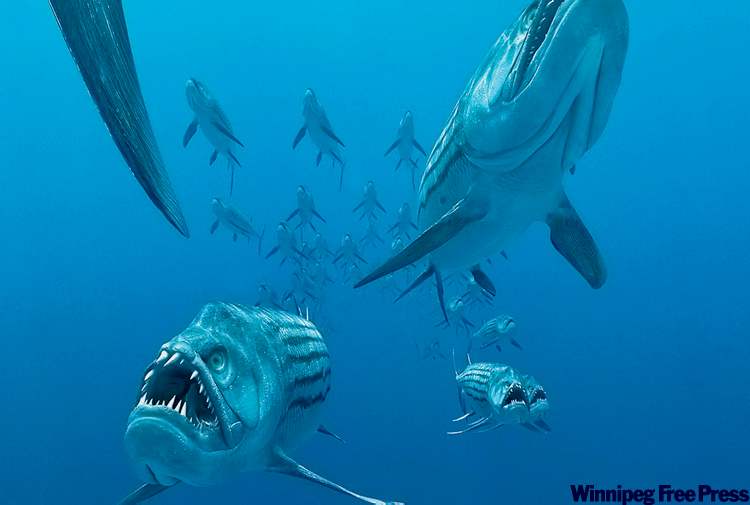
NEAR MORDEN — A giant predatory fish that once prowled the prehistoric sea was found near here with the catch of the day in its mouth — the flipper of a huge marine reptile.
The bones of an 80-million-year-old Xiphactinus as long as a shipping container were unearthed in the Manitoba Escarpment, with the flipper of a mosasaur between its jaws.
The discovery was made by one of the Canadian Fossil Discovery Centre’s summer staff while walking through a drainage ditch along the edge of what used to be the Western Interior Seaway.
"Science brings you so far," said Tyler Schroeder, general manager of the centre in Morden. "Magic or luck brings you the rest of the way."
The specimen is about six metres long, making it the largest in the museum’s collection of fish fossils.
"We’ll be setting a new landmark for ourself with this," Schroeder said.
It has caught the attention of the Discovery Channel’s Daily Planet, which sent a crew to the site of the Xiphactinus find earlier this week.
The centre’s resident paleontologist Joey Hatcher doesn’t know if the 350-kilogram fish was trying to eat the mosasaur, or fighting with it. It’s the first evidence he’s seen of the big fish preying on the giant marine reptiles.
"We find mosasaurs with their stomach contents chock full of fish. But to find a fish with a mosasaur in its jaws is really amazing luck," said Hatcher, who has dinosaur experience in the U.S.
The centre houses Canada’s largest collection of marine reptile fossils, including a 13-metre mosasaur.
The fossils are from the saltwater seaway that covered central North America in the Late Cretaceous Period 80 million years ago, not the freshwater Lake Agassiz caused by a glacier melt just 12,000 years ago .
The Canadian Fossil Discovery Centre is using the Morden Community Centre to showcase its finds from area digs while preparing a business plan and fundraising for a permanent museum, Schroeder said.
For now, there are two paleontologists on site five days a week, along with volunteers and summer staff from Winnipeg, Japan and Washington state working on undergraduate and postgraduate degrees. Every day they’re uncovering more fossils, Schroeder said.
The plan is to make Morden the Drumheller of marine reptile exhibits. The Alberta town has turned its dinosaur discovery into a tourist destination, and the Morden centre is trying to do likewise.
In the meantime, tours are available, with half-day trips and five-day dig packages. You can’t enter one of the dig sites without a staff member, Schroeder said. "You have to be out with someone who has a permit."
And you can’t keep what you find.

"All of our fossils are owned by the Province of Manitoba — they’re recognized as historical artifacts," Schroeder said.
For more information, see www.discoverfossils.com.
carol.sanders@freepress.mb.ca
Carol Sanders
Legislature reporter
Carol Sanders is a reporter at the Free Press legislature bureau. The former general assignment reporter and copy editor joined the paper in 1997. Read more about Carol.
Every piece of reporting Carol produces is reviewed by an editing team before it is posted online or published in print — part of the Free Press‘s tradition, since 1872, of producing reliable independent journalism. Read more about Free Press’s history and mandate, and learn how our newsroom operates.
Our newsroom depends on a growing audience of readers to power our journalism. If you are not a paid reader, please consider becoming a subscriber.
Our newsroom depends on its audience of readers to power our journalism. Thank you for your support.
Carol Sanders
Legislature reporter
Carol Sanders is a reporter at the Free Press legislature bureau. The former general assignment reporter and copy editor joined the paper in 1997. Read more about Carol.
Every piece of reporting Carol produces is reviewed by an editing team before it is posted online or published in print — part of the Free Press‘s tradition, since 1872, of producing reliable independent journalism. Read more about Free Press’s history and mandate, and learn how our newsroom operates.
Our newsroom depends on a growing audience of readers to power our journalism. If you are not a paid reader, please consider becoming a subscriber.
Our newsroom depends on its audience of readers to power our journalism. Thank you for your support.
Advertisement Advertise With Us
Advertisement Advertise With Us