Paintings, photos shine light on South Asian aunty style

Advertisement

Advertise with us

TORONTO - Toronto artist Meera Sethi's paintings and photos feature a group of women not often appreciated for their sense of style: South Asian aunties.

Read this article for free:


or

Already have an account? Log in here »

To continue reading, please subscribe:

Subscribe and receive a limited-edition Free Press branded hat or tote.

Digital Subscription

One year of digital access for only $205*

  • Enjoy unlimited reading on winnipegfreepress.com
  • Read the E-Edition, our digital replica newspaper
  • Access News Break, our award-winning app
  • Play interactive puzzles

*First annual payment billed as $205.00 + GST for one year. This annual subscription will automatically renew at $233.00 + GST every 52 weeks (10% off the regular annual price of $259.35). Offer available to new and qualified returning subscribers only. Cancel any time.

To continue reading, please subscribe:

Add Free Press access to your Brandon Sun subscription for only an additional

$1 for the first 4 weeks*

  • Enjoy unlimited reading on winnipegfreepress.com
  • Read the E-Edition, our digital replica newspaper
  • Access News Break, our award-winning app
  • Play interactive puzzles
Start now

*Your next Brandon Sun subscription payment will increase by $1.00 and you will be charged $17.95 plus GST for four weeks. After four weeks, your payment will increase to $24.95 plus GST every four weeks.

Hey there, time traveller!
This article was published 17/06/2016 (3729 days ago), so information in it may no longer be current.

TORONTO – Toronto artist Meera Sethi’s paintings and photos feature a group of women not often appreciated for their sense of style: South Asian aunties.

In one of Sethi’s paintings, Preeti Aunty pairs a multi-coloured salwar kameez — a traditional Indian outfit that includes pants and a sash — with a “6IX” baseball cap. In another, Pinky Aunty is wearing sneakers with her salwar kameez.

“(Aunties are) dismissed as not having style, not being attractive, not being terribly interesting, kind of just taking care of others,” Sethi says. “They don’t get a lot of love on those levels.”
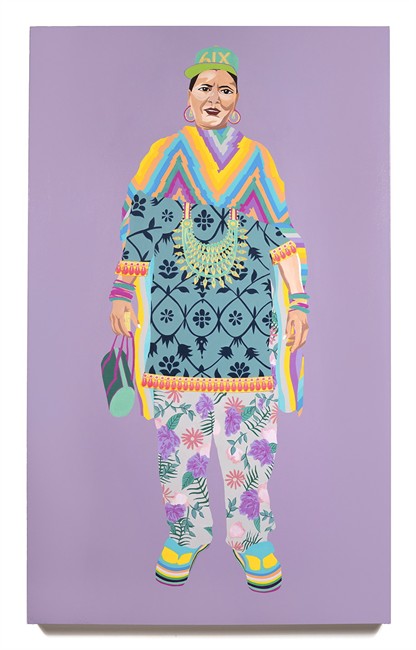
A painting by Meera Sethi from the exhibit
A painting by Meera Sethi from the exhibit "Upping the Aunty," on display at Daniels Spectrum in Toronto is shown in this undated handout photo. Sethi's paintings and photos feature a group of women not often appreciated for their sense of style: South Asian aunties. THE CANADIAN PRESS/HO, Meera Sethi, MANDATORY CREDIT

An aunty isn’t necessarily a relative among South Asians — she’s simply a woman, about 20 or 30 years older, whom you call aunty to show respect. You might refer to a friend’s mom as aunty, or someone you just met.

Sethi’s “Upping the Aunty” project began in 2014, with a series of photos featuring the street style of aunties. An “Upping the Aunty” colouring book was released last year, and the paintings, inspired by some of the photos from the beginning of the project, are the final step.

Sethi says it’s tough to put her finger on exactly what she was looking for before choosing an aunty for a photo.

“It’s sort of this feeling or attitude, or the way that things have been put together that looks interesting or fresh or new.”

Sethi wonders why South Asian aunties can’t be regarded as sources of fashion inspiration, pointing out that they have some “really cool style” that isn’t seen elsewhere.

“You’ll see … pattern on pattern, colour on colour. You’re gonna see socks with sandals in the summer and contrasting colours…. I think they’re kind of having their moment,” Sethi says of aunties. “It’s long overdue that we look at style from a non-Eurocentric perspective.”

Maria Qamar, another Toronto-based artist who focuses on South Asian culture and sells her work in various forms under the name “Hatecopy,” says aunties are a “recurring theme” in her work. A trio of aunties are featured in one piece accompanied by the words “Trust No Aunty.” Qamar says the piece was initially inspired by how aunties are portrayed in Indian soap operas — “a fictional character that hyperbolizes something that actually does happen in our lives.”

“For example, on the very, very cliched topic of marriage, oh you know, your parents push you towards marriage. In a soap opera, that aunty will plot 13 different ways to get you married to the wrong guy,” Qamar explains.

“The sheer ridiculousness of how exaggerated that aunty is in (South Asian) pop culture, that’s what’s so alluring to me.”

But Qamar doesn’t see aunties, specifically, as popular in art right now. Rather, it’s South Asian art in general that’s gaining prominence, she points out.

“Aunty is just a word, like sir or madam,” Qamar says. “It’s always been popular because it’s an aspect of our culture.”

Sethi’s paintings and photos are being showcased at Daniels Spectrum in Toronto until July 15.

———

On the web:

http://www.meerasethi.com

http://www.hatecopy.com

Report Error Submit a Tip

More Stories

Renewed spirit and life: Indigenous treatment centre expands with $21-M revamp

Scott Billeck 5 minute read Preview

Renewed spirit and life: Indigenous treatment centre expands with $21-M revamp

Scott Billeck 5 minute read Yesterday at 3:44 PM CDT

Don Robinson knows first-hand that many people don’t get sober by themselves.

In late June 1984, Robinson downed his last drink. His recovery began at Pritchard House in Winnipeg’s North End, a 22-bed treatment facility run by the Native Addictions Council of Manitoba.

“I didn’t get sober by myself,” said Robinson, a member of Bunibonibee Cree Nation who now works in grief and trauma counselling and traditional knowledge as an elder at Ka Ni Kanichihk Inc.

More than four decades later, Robinson was back at the council on Monday, crowded into a room at its newly renovated treatment centre at 160 Salter St. — a place he once turned to for help and where he helps others now.

Read
Yesterday at 3:44 PM CDT

Reimagining education in Manitoba

Jim Silver 4 minute read 2:00 AM CDT

There has been much talk lately about how Manitoba can strengthen its economy and improve its general well-being. Adding a third component to our education system, one that would be equal in funding and recognition to K-12 and post-secondary education, would do just that.

That third component, adult basic education, already exists, but with inadequate funding and little recognition.

Adult basic education includes adult learning centres that offer mature high school diplomas to those who have not previously completed high school, and adult literacy programs that bring adults up to high school entry level.

Adult basic education works well. Since 2003, some 25,000 Manitobans have earned their mature high school diplomas. Enough graduates move off employment and income assistance, saving the provincial government money, and into full-time employment, increasing the government’s tax revenue, so that over a 10-year period the government makes more than it spends on adult basic education. The system pays for itself.

Filtering the worst of our behaviour

Gwynne Dyer 5 minute read 2:00 AM CDT

On Sunday, Aug. 30, a Falcon Heavy rocket delivered the Nancy Grace Roman space telescope onto a direct transfer trajectory to its permanent home at the Lagrange Two Point (L2), 1.5-million km from Earth. In 100 days it will reach its station, power up, and start observing the universe.

Astronomers will use it to try to understand the nature of dark matter, which makes up most of the mass in the universe (but some say may not even exist).

It is expected to find up to 100,000 new exoplanets circling other stars, and may be able to spot ones even smaller than Mars. Current methods can only see much bigger ones.

It will test a new technology called a coronagraph, which may one day be able to detect life on some of those planets by analyzing the light reflected from them. It would be nice to have a better answer to scientist Enrico Fermi’s famous question: “Where is everybody?”

Love of the rink blossomed differently for mother-daughter figure skaters

Grace Penner 8 minute read Preview

Love of the rink blossomed differently for mother-daughter figure skaters

Grace Penner 8 minute read Yesterday at 6:20 PM CDT

It’s said that home is where the heart is, and for Dana and Marrin McKee that has always been the rink.

The mother-daughter duo of figure skating coaches always find comfort lacing up in chilly arenas.

Dana McKee’s origin story was very similar to her daughter’s, having a strong motherly push onto the ice. Much like learning to swim or drive a car, Dana’s mother believed that skating was an important life skill that needed to be honed.

Growing up in Morris, McKee spent the majority of her youth in the CanSkate program — a developmental learn-to-skate stage teaching the basics of standing upright.

Read
Yesterday at 6:20 PM CDT

Art shines light on South Asian aunty style

Shetu Modi, The Canadian Press 4 minute read Preview

Art shines light on South Asian aunty style

Shetu Modi, The Canadian Press 4 minute read Friday, Jun. 17, 2016

TORONTO - Toronto artist Meera Sethi's paintings and photos feature a group of women not often appreciated for their sense of style: South Asian aunties.

In one of Sethi's paintings, Preeti Aunty pairs a multi-coloured salwar kameez — a traditional Indian outfit that includes pants and a sash — with a "6IX" baseball cap. In another, Pinky Aunty is wearing sneakers with her salwar kameez.

"(Aunties are) dismissed as not having style, not being attractive, not being terribly interesting, kind of just taking care of others," Sethi says. "They don't get a lot of love on those levels."

An aunty isn't necessarily a relative among South Asians — she's simply a woman, about 20 or 30 years older, whom you call aunty to show respect. You might refer to a friend's mom as aunty, or someone you just met.

Read
Friday, Jun. 17, 2016

Mayoral rematch between Gillingham, Klein gets ugly on Day 1

Joyanne Pursaga 6 minute read Preview

Mayoral rematch between Gillingham, Klein gets ugly on Day 1

Joyanne Pursaga 6 minute read Updated: Yesterday at 6:25 PM CDT

Former city councillor and provincial cabinet minister Kevin Klein says he will soon enter the race to become Winnipeg’s next mayor — prompting an immediate war of words with incumbent Scott Gillingham.

Gillingham quickly responded to the announcement by calling Klein “toxic” and a “fixer” for Peter Nygard.

Klein said Tuesday he had decided not to enter the mayoral race weeks ago due to an unspecified health scare that required surgery. After recovering, he decided to run.

“The future of the city means a lot to me. I believe that we have so much untapped potential that I felt I should do something about it,” said Klein, noting he felt compelled to run because key city issues, such as perceptions of public safety in the downtown, have grown worse over the past four years.

Read
Updated: Yesterday at 6:25 PM CDT