

Straining to hit the high notes
Streep carries the day in entertaining, but shallow tale of terrible opera singer

Advertisement
Read this article for free:
or
Already have an account? Log in here »
To continue reading, please subscribe:
Monthly Digital Subscription
$1 per week for 24 weeks*
- Enjoy unlimited reading on winnipegfreepress.com
- Read the E-Edition, our digital replica newspaper
- Access News Break, our award-winning app
- Play interactive puzzles
*Billed as $4.00 plus GST every four weeks. After 24 weeks, price increases to the regular rate of $19.95 plus GST every four weeks. Offer available to new and qualified returning subscribers only. Cancel any time.
Monthly Digital Subscription
$4.99/week*
- Enjoy unlimited reading on winnipegfreepress.com
- Read the E-Edition, our digital replica newspaper
- Access News Break, our award-winning app
- Play interactive puzzles
*Billed as $19.95 plus GST every four weeks. Cancel any time.
To continue reading, please subscribe:
Add Free Press access to your Brandon Sun subscription for only an additional
$1 for the first 4 weeks*
*Your next subscription payment will increase by $1.00 and you will be charged $16.99 plus GST for four weeks. After four weeks, your payment will increase to $23.99 plus GST every four weeks.
Read unlimited articles for free today:
or
Already have an account? Log in here »
Hey there, time traveller!
This article was published 13/08/2016 (3525 days ago), so information in it may no longer be current.
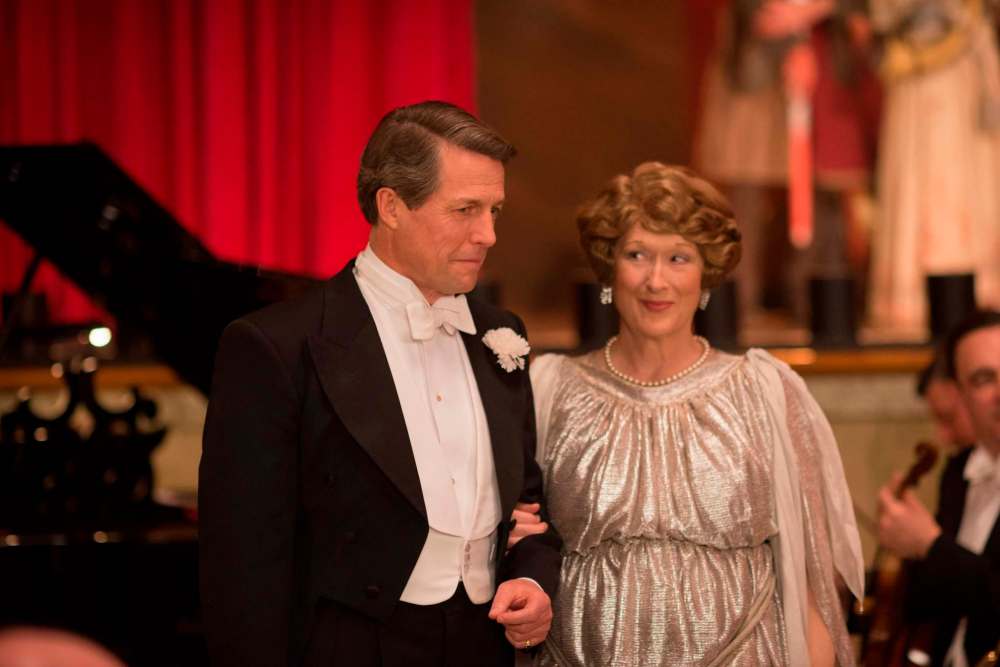
In this light, larky biopic of “the world’s worst singer,” Meryl Streep stars as delusional diva Florence Foster Jenkins, who attracted a cult of loyal listeners despite a crashing lack of talent. Florence regularly performed for New York soirées in the early 1900s, mangling the classical repertoire with passionate ineptitude.
How exactly does this film turn ear-scrapingly awful singing into crowd-pleasing summer cinema? Director Stephen Frears (Philomena, The Queen, High Fidelity) and scripter Nicholas Martin, who has written mostly for British TV, do likeable work, but mostly it comes down to the infectious nature of Streep’s misguided, gusto-grabbing musicality.
(Consider what happened at FFJ’s Winnipeg première: as the film finished and the crowd wandered out into the lobby, several audience members vied with each other to see who could perform the shriekiest version of the Bell Song from Lakmé. There’s something curiously compelling about the whole Florence Foster Jenkins phenomenon.)
A wealthy socialite with a sincere belief in the power of music, Florence uses her inheritance to help fund New York’s performing arts. In return, her own concerts are indulged, the small, select audiences either smiling in polite middlebrow ignorance or disguising their laughter with strategic coughing fits and bursts of applause.
Florence’s longtime companion St. Clair Bayfield (Hugh Grant), a failed Shakespearean actor and professional Englishman, tactfully shepherds her “career.” He bribes and bullies the critics, vets the spectators, and hires understanding support, including pianist Cosme McMoon (Simon Helberg of The Big Bang Theory).
This carefully constructed bubble might pop, however, when Florence makes the fateful decision to perform a public concert at Carnegie Hall in 1944.
Streep plays Florence as a boundlessly enthusiastic innocent, her girlishness contrasting poignantly with her massive Valkyrie-like costumes. The musical performances are carefully calibrated. Singing well is hard, but pretending to sing badly could be even harder, and Streep mostly manages to pull off cat-being-strangled comedy without tipping over into outright unlistenable tragedy.
Grant, formerly burdened with relentless charm, is able to do much better work now that he no longer has floppy bangs. Looking his full 55 years, Grant brings a lovely strain of seriousness to a tricky comic role. St. Clair is a bit of a bounder — he keeps a Hell’s Kitchen apartment and a younger girlfriend — but his protective tenderness and devotion to Florence are undeniable.
As Florence’s initially incredulous but ultimately affectionate accompanist, Helberg occasionally overplays the sitcom-y reaction shots. He does do his own piano work, however, which allows Frears to avoid the usual divided set-up in which the camera constantly switches off between shots of the star making a dreamy “musical” face and close-ups of what are clearly someone else’s hands.

The script could occasionally go darker and deeper. In one scene, maestro Arturo Toscanini (John Kavanagh) shows up at Florence’s home with flowery compliments, along with a seemingly offhand mention of the money troubles threatening his next project.
Martin hints at the sometimes queasy relationship between patrons and artists. He fleetingly suggests perhaps Florence, who has the luxury of self-funding her musical career, is being indulged and enabled by paid hangers-on and sycophants. He intimates perhaps her enveloping self-delusion isn’t an entirely positive thing.
Mostly, though, the film skirts these issues, falling back on a generalized, sentimentalized “follow your dream” message.
Ultimately, this amiable and easy approach makes for an entertaining story but fails to get to the complicated, slightly uncomfortable heart of Florence’s so-bad-it’s-good cult appeal.
alison.gillmor@freepress.mb.ca
Studying at the University of Winnipeg and later Toronto’s York University, Alison Gillmor planned to become an art historian. She ended up catching the journalism bug when she started as visual arts reviewer at the Winnipeg Free Press in 1992.
Our newsroom depends on a growing audience of readers to power our journalism. If you are not a paid reader, please consider becoming a subscriber.
Our newsroom depends on its audience of readers to power our journalism. Thank you for your support.
Movie review
Florence Foster Jenkins
● Starring Meryl Streep and Hugh Grant
Grant Park, Polo Park
● PG
● 111 minutes
★★★1/2 out of five

A real-life, screwball comedy with a solid-gold cast. Grant may have just sealed his first Oscar nomination.
— Rafer Guzman, Newsday
It’s not necessary to be a classical-music buff to be charmed by this thoroughly entertaining film that never hits a false note.
— Calvin Wilson, St. Louis Post-Dispatch
Even when her notes are intolerably sour, Jenkins’s story is never less than touchingly bittersweet.
— Ann Hornaday, Washington Post
It’s mildly amusing when it should be funny, sentimental when it should be deep, and all too easy when it should be unsettling. It’s still some kind of success, but a modest one.
— Mick LaSalle, San Francisco Chronicle
Studying at the University of Winnipeg and later Toronto’s York University, Alison Gillmor planned to become an art historian. She ended up catching the journalism bug when she started as visual arts reviewer at the Winnipeg Free Press in 1992.
Our newsroom depends on a growing audience of readers to power our journalism. If you are not a paid reader, please consider becoming a subscriber.
Our newsroom depends on its audience of readers to power our journalism. Thank you for your support.
Advertisement Advertise With Us
Advertisement Advertise With Us