

Fifty shades of stray
Beautiful documentary is a cat lover's dream

Advertisement
Read this article for free:
or
Already have an account? Log in here »
To continue reading, please subscribe:
Monthly Digital Subscription
$1 per week for 24 weeks*
- Enjoy unlimited reading on winnipegfreepress.com
- Read the E-Edition, our digital replica newspaper
- Access News Break, our award-winning app
- Play interactive puzzles
*Billed as $4.00 plus GST every four weeks. After 24 weeks, price increases to the regular rate of $19.95 plus GST every four weeks. Offer available to new and qualified returning subscribers only. Cancel any time.
Monthly Digital Subscription
$4.99/week*
- Enjoy unlimited reading on winnipegfreepress.com
- Read the E-Edition, our digital replica newspaper
- Access News Break, our award-winning app
- Play interactive puzzles
*Billed as $19.95 plus GST every four weeks. Cancel any time.
To continue reading, please subscribe:
Add Free Press access to your Brandon Sun subscription for only an additional
$1 for the first 4 weeks*
*Your next subscription payment will increase by $1.00 and you will be charged $16.99 plus GST for four weeks. After four weeks, your payment will increase to $23.99 plus GST every four weeks.
Read unlimited articles for free today:
or
Already have an account? Log in here »
Hey there, time traveller!
This article was published 31/05/2017 (3231 days ago), so information in it may no longer be current.
Kedi is Turkish for cat and that simple title aptly sums up this simple but lovely documentary, a fond and often touching look at the street cats of Istanbul.
In Istanbul, “cat lady” is no slur — as a matter of fact, the majority of folks featured feeding, stroking, caring for and anthropomorphizing the animals here are men — and it soon becomes evident the affection between the streetwise felines and the people who care for them is very much a two-way street.
The beautifully filmed doc (in Turkish with English subtitles) is a cat lover’s dream, but it also acts as a love letter to Istanbul, its fish markets and cafés, its haphazard roads and shabby elegance, the blue expanse of the Bosphorus under gull-filled skies.
Director Ceyda Torun pays as much reverence to the Turkish city’s quirks as she does to those of its furry denizens, and the camera gives us a cat’s-eye view, often prowling through the funky Beyoglu neighbourhood at shin-level.
The film seems to suggest the city, with its blend of east and west, is unique in its attitude toward the thousands of cats that roam its cobbled streets — and that might be true. In most cities, these animals would be seen as a nuisance; in Istanbul, they are not only tolerated, but often doted on.
“In a way, cats are our cultural symbol,” says one interviewee.
“The cups are for cats and dogs. If you don’t want to be desperate for water in the next life, don’t touch these cups,” reads a sign taped up over containers on a sidewalk.
The animals followed by Torun — she singles out seven for special notice — don’t look much like strays. They’re sleek, well-fed and well-groomed (with the occasional nicked ear or scratch as the result of a back-alley brawl).
This is largely because they are considered a part of the soul of the city. Citizens wax poetic about what they bring to metropolitan life, and many of the cats are fed daily and make visits to their regular haunts; they’re far from feral.
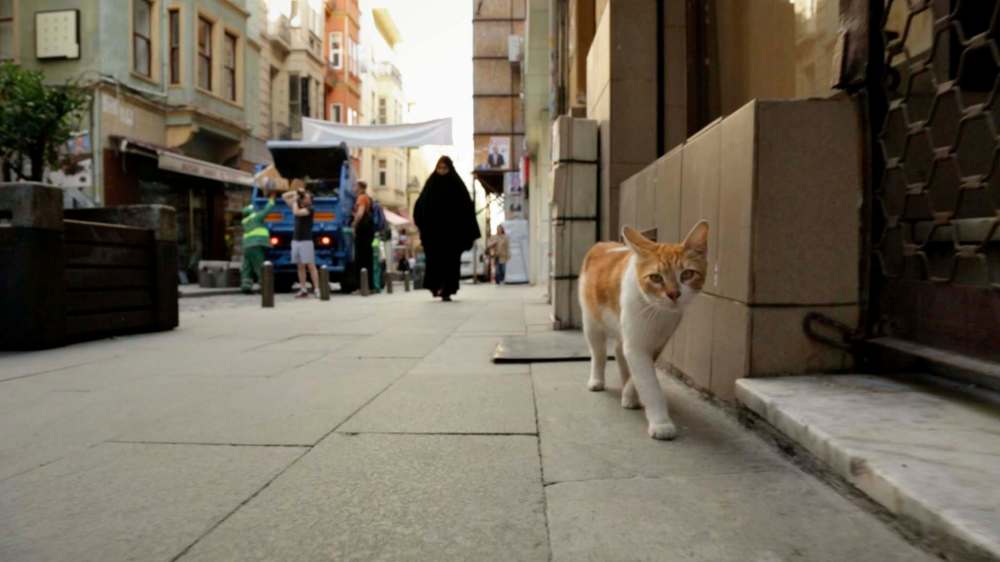
They roam where they want, separate from housecats but missed if they’re absent. One hunts mice at a restaurant along the water; the owners seem to consider him an employee. Another is a friendly fixture at an open-air market where locals lament the loss of green space for cats to roam.
But they’re not all adorably affectionate or useful. Take the black-and-white female fondly known as Psycho, a staunchly independent cat whose claws come out when her territory is challenged.
But her non-owner revels in her contrary spirit and in the rare moments when she consents to some petting.

Some people must dislike them — and their presence in restaurants and in food vendors’ stalls can’t be hygienic — but more often they are treated like somewhat aloof mascots.
Certain interviewees overly romanticize these animals, claiming their inherent wildness is what gives them their spirit.
It’s sweet to hear a café worker say, “We all have running tabs at the vet… whatever is in our tip jar goes to the vet” to provide care for Gamsiz (Carefree), a neighbourhood tom who’s a bit of a scrapper. But you can’t help but wish some of those tips would go toward getting him neutered.
And there’s perhaps a bit too much artsy philosophizing about the mystery of cats and why we relate to them. The film works best when it doesn’t attribute magical powers to the animals, but focuses instead on the people who have found succor in caring for them.
jill.wilson@freepress.mb.ca Twitter: @dedaumier
Jill Wilson is the editor of the Arts & Life section. A born and bred Winnipegger, she graduated from the University of Winnipeg and worked at Stylus magazine, the Winnipeg Sun and Uptown before joining the Free Press in 2003. Read more about Jill.
Jill oversees the team that publishes news and analysis about art, entertainment and culture in Manitoba. It’s part of the Free Press‘s tradition, since 1872, of producing reliable independent journalism. Read more about Free Press’s history and mandate, and learn how our newsroom operates.
Our newsroom depends on a growing audience of readers to power our journalism. If you are not a paid reader, please consider becoming a subscriber.
Our newsroom depends on its audience of readers to power our journalism. Thank you for your support.
Movie review

Kedi
Directed by Ceyda Torun
Cinematheque
Subject to classification
80 minutes
★★★★ out of five
Other voices
Kedi is the cat’s meow. Literally.
— Adam Graham, Detroit News
Cats wander in and out of frame; humans speculate on whether the local cats are ambitious or arrogant; Turkish music spills onto the soundtrack and there’s more than one growler of a catfight.
— John Hartl, Seattle Times
Those who don’t especially like cats — or Istanbul, for that matter — might not get a lot out of Turkish director Ceyda Torun’s love letter to the feline population of her native city. For everyone else, it should be an almost unadulterated pleasure.
— Peter Keough, Boston Globe
Though pleasant to watch, (Ceyda) Torun’s feature debut feels more like a meandering montage than a structured narrative, and it could easily be half as long.
— Vanessa H. Larson, Washington Post
Jill Wilson is the editor of the Arts & Life section. A born and bred Winnipegger, she graduated from the University of Winnipeg and worked at Stylus magazine, the Winnipeg Sun and Uptown before joining the Free Press in 2003. Read more about Jill.
Jill oversees the team that publishes news and analysis about art, entertainment and culture in Manitoba. It’s part of the Free Press‘s tradition, since 1872, of producing reliable independent journalism. Read more about Free Press’s history and mandate, and learn how our newsroom operates.
Our newsroom depends on a growing audience of readers to power our journalism. If you are not a paid reader, please consider becoming a subscriber.
Our newsroom depends on its audience of readers to power our journalism. Thank you for your support.
Advertisement Advertise With Us
Advertisement Advertise With Us
History
Updated on Wednesday, May 31, 2017 7:47 AM CDT: Photos added.
Updated on Wednesday, May 31, 2017 7:52 AM CDT: Format fixed.