A housing hero gets her due
Documentary looks at 1950s, '60s urbanization with a view to the future

Advertisement
Read this article for free:
or
Already have an account? Log in here »
To continue reading, please subscribe:
Digital Subscription
One year of digital access for only $1.44 a week*
- Enjoy unlimited reading on winnipegfreepress.com
- Read the E-Edition, our digital replica newspaper
- Access News Break, our award-winning app
- Play interactive puzzles
*Billed as $5.77 plus GST every four weeks. After 52 weeks, price increases to the regular rate of $19.95 plus GST every four weeks. Offer available to new and qualified returning subscribers only. Cancel any time.
To continue reading, please subscribe:
Add Free Press access to your Brandon Sun subscription for only an additional
$1 for the first 4 weeks*
- Enjoy unlimited reading on winnipegfreepress.com
- Read the E-Edition, our digital replica newspaper
- Access News Break, our award-winning app
- Play interactive puzzles
*Your next Brandon Sun subscription payment will increase by $1.00 and you will be charged $17.95 plus GST for four weeks. After four weeks, your payment will increase to $24.95 plus GST every four weeks.
Read unlimited articles for free today:
or
Already have an account? Log in here »
Hey there, time traveller!
This article was published 24/06/2017 (3402 days ago), so information in it may no longer be current.
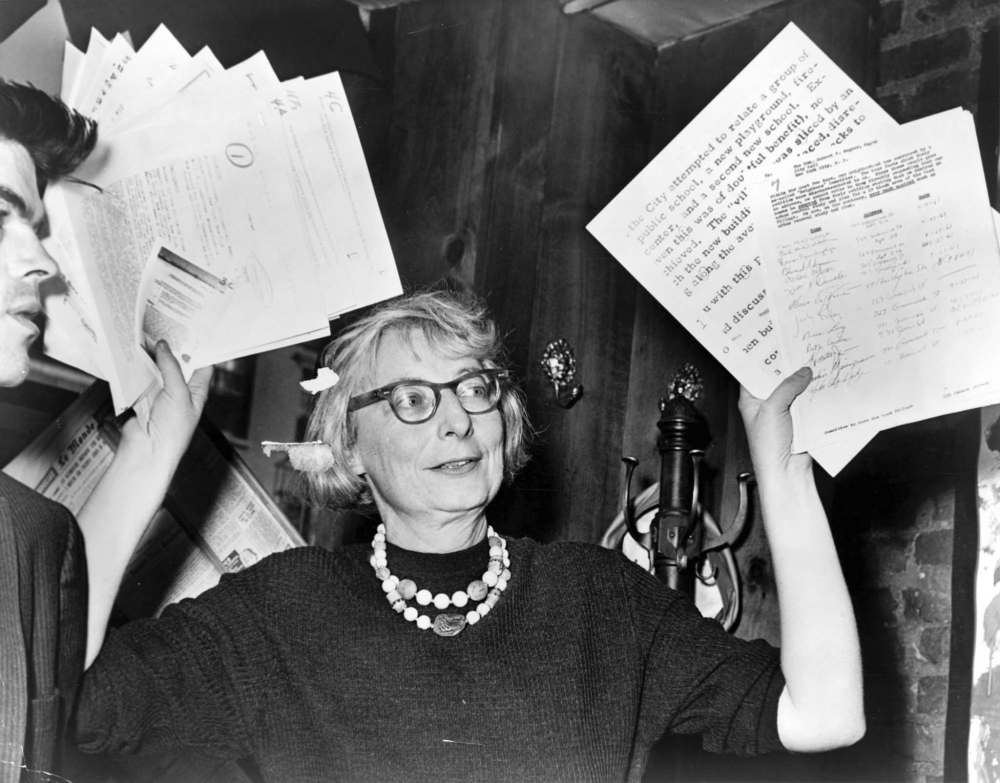
Documentaries always benefit from human drama, and this new look at influential urban thinker Jane Jacobs has a clear conflict and crackerjack characters.
On one side, we have Jacobs, scrappy grassroots activist. On the other, Robert Moses, power broker, money man and master builder. In this cogent, urgent, zippy doc, director Matt Tyrnauer (Valentino: The Last Emperor) has them duking it out for the soul of New York City in the 1950s and ’60s.
Jacobs, who started as a journalist, believed that urban development had to begin with people and how they really lived, not with overarching theories. Her landmark 1961 book, The Death and Life of Great American Cities, advocated for vital urban neighbourhoods with a messy mix of old and new buildings and diverse uses. For her, everything started at the street level.
Moses, an unelected official who amassed an enormous amount of bureaucratic clout, took a God’s-eye view of the city. With a hardline modernist vision that favoured tower blocks and expressways, he tore down low-income neighbourhoods to make way for massive planned building programs.
Jacobs’ and Moses’s conflict over urban issues is bound up with gender and race.
At a time when most professional city planners were men, Jacobs was often treated with condescension and dismissed as a meddling housewife. Social critic Lewis Mumford referred to her book as “Mother Jacobs’ Home Remedies” in the New Yorker.
The neighbourhoods that Moses tore down were often predominantly African-American and Hispanic, with vast numbers of people displaced into isolated and dysfunctional high-rise social housing.
Citizen Jane concentrates on key Jacobs-Moses showdowns in New York City, including one that would have levelled SoHo to make way for a freeway. There is little about Jacobs’ later life in Toronto, where she moved in 1968. The film focuses on her beliefs, not her biography.

And while this is essentially a documentary of ideas, Tyrnauer keeps things lively and fast-moving with a deft mix of archival footage and opinionated talking-head interviews.
Citizen Jane is not meant to be an even-handed argument — the title makes that clear. There is no mention of recent revisionist takes on Moses’s legacy. There is no acknowledgement that the dense urban neighbourhoods Jacobs championed as havens of social and economic diversity have become, in many North American cities, enclaves of white affluence.
Tyrnauer makes his own activist argument in calls to action that bookend the film. The particular New York battles between Jacobs and Moses may be in the past, he suggests, but the war goes on, with the super-accelerated rate of global urbanization making it even more crucial. With footage that looks like something out of a dystopian sci-fi movie, one interview subject describes current city development in China as “Robert Moses on steroids.”
We are making decisions right now, Citizen Jane makes clear, that will affect our world for generations.
alison.gillmor@freepress.mb.ca
Studying at the University of Winnipeg and later Toronto’s York University, Alison Gillmor planned to become an art historian. She ended up catching the journalism bug when she started as visual arts reviewer at the Winnipeg Free Press in 1992.
Our newsroom depends on a growing audience of readers to power our journalism. If you are not a paid reader, please consider becoming a subscriber.
Our newsroom depends on its audience of readers to power our journalism. Thank you for your support.
Movie review

CITIZEN JANE: BATTLE FOR THE CITY
Directed by Matt Tyrnauer
● Cinematheque
● G ● 92 minutes
★★★★ out of five
Other voices
The movie is scored like a thriller, seemingly building to some terrifying conclusion. And, in a way, it does…
— Stephanie Merry, Washington Post
It’s a good film for lovers of New York, but even they might find monotony in its reliance on library footage of street scenes.
— Edward Porter, Sunday Times
Anyone seeking a demonstration of how completely orthodoxy and heresy can change places need look no further than the brisk documentary Citizen Jane: Battle for the City.
— Kenneth Turan, Los Angeles Times
A fascinating documentary captures the showdown, half a century ago, between the activist Jane Jacobs and the Trumpian urban planner Robert Moses: a fight for the future of New York.
— Owen Gleiberman, Variety
Studying at the University of Winnipeg and later Toronto’s York University, Alison Gillmor planned to become an art historian. She ended up catching the journalism bug when she started as visual arts reviewer at the Winnipeg Free Press in 1992.
Our newsroom depends on a growing audience of readers to power our journalism. If you are not a paid reader, please consider becoming a subscriber.
Our newsroom depends on its audience of readers to power our journalism. Thank you for your support.
Advertisement Advertise With Us
Advertisement Advertise With Us