A Canadian culinary legacy
Madame Benoît was a cultural powerhouse
Advertisement
Read this article for free:
or
Already have an account? Log in here »
To continue reading, please subscribe:
Digital Subscription
One year of digital access for only $1.44 a week*
- Enjoy unlimited reading on winnipegfreepress.com
- Read the E-Edition, our digital replica newspaper
- Access News Break, our award-winning app
- Play interactive puzzles
*Billed as $5.77 plus GST every four weeks. After 52 weeks, price increases to the regular rate of $19.95 plus GST every four weeks. Offer available to new and qualified returning subscribers only. Cancel any time.
To continue reading, please subscribe:
Add Free Press access to your Brandon Sun subscription for only an additional
$1 for the first 4 weeks*
- Enjoy unlimited reading on winnipegfreepress.com
- Read the E-Edition, our digital replica newspaper
- Access News Break, our award-winning app
- Play interactive puzzles
*Your next Brandon Sun subscription payment will increase by $1.00 and you will be charged $17.95 plus GST for four weeks. After four weeks, your payment will increase to $24.95 plus GST every four weeks.
Read unlimited articles for free today:
or
Already have an account? Log in here »
Hey there, time traveller!
This article was published 05/07/2017 (3257 days ago), so information in it may no longer be current.
The excitement (and the smoke) from the Canada 150 fireworks has mostly dissipated. Now that it’s a little quieter, it’s a good time to reflect on what it is that defines us as Canadian.
It’s a question that people have been asking since Confederation. Is it our geography? Founding cultures? The “mosaic?” Humour? Apologetic nature? Health care?
I would like to suggest different criteria: we are what we eat.
Of all the things that define us and our culture, surely food — and our propensity to adopt and adapt all good things for our plates — must be at the top of the list. If we’ve struggled to define our national identity, we’ve had to work just as hard to define what “Canadian cuisine” is. And it’s important to do so, not only for our collective identity and how to make the best and most responsible use of our resources, but for matters such as tourism and hospitality.You can not promote what you cannot define.
We can boast a list of good Canadian chefs, both in the kitchen and on television, in this country. They all contribute to our culinary identity.
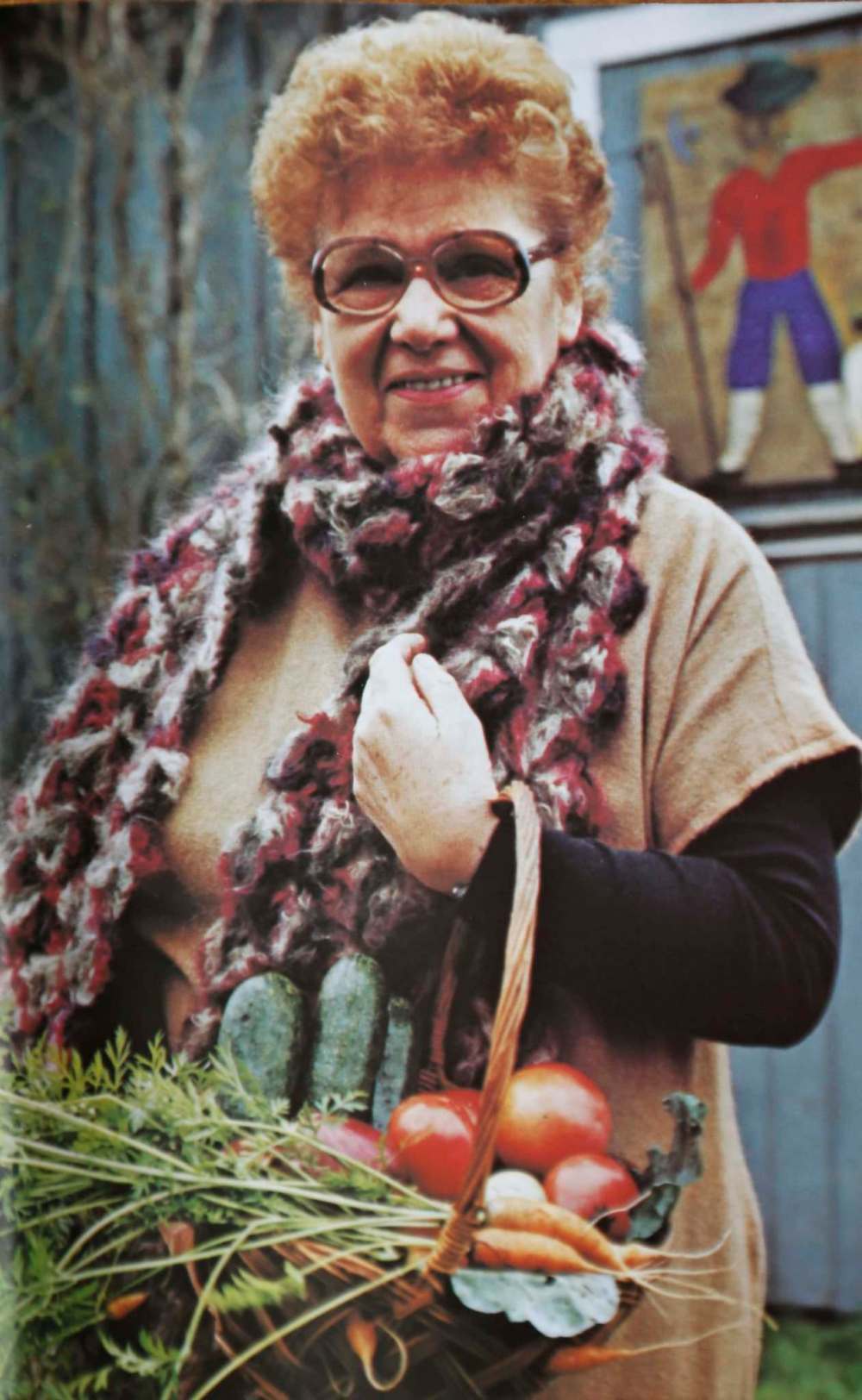
But I think it’s fair to say they all owe a debt to one quite brilliant woman: Madame Jehane Benoît, Cordon Bleu chef, restaurateur, cooking-school founder, author, radio and television broadcaster.
Benoît was born in Montreal. She lived her life right in the middle of our contemporary history, “bookended” by about three decades. She was born in 1904 — 37 years after Confederation — and died in 1987, 30 years before Canada 150. At the beginning of her life, most farmhouses still did not have electricity. Cars were just coming onto the market. Broadcast radio began in 1921 and she was on the air in 1943, at age 39.
Television had not yet been invented when she was born — although she would become one of the first television chefs, appearing on Radio Canada (and then on CBC’s Take 30) in 1952 at age 48, a good 11 years before America’s Julia Child on PBS.
When Benoît died, home computers were just starting to take off.
She saw great change out in the world — and in her kitchen — and she was always excited by it. She embraced kitchen technology and wrote one of the first microwave cookbooks. She was officially recognized for her many contributions in 1973, when she was made an Officer of the Order of Canada.
Benoît trained in France at the Cordon Bleu and she studied food chemistry under Dr. Edouard de Pomiane-Pozerski. She founded her cooking school, Fumet de la Vieille France, in Montreal. She opened the Salad Bar — a vegetarian restaurant — in 1935.
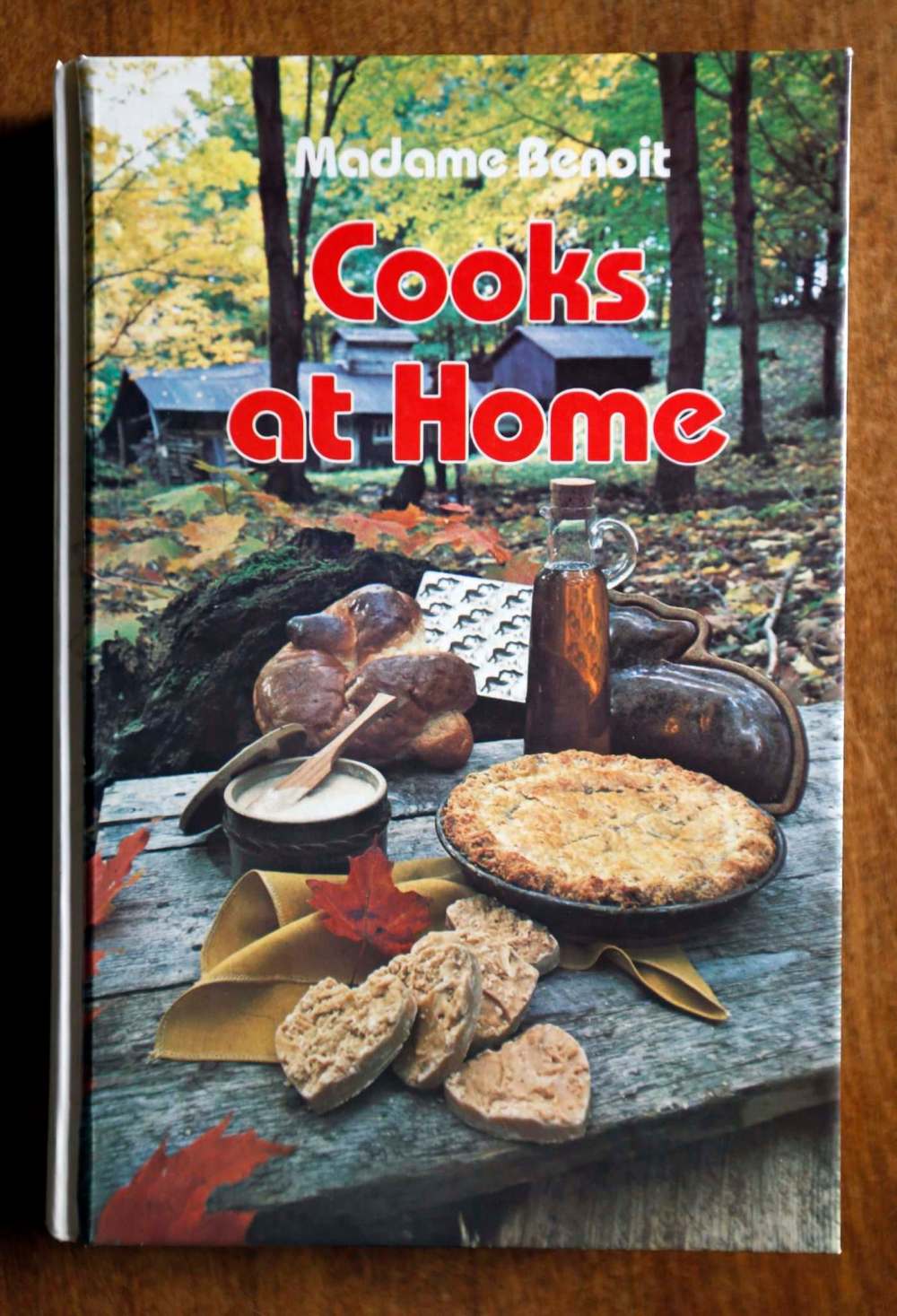
She was a collector of recipes and a writer of some 30 cookbooks, publishing Chocolate Around the Clock in 1941; is well-known for her bestseller Encyclopedia of Canadian Cooking; and finished with her last cookbook, Madame Benoît Cooks at Home, in 1987.
What made her books and broadcasts so important was Benoît’s interest and appeal beyond her home province. She was genuinely interested in what was available regionally.
Now we call it “eating locally,” but it was really Benoît who got the ball rolling. You can see it documented in The Canadiana Cookbook (1970) — neatly divided by province, including Yukon and Northwest Territories.
And that brings us back to the question of what is Canadian cuisine? In 1967, Pierre Berton — writing as a diner, not a cook — published The Centennial Food Guide. He struggled with the notion of a national dish, concluding that it made more sense to take a regional approach. That was something Madame Benoît did from the get-go. You can see it in a 1968 episode of Take 30 (watch it here: cbc.ca/archives/entry/cooking-with-clarkson), where she and Adrienne Clarkson — during her broadcasting career, before she became Canada’s Governor General — make a traditional Chinese duck in plum sauce. According to Clarkson, Canada has the best ingredients for Chinese cooking.
We are fortunate that we have so much to choose from that is indigenous to this country.
Maple syrup. Salmon. Twwrout. Corn. Beans. Pulses. Strawberries. Blueberries. Saskatoon berries. Wild greens and herbs. Birch syrup. Pickerel. Char. Venison. Duck. Duck. Goose.
Add wheat to the mix and suddenly you have bannock. Then add dairy and you get a plethora of cheeses. Throw in a world of spices and some pulses or legumes and get something new. Culinary adaptivity has always been the marker of Canadian cuisine. That’s what trade and immigration does.
We take two basic ingredients — say wheat flour and potato — add a few culturally-specific variations and make perogies, samosas, cornish pasties, potato pancakes or gnocchi. We’ll make those dishes out of what’s right here. And we’re not afraid to change them up. That’s important to those of us who cook.
Madame Benoît was important to me because (in spite of the fact I was just a kid) I do have some recollection of seeing her on TV.
It’s funny to watch some video clips of her online, to hear and recognize her voice. She was so charming, and I’m sure she was an absolute pistol in the kitchen.
Just watch the segment “Cooking expert Jehane Benoît whips up a buffet for 20 hungry men” . Here’s what she had to say about serving them:
“I don’t think you should ever make a buffet all cold or all hot because it’s too involved. You should also try to direct your guests in eating the warm dish first and not clutter their plates with everything and then when they are finished with the hot things, then go to the cold things and help themselves. I think it’s much nicer.
“And if you think they are not going to do it,” she says as she puts her hand on her hip, “just stand at the table and get them to do it.”
I remind you — this was a buffet for 20 hungry men (farmhands, no doubt — this was 1964). She wasn’t kidding around.
That’s the right attitude for a cook, whether at home or in a restaurant: cook with love, but be the boss.
Madame Benoît Cooks at Home is one of my favourite cookbooks. It is a very personal cookbook, detailing her life and the food she loved best. Reading it, you get a sense of the person she was and the joy she felt for life and for cooking for those she loved. Her prose feels familiar. You can almost hear her Québécois accent. Her recipes are old-fashioned and wholesome.
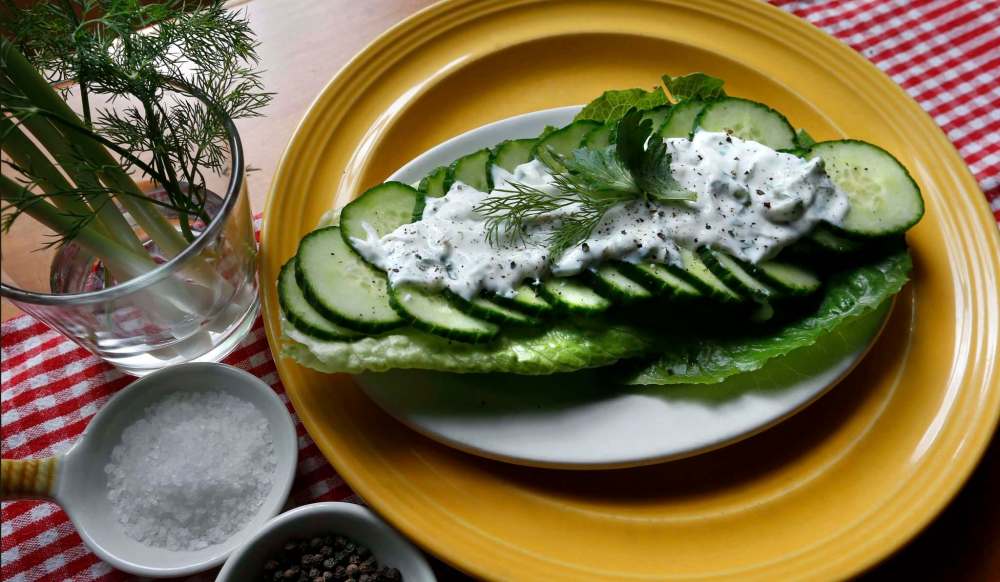
This recipe for a cucumber salad is adapted from that cookbook. It has dill, cucumber and sour cream, favourite flavours that appeal to my eastern European roots (transplanted here by immigrant grandparents). Mind you, you could swap out the dill and put a little curry in — kind of like an eastern European version of Indian raita.
What can I say? I am what I eat. I’m Canadian.
Twitter: @WendyKinginWpg