

Sticking to their Plan
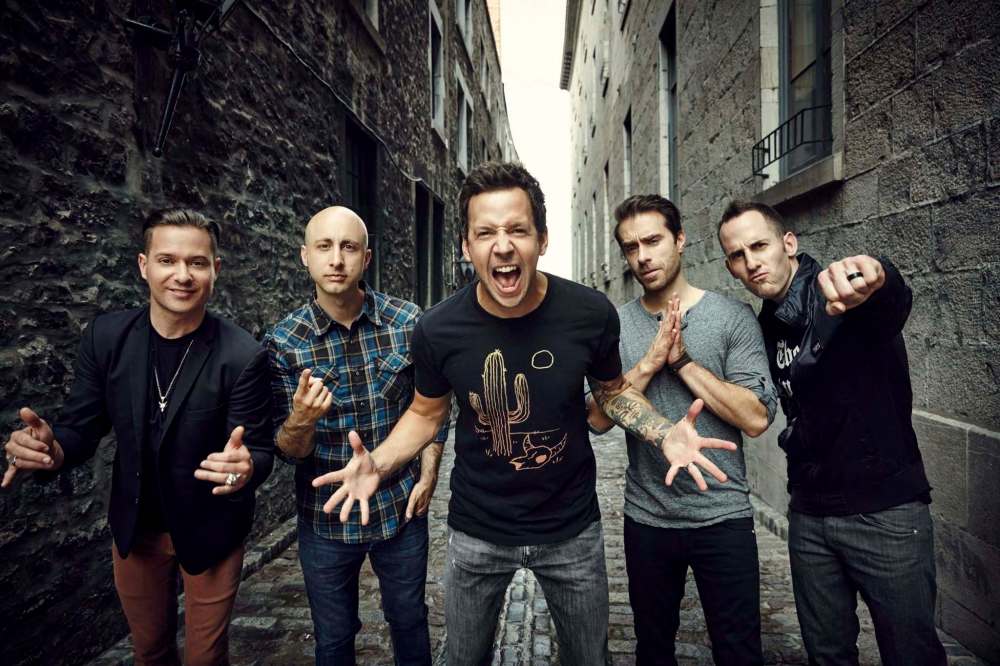
Montreal pop-punk band turns back the clock, embracing the past -- and their fans -- on tour celebrating hit-laden 15-year-old first album

Advertisement
Read this article for free:
or
Already have an account? Log in here »
To continue reading, please subscribe:
Monthly Digital Subscription
$1 per week for 24 weeks*
- Enjoy unlimited reading on winnipegfreepress.com
- Read the E-Edition, our digital replica newspaper
- Access News Break, our award-winning app
- Play interactive puzzles
*Billed as $4.00 plus GST every four weeks. After 24 weeks, price increases to the regular rate of $19.95 plus GST every four weeks. Offer available to new and qualified returning subscribers only. Cancel any time.
Monthly Digital Subscription
$4.99/week*
- Enjoy unlimited reading on winnipegfreepress.com
- Read the E-Edition, our digital replica newspaper
- Access News Break, our award-winning app
- Play interactive puzzles
*Billed as $19.95 plus GST every four weeks. Cancel any time.
To continue reading, please subscribe:
Add Free Press access to your Brandon Sun subscription for only an additional
$1 for the first 4 weeks*
- Enjoy unlimited reading on winnipegfreepress.com
- Read the E-Edition, our digital replica newspaper
- Access News Break, our award-winning app
- Play interactive puzzles
*Your next Brandon Sun subscription payment will increase by $1.00 and you will be charged $17.95 plus GST for four weeks. After four weeks, your payment will increase to $24.95 plus GST every four weeks.
Read unlimited articles for free today:
or
Already have an account? Log in here »
Hey there, time traveller!
This article was published 07/09/2017 (3167 days ago), so information in it may no longer be current.
Fifteen years ago, Montreal based five-piece Simple Plan dropped an album that changed their lives.
No Pads, No Helmets… Just Balls — their first of five records to date — was released in 2002 and fell right within the peak of pop-punk popularity that, at the time, was driven by bands such as Good Charlotte and Blink-182. Their timing could not have been better; the record went two-times platinum in Canada and spawned four smash singles: I’m Just a Kid, I’d Do Anything, Addicted and Perfect. They toured the world, they got to work with the best producers and they were — and still are — living the dream.
For many fans, Simple Plan played a formative role in their teenage musical education, so when the anniversary of the album’s release rolled around, the band felt like something had to be done to celebrate. What they hadn’t anticipated was the immense desire of those fans all over the globe to celebrate with them, turning their planned two-week tour into one that has spanned nearly a year and includes a stop at the Burton Cummings Theatre on Sept. 10.
Simple Plan guitarist Jeff Stinco connected with the Free Press last week to chat about how the band feels about that life-changing album and why it’s OK to embrace nostalgia.
Free Press: What’s it like to be Simple Plan in 2017 as opposed to Simple Plan in 2002?
Jeff Stinco: Well that’s interesting. Lots has changed you know? We’re dads now, we have a certain legacy to fall back on which we didn’t have back then.
We were kids kind of pushing our way through tours and hoping the songs would go somewhere. Now there’s a base, there’s a fan base that’s following us, it’s great to be looking back and taking the time to go back and celebrate those big moments of our career.
So I think if anything, what’s changed is now we have a little more experience, we’re not as crazy as we were back then, we have responsibilities so that changes it a lot as well.
But at the same time, it’s still all about the music, we’re still very ambitious guys, we’re still very hungry to visit more places and to tour. Lots has changed but at the same time the essence of the band has remained.
FP: When that first record came out, a lot of your fans were very young, maybe even too young, to go see your shows. How has your relationship changed with your fans over the years? Are you finding it’s the same group who has stuck by you the whole time or are you tapping into new markets?
JS: You know, I think you pointed out something very interesting; some of our fans back then, when we were on the TV and on the radio, were six, were five, were seven, were eight – they were too young to go to the shows, but they’re now 20 or 25, and they’re now coming to the shows and introducing us to their kids… and then you have people our age who are basically reliving those moments of their lives and you’ve got really young people who are exposed to the music through Spotify playlists or through YouTube, and that’s interesting.
It shows that there’s a renewal of what a fanbase is and at the same time it shows people are still sticking around and that record had an importance for people, it meant something, it was a big part of their youth. It’s interesting to see there’s definitely all these sides living together at the show.
FP: I feel like nostalgia sometimes has a bit of a negative connotation, but it’s interesting to me that you guys are so fully embracing that idea.
JS: Well you’re right, and the reality of it is nostalgia is often related to being a has-been, you know? I think that’s what people fear; people fear that their best years are behind them. And we had the same kind of fears. You always wonder if you start tapping into the nostalgia thing are you basically saying bye to the possibility of having new material that actually means something.
But I don’t think that’s the way it works… we’re in an era right now where people are throwing back Thursdays, people are celebrating openly.
And really, you’re only as relevant as the new music you put out, so I mean it’s not because we’re celebrating that anniversary that it prevents us from releasing new material, that’s not the case.
We will release new material and the new material, it’s always going to be an uphill battle because you’re not the new band anymore, you never will be again… After that the music has to talk, the music has to make its way into people’s lives and record players and it’s a challenge every time.
We’re looking forward to putting new music out and to try new things and to try to renew what Simple Plan is, but it doesn’t prevent us from saying that was a big moment in our career, it changed our lives.

FP: I read an interview the band did last year about making this record, and I never realized it was such a difficult process for you. Can you talk a bit about that?
JS: Absolutely. I think when we were younger we were kind of scared to talk about how difficult that record was for us to make. We didn’t want to insult the producer who had made it and I think it was sort of a mistake because he’s been interviewed, Arnold Lanni, who was the producer, he’s been interviewed recently around the celebration of this record and he says it openly, like, ‘Yep, that was a tough record to make. We both had different perspectives on what that record should be and I pushed those guys really hard.’
For me, as a guitar player, I really, really had a hard time. I must have re-recorded that record honestly, maybe 10 or 15 times, over and over, and I felt that the record was good. I never thought it was necessary to redo all those tracks… I was just out of musical school back then and I was at the peak of my technical ability and that music was pretty easy for me to play, but I didn’t realize it wasn’t about execution, it wasn’t about technical ability.
Arnold was pursuing something else, he was pursuing a melodic thing, he was pursuing an aesthetic, he was pursuing something a little different, and he really, really pushed my boundaries on that a record.
It was a great learning curve, but at the same time, when you’re in it, and you’re making a record for a full year in a Toronto in a warehouse where you’re living in bunk beds in a windowless room, it gets to your head, it’s easy to go crazy.
Arnold had a more poppy perspective for that record but we really wanted to establish ourselves in more pop-punk world and that record definitely comes out of that tension.
FP: What are you most proud of when it comes to Simple Plan?
JS: Well I’m most proud that we stayed friends over all these years. People assume that when you keep on touring as a unit, as a band, it means that you’re necessarily all getting along, which is not the case with most bands we tour with… we’re real friends and still get along really well.
We’re currently going through a challenge, our bass player is fighting depression and he decided to take some time for himself to get better, and he is getting better…
Now, through all those challenges we’re still together, we’re still sticking by each other.
This interview has been condensed and edited for length
Twitter: @NireRabel

Our newsroom depends on a growing audience of readers to power our journalism. If you are not a paid reader, please consider becoming a subscriber.
Our newsroom depends on its audience of readers to power our journalism. Thank you for your support.
Concert preview
Simple Plan
With Courage My Love, Selfish Things, & The Bottom Line
Sept. 10, 7 p.m.
Burton Cummings Theatre
Tickets range in price from $25-$45, available at Ticketmaster
Video
Our newsroom depends on a growing audience of readers to power our journalism. If you are not a paid reader, please consider becoming a subscriber.
Our newsroom depends on its audience of readers to power our journalism. Thank you for your support.
Advertisement Advertise With Us
Advertisement Advertise With Us