A few good men
About 100 Manitoba male subjects between 30 and 46 would make trail-blazing study even more accurate
Advertisement
Read this article for free:
or
Already have an account? Log in here »
To continue reading, please subscribe:

Digital Subscription
One year of digital access for only $205*
- Enjoy unlimited reading on winnipegfreepress.com
- Read the E-Edition, our digital replica newspaper
- Access News Break, our award-winning app
- Play interactive puzzles
*First annual payment billed as $205.00 + GST for one year. This annual subscription will automatically renew at $233.00 + GST every 52 weeks (10% off the regular annual price of $259.35). Offer available to new and qualified returning subscribers only. Cancel any time.
To continue reading, please subscribe:
Add Free Press access to your Brandon Sun subscription for only an additional
$1 for the first 4 weeks*
- Enjoy unlimited reading on winnipegfreepress.com
- Read the E-Edition, our digital replica newspaper
- Access News Break, our award-winning app
- Play interactive puzzles
*Your next Brandon Sun subscription payment will increase by $1.00 and you will be charged $17.95 plus GST for four weeks. After four weeks, your payment will increase to $24.95 plus GST every four weeks.
Read unlimited articles for free today:
or
Already have an account? Log in here »
Hey there, time traveller!
This article was published 16/04/2018 (3022 days ago), so information in it may no longer be current.
Only middle-aged men need apply.
In a world where this demographic is often over-represented — whether that’s in business, politics and finance — a team of some of Canada’s leading researchers are looking for about 100 men between the ages 30 to 46 for a ground-breaking, Manitoba-based health study. The Manitoba Personalized Lifestyle Research program — TMPLR for short — is an observational study examining how our sleep, diet, physical activity and other activities interact, along with additional factors like genetics and even the bacteria in our gut.
“It’s really about looking at the connection between lifestyle and disease risk,” says Dylan MacKay, a community health researcher focused on Type 2 diabetes.
It’s a rare examination of an understudied age group, he adds.
“There is a lot of good evidence that disease risk factors can start before you are born, but there is already a lot of coverage in research.”
Older age groups are also studied frequently.
Yet people between 30 and 46 haven’t had much focus, MacKay says. “And that’s when you really start to see the biomarkers and risk factors for chronic disease occur.”
Running for about two years,TMPLR is funded by Research Manitoba and has already attracted the majority of the 800 or so participants from across Manitoba it requires. But finding men has been challenging.
“We’re still looking to get those last 150 participants — all of them men,” says MacKay, an assistant professor in community health sciences at the University of Manitoba.
The lack of male participation is problematic, potentially holding up research.
That would be a shame, he adds, because TMPLR is an unprecedented scientific endeavour, bringing together so many different data points regarding lifestyle as well as blood sugar, cholesterol, blood pressure and bone density — to name a few.
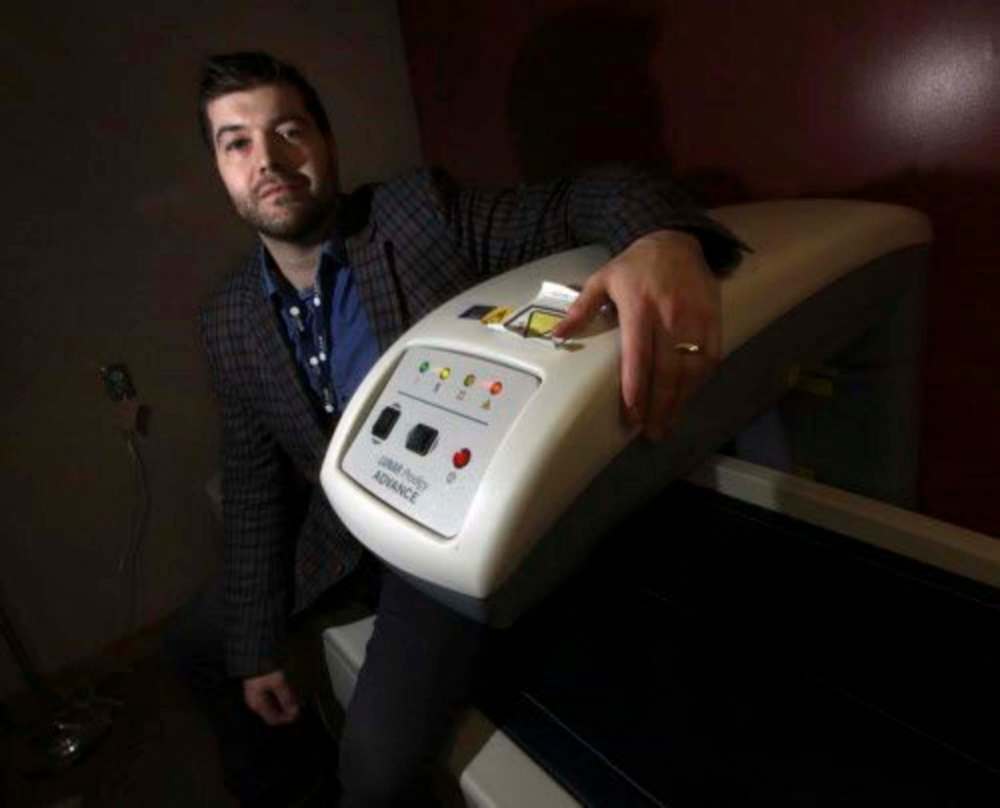
Participants spend about two hours on two consecutive days at the Richardson Centre for Functional Foods and Nutraceuticals at the U of M, where they give blood and undergo several tests including some they’re unlikely to access to through a family doctor. These include a dual energy X-ray absorptiometry — or DXA scan — which measures bone, muscle and fat composition. Participants also receive a pulse-wave analysis, measuring the health of large and small blood vessels.
As well, they find out how their cardiovascular fitness measures up with a sub-maximal cardiorespiratory fitness test. This involves riding a stationary bike while wearing an oxygen mask to monitor breathing. It helps determine aerobic capability without breaking (much of) a sweat.
In short, if you’re curious about your health, this study is for you, says Peter Jones, senior director for TMPLR.
Of course, at this juncture, it’s middle-aged men researchers want.
“We want to have as fulsome a data set as possible, so the 13 investigators can do a deep dive and conduct the sub-analyses as they wish, but the data must be robust enough to help them answer their questions,” Jones says, explaining the need for more male subjects.
Most importantly, the health information gathered has the potential to lead to trail-blazing research, he adds. In large part that’s because the researchers looking forward to analyzing the data are a who’s who among Manitoba’s top health scientists. Among them are TMPLR’s junior director Meghan Azad — a world-renowned researcher on asthma, obesity and allergies — and Dr. Navdeep Tangri — who developed the gold standard for calculating kidney-failure risk.
For all scientists involved, TMPLR is a mother-lode of health information.
“It’s pretty difficult to have a data-set like this from a large group of people, where everything is measured under controlled circumstances,” says Jones, a Canada Research Chair in Functional Foods and Nutrition.
For Jones, whose research focuses on how lifestyle and other factors influence cholesterol, the study is a rare chance to examine the fat composition of hundreds of people and how it may affect cholesterol.
“My inkling is people who are overweight — particularly if that weight is above the beltline — will be those who manufacture more cholesterol than they need.”
Another area of his work involves a potential link between cholesterol and how much formula individuals were fed as babies.
Jones says formula has very little cholesterol, and some research indicates the body manufactures more of it to compensate. Additional studies have suggested this could lead to individuals producing too much as adults. Jones says TMPLR should shed more light on the issue, hopefully, establishing more clearly if a link exists or not.
Other researchers are interested in the activity and fitness data, including Todd Duhamel, a professor at the Faculty of Kinesiology and Recreation Management at the U of M.
“A lot of the work we’re focused on involves patterns of activity, sedentary behaviour and physical fitness.”
Increasingly, research indicates sitting too much is a health hazard. In fact, it may even cancel out the benefits of regular exercise, he says. Of special interest is the TMPLR data collected from an activity monitor each participant wears for a week.
“We have 15 data points per second we’re collecting,” Duhamel says.
From that, researchers can determine how much and how fast participants move, and even how long and well they sleep.
Despite the wealth of health information already collected, without adequate ‘man-data’ the study will be incomplete, MacKay says.
“Biologically, men and women are quite different and so we want to make sure we have balance.”
He adds social norms around gender also affect health, pointing to men generally being diagnosed with Type 2 diabetes later than women because males typically do not see a family doctor as often.
MacKay says for this reason it’s not uncommon for men to find out they have diabetes only after they suffer a heart attack or stroke.
“So they’ve already progressed onto a worse health condition because they haven’t been screened for chronic disease.”
TMPLR, he adds, would help illustrate what’s going on with blood-glucose levels and other diabetes risk factors in the modern, Manitoba male.
More broadly, a lack of gender parity in the study could skew data, preventing researchers from uncovering meaningful differences among women’s and men’s health, leading to breakthroughs.

“That’s the dream of everybody on the TMPLR team — that we do health research that improves people’s lives and helps prevent or treat disease in the future,” Mackay says.
“That’s certainly why I do what I do.”
joelschles@gmail.com
History
Updated on Monday, April 16, 2018 8:09 AM CDT: Adds photo
Updated on Tuesday, April 17, 2018 8:38 AM CDT: Adds that TMPLR is funded by Research Manitoba