

Maniac a trippy, meta take on loneliness
Advertisement
Read this article for free:
or
Already have an account? Log in here »
To continue reading, please subscribe:
Monthly Digital Subscription
$1 per week for 24 weeks*
- Enjoy unlimited reading on winnipegfreepress.com
- Read the E-Edition, our digital replica newspaper
- Access News Break, our award-winning app
- Play interactive puzzles
*Billed as $4.00 plus GST every four weeks. After 24 weeks, price increases to the regular rate of $19.95 plus GST every four weeks. Offer available to new and qualified returning subscribers only. Cancel any time.
Monthly Digital Subscription
$4.99/week*
- Enjoy unlimited reading on winnipegfreepress.com
- Read the E-Edition, our digital replica newspaper
- Access News Break, our award-winning app
- Play interactive puzzles
*Billed as $19.95 plus GST every four weeks. Cancel any time.
To continue reading, please subscribe:
Add Free Press access to your Brandon Sun subscription for only an additional
$1 for the first 4 weeks*
*Your next subscription payment will increase by $1.00 and you will be charged $16.99 plus GST for four weeks. After four weeks, your payment will increase to $23.99 plus GST every four weeks.
Read unlimited articles for free today:
or
Already have an account? Log in here »
Hey there, time traveller!
This article was published 29/09/2018 (2754 days ago), so information in it may no longer be current.
It may be a 10-episode limited series, but Maniac is a whole lot of manic, trippy meta-television. This new Netflix offering, adapted from a Norwegian show of the same name, is both entertaining and totally exasperating, its pile-up of plotting hijinks, tonal ping pong and visual fireworks almost burying its rather poignant look at the suffering human mind.
In Maniac’s press of too-muchness, there’s a Cold War sci-fi farce and an elegant period caper. There’s a drunken elf who seems peeved to have landed in a Lord of the Rings knock-off. There’s even a 1980s Long Island lemur heist. At this point, it just sounds like the scripters were playing Mad Lib.
There are deliberately bad wigs (Justin Theroux’s looks like it might get up and walk away), intentionally bad accents (at one point, Jonah Hill is speaking with Austrian-Finnish-Swedish-Dutch-Italian-Icelandic inflections) and many hokey jokes.
Despite all this complicated kookiness, the core story is surprisingly simple. In a gonzo version of New York City that feels like 2020 by way of 1976, Annie (Emma Stone) is dealing with a traumatic loss and a strange psychotropic addiction. Owen (Hill), the misfit son of a wealthy dynasty, wanders through life, lost, sad and hallucinating that he has been called on to save the world.
Owen and Annie enter an experimental pharmaceutical trial that requires them to ingest three pills in three days. The study is run by the chain-smoking Dr. Azumi Fujita (Sonoya Mizuno) and the comically monikered Dr. Mantleray (Theroux), who believe this regimen will not only cure mental illness but ultimately eliminate all human unhappiness. During the process, the patients enter into dream-like trances in which they re-enact their traumas, identify their defense mechanisms and confront and vanquish their primal pain. Their progress is monitored by a super-computer named GRTA, whose dawning self-awareness is swiftly followed by a crippling cyber-depression, at which point everything goes absolutely haywire.
Conveniently, Annie and Owen’s mindscapes just happen to resemble popular movie genres with very high production values. In this way, director Cary Joji Fukunaga (who brought his visual flair to True Detective’s first season) and co-scripter Patrick Somerville (who honed his surrealism on The Leftovers) get to make several elaborate mini-movies. Annie and Owen cycle through ultra-violent gangster grit, soaring epic fantasy, paranoid espionage and a ritzy 1940s country-house party, sometimes parting but always finding each other again.
Meanwhile, the world they physically inhabit is kind of like ours but also just a bit off. Surveillance technology is highly advanced, but the décor has a plastic-fantastic 1970s feel, and the stylistic riffs range from Blade Runner and Kubrick to bad ‘80s music videos and 8-bit games.
The predominant vibe is one of atomized isolation and alienation. Owen lives in an anti-social micro-apartment, while Annie’s father has retreated into a literal isolation tank called an A-Void. Dr. Mantleray has sex only with an unwieldy virtual-reality contraption, while Dr. Fujita has barely left the pharmaceutical company’s headquarters in years. She sleeps in a padded drawer near the computer.
To compensate, people resort to commercialized intimacy. Friend Proxies will hang out with you for a fee. AdBuddies will pay for your coffee or subway fare if you’re willing to put up with a person following you around and reading ads aloud. Maybe the creepiest service is Daddy’s Home, which encourages solitary men to insert themselves into a family grieving the loss of a husband and father.
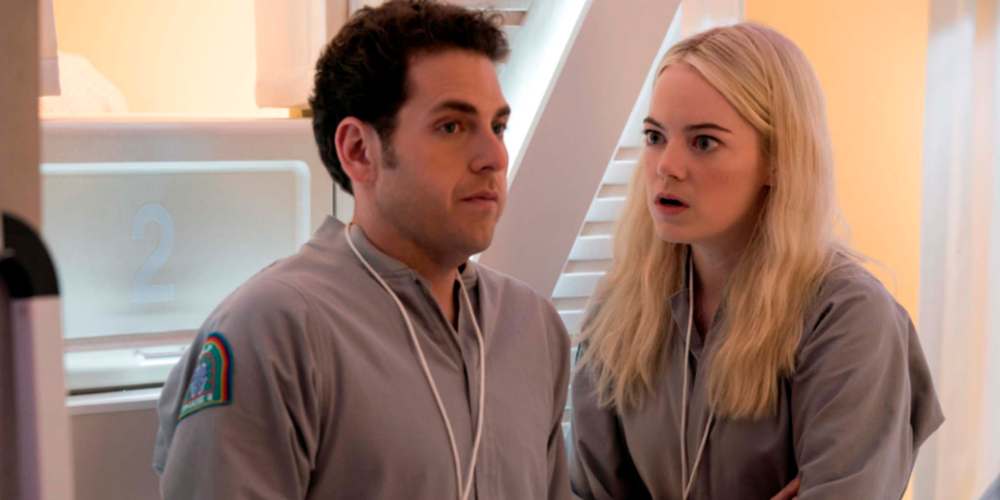
Though Maniac comes perilously close to Hollywood’s perpetual romanticization of mental illness, the series is not really concerned with its individual characters’ psychiatric labels but with diagnosing our culture as a whole. Even as their adventures get wackier and wackier, Annie and Owen embody the very real loneliness that pervades 21st-century society.
This lovely little human story, about the need for meaning and connection, comes through intermittently. Hill, as with many actors known first for comedy, strains too hard for dramatic power and sometimes falters, but Stone, who can be emotionally grounded while sarcastically enduring elf ears and a fake Middle Earth accent, is Maniac’s broken, beating heart.
The series begins with a very clear message. “Camaraderie, communion, family, friendship, love, what have you,” Dr. Mantleray intones. “We’re lost without connection.” Unfortunately, that poignant message is often lost beneath Fukunaga and Somerville’s aggressively whimsical quirk fest.