

A tough and tender tale
PTE's How It Ends uses unconventional methods to talk about end-of-life choices

Advertisement
Read this article for free:
or
Already have an account? Log in here »
To continue reading, please subscribe:
Monthly Digital Subscription
$1 per week for 24 weeks*
- Enjoy unlimited reading on winnipegfreepress.com
- Read the E-Edition, our digital replica newspaper
- Access News Break, our award-winning app
- Play interactive puzzles
*Billed as $4.00 plus GST every four weeks. After 24 weeks, price increases to the regular rate of $19.95 plus GST every four weeks. Offer available to new and qualified returning subscribers only. Cancel any time.
Monthly Digital Subscription
$4.99/week*
- Enjoy unlimited reading on winnipegfreepress.com
- Read the E-Edition, our digital replica newspaper
- Access News Break, our award-winning app
- Play interactive puzzles
*Billed as $19.95 plus GST every four weeks. Cancel any time.
To continue reading, please subscribe:
Add Free Press access to your Brandon Sun subscription for only an additional
$1 for the first 4 weeks*
*Your next subscription payment will increase by $1.00 and you will be charged $16.99 plus GST for four weeks. After four weeks, your payment will increase to $23.99 plus GST every four weeks.
Read unlimited articles for free today:
or
Already have an account? Log in here »
Hey there, time traveller!
This article was published 20/04/2019 (2541 days ago), so information in it may no longer be current.
It’s very difficult to talk about How It Ends. Not because decisions surrounding death are a divisive issue or because thinking about our own mortality is unpleasant, but because to reveal too much about the performance would be to rob it of its surprising, unsettling power.
Winnipeg playwright/actor Debbie Patterson formed Sick + Twisted Theatre company to create and present work that explores living with a disability. With How It Ends — the final instalment in Prairie Theatre Exchange’s (PTE) Leap Series, dedicated to more experimental theatre — she has crafted a tough and tender work that veers from thoughtful to devastating to goofy without losing a step.
The play — an immersive promenade experience that moves to several venues within the PTE space — opens in the Colin Jackson Studio. A brother (Andrew Cecon) and sister (Johanna Riley) are fishing in a rowboat on an idyllic lake. Their loving sibling banter might seem a tad morbid — they quote Samuel Beckett and Elisabeth Kübler-Ross at each other — but they’re in the twilight of their lives and the end looms large.
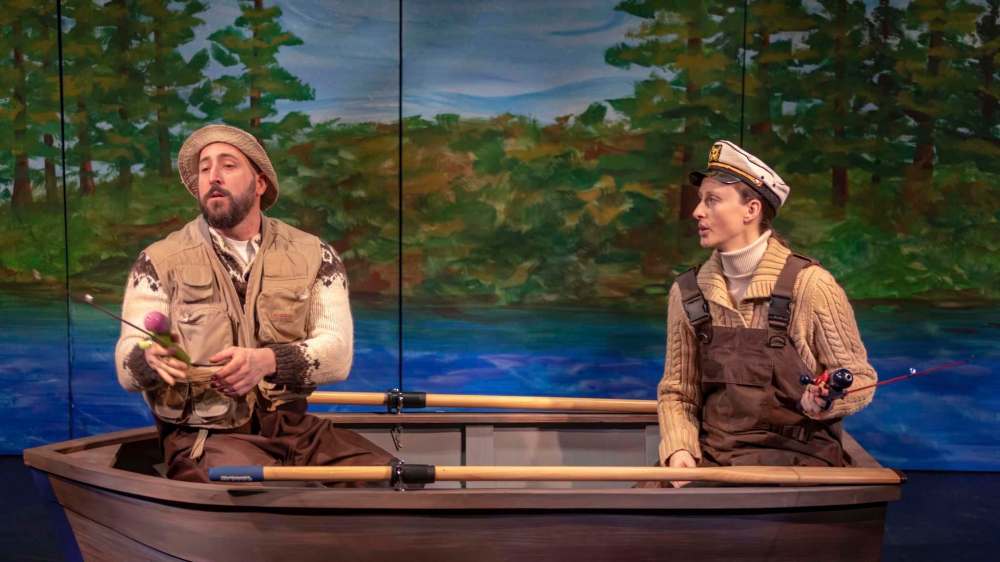
Their mother’s death comes up several times; it’s evident she chose to end her life in a way they don’t necessarily agree on. The daughter has spent her life working in palliative care, seemingly in reaction to her mother’s choice.
After a bolt of lightning, audience members are led out of their seats and on a journey through the backstage area, ending up in a softly lit white chamber, seated in a circle.
Clad in a white suit, playwright Patterson appears as a jovial but kind of pushy angel, clanking, ungraceful golden wings attached to her wheelchair. After pointing out that we are all on borrowed time, she encourages the audience to think about how they’d want to go: quickly, without pain or enduring some suffering to get the gift of more time.
Patterson’s broad smile and cajoling tone soften the hard questions she’s asking and mitigate the discomfort we feel when addressing our own biases about what makes life worth living and what circumstances are a bridge too far.
The playwright isn’t afraid to use her disability to remind us we are all only temporarily able-bodied. She challenges the notion that what’s broken should be thrown away and asks us to think about “What makes you, you?”
The decision to stage the action unconventionally and in the round is a canny one. The actors, who incorporate dance as they move about to address all portions of the audience, are looking you right in the eye — often with real people’s words in their mouths — so their messages, which are sometimes at odds, never feel didactic. It makes the audience part of a conversation, rather than an argument, and each actor is so empathetic, the audience is drawn in.
Toronto-based dancer Marie-Josée Chartier plays the mother who chose to end her life with the help of Dignitas, the Swiss non-profit that advocates and offers supports for improving care and choice about the end of life. She is a lovely presence, exuding quiet confidence and calm.
Cecon and Riley, as siblings who took away different things from watching their mother die, both strike a perfect balance between ruefulness and humour.

There are a couple of instances where the dialogue feels more clunky and obvious than artful, but Patterson’s script, which makes use of verbatim interviews she did with a variety of people about end-of-life issues, gracefully addresses ideas of agency and control, of surrendering without giving up.
If this sounds maudlin, it’s anything but. To be sure, there are scenes that are certain to inspire tears, both because of what’s happening onstage and because of our own inescapable connections to death, but How It Ends approaches its big questions with such playfulness and warmth, and such cleverness and ingenuity in its staging, that its final impression is one of uplift and peace.
No matter what your opinions on end-of-life choices, How It Ends feels like a gift, reminding us that life is always ending, but it’s not over yet.
jill.wilson@freepress.mb.ca
Twitter: @dedaumier
Jill Wilson is the editor of the Arts & Life section. A born and bred Winnipegger, she graduated from the University of Winnipeg and worked at Stylus magazine, the Winnipeg Sun and Uptown before joining the Free Press in 2003. Read more about Jill.
Jill oversees the team that publishes news and analysis about art, entertainment and culture in Manitoba. It’s part of the Free Press‘s tradition, since 1872, of producing reliable independent journalism. Read more about Free Press’s history and mandate, and learn how our newsroom operates.
Our newsroom depends on a growing audience of readers to power our journalism. If you are not a paid reader, please consider becoming a subscriber.
Our newsroom depends on its audience of readers to power our journalism. Thank you for your support.
Theatre review
How It Ends
Prairie Theatre Exchange’s Leap Series
● To April 28
● Tickets at pte.mb.ca
★★★★1/2 out of five
Jill Wilson is the editor of the Arts & Life section. A born and bred Winnipegger, she graduated from the University of Winnipeg and worked at Stylus magazine, the Winnipeg Sun and Uptown before joining the Free Press in 2003. Read more about Jill.
Jill oversees the team that publishes news and analysis about art, entertainment and culture in Manitoba. It’s part of the Free Press‘s tradition, since 1872, of producing reliable independent journalism. Read more about Free Press’s history and mandate, and learn how our newsroom operates.
Our newsroom depends on a growing audience of readers to power our journalism. If you are not a paid reader, please consider becoming a subscriber.
Our newsroom depends on its audience of readers to power our journalism. Thank you for your support.
Advertisement Advertise With Us
Advertisement Advertise With Us