Bizarre social-science experiment makes waves
Documentary profiles stranger-than-fiction seafaring saga

Advertisement
Read this article for free:
or
Already have an account? Log in here »
To continue reading, please subscribe:

Digital Subscription
One year of digital access for only $205*
- Enjoy unlimited reading on winnipegfreepress.com
- Read the E-Edition, our digital replica newspaper
- Access News Break, our award-winning app
- Play interactive puzzles
*First annual payment billed as $205.00 + GST for one year. This annual subscription will automatically renew at $233.00 + GST every 52 weeks (10% off the regular annual price of $259.35). Offer available to new and qualified returning subscribers only. Cancel any time.
To continue reading, please subscribe:
Add Free Press access to your Brandon Sun subscription for only an additional
$1 for the first 4 weeks*
- Enjoy unlimited reading on winnipegfreepress.com
- Read the E-Edition, our digital replica newspaper
- Access News Break, our award-winning app
- Play interactive puzzles
*Your next Brandon Sun subscription payment will increase by $1.00 and you will be charged $17.95 plus GST for four weeks. After four weeks, your payment will increase to $24.95 plus GST every four weeks.
Read unlimited articles for free today:
or
Already have an account? Log in here »
Hey there, time traveller!
This article was published 09/08/2019 (2568 days ago), so information in it may no longer be current.
In this weird and wild film, an anthropologist who has just attended a conference on the roots of violence is flying home. His plane is hijacked by terrorists.
The scripting seems a bit obvious, right? A little on the nose?
Except The Raft is a documentary, and that initial hostage-taking incident is just the first improbable installment in a stranger-than-fiction saga. Packed with nutty true-life drama and some sly satirical comedy, this hybrid doc from Swedish artist and filmmaker Marcus Lindeen (Regretters) plays up the implausibility of its bizarro fact-based tale.
The hijacked anthropologist is the Spanish-born, Mexico-based Santiago Genoves, who in 1973 comes up with a social-science experiment even the most morally depraved reality TV producer would think twice about. He decides to take 10 people from different cultures, races, religions and social backgrounds and put them on a small raft drifting across the Atlantic Ocean.
He will be there, too, observing. The raft, called the Acali, has no motor, only intermittent radio contact with the wider world, and there are no following boats. The one trained sailor on board is the Swedish captain, Maria Bjornstam. In a tight space with no possibility of escape and a constant threat of disaster, Genoves believes he will gain intimate insight into what makes human beings violent.
“I believe that in a dangerous situation people will act on their instincts, and I will be able to study them,” he writes.
What could go wrong?
The journey starts with a cinematic hook. Just as the raft is being towed out to catch the ocean currents, Bjornstam’s boyfriend makes radio contact. Has she actually read the paperwork? he asks. She has signed a slave contract that demands she hand herself over, mind and body, to Genoves, he insists. She is risking death.
It’s like a last-minute warning out of a B-grade horror movie, and like a movie character, Bjornstam ignores it.
Lindeen uses archival footage and excerpts from Genoves’s written accounts (read by an actor) intercut by present-day interviews with the rafters who are still alive. He has also constructed a life-size plywood replica of the Acali, encouraging his subjects — who are now in their 70s — to tell stories and sometimes even act out their experiences.
It’s a strange, stylized set-up that travels some of the same conceptual ground as Joshua Oppenheimer’s The Act of Killing.

The intervening decades have made it clear how unethical Genoves’s work was. It’s no coincidence that the 1961 Milgram experiment and the Stanford Prison Experiment of 1971 have also been subjects of recent films.
The gap between what Genoves tells himself he’s doing and what he’s actually doing is fascinating. He claims to be serving the ideals of peace, but his motives seem darker and more personal. Once the raft is at sea, a veneer of sketchy science can’t quite cover the man’s growing God complex.
Perhaps Genoves’s greatest delusion is that he is outside the experiment, when he’s perhaps the most volatile subject of all.
He gives the crew weekly questionnaires. (Sample query: “If you could get rid of one person on the raft, who would that be?”) He puts the women in charge, not because he’s progressive, but because he hopes the upended power structure will incite violence among the men.
He also tries to use sex to stir up jealousy, shame and conflict.
“I have selected participants who are sexually attractive, and placed among them a Catholic priest,” he explains.
The tabloid media picked up this vibe and started calling the Acali “the love raft” — though as the matter-of-fact Israeli doctor suggests, the boat’s cramped setup made it hard to have sex. (Maybe the two people on night watch could manage, she recalls, but you had to be quick and “keep one hand for steering.”)

All the while, Genoves’s paranoia, his need for power and control, and his use of what one rafter calls “Gestapo tactics” increase.
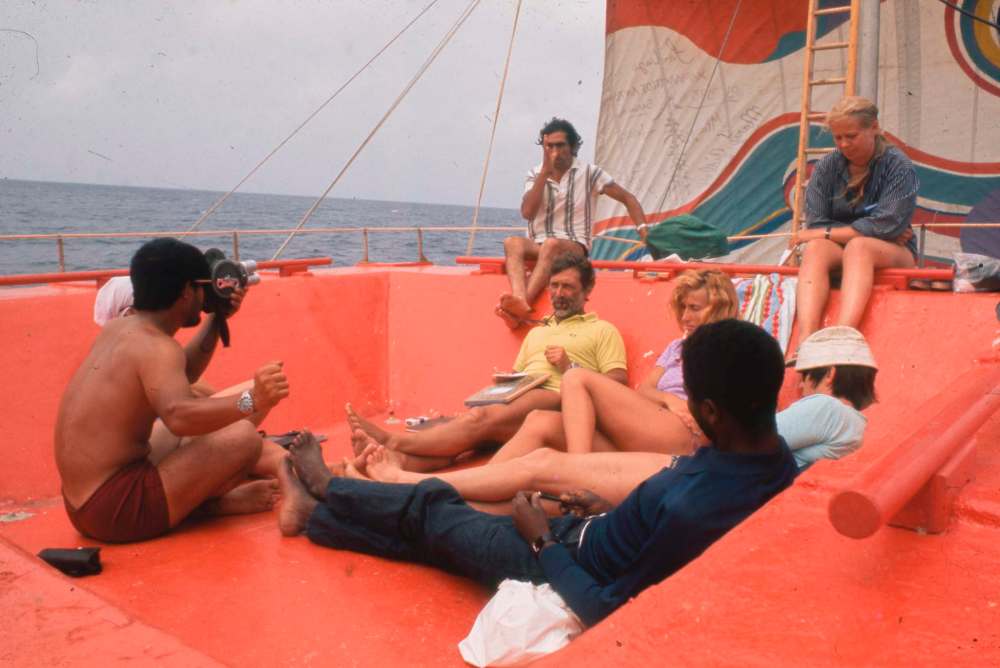
There are some crazy plot twists. At times, The Raft feels like The Caine Mutiny crossed with Love Island crossed with a summer stock production of Hair.
But along with its occasionally lurid entertainment value, the documentary offers some serious and timely observations about the human potential for violence, as well our capacity for compassion and collaboration. The survivors are mostly women, which allows for a retroactive feminist take on the whole Acali experience.
It turns out something important was revealed on the raft, just not what Genoves expected.
“His experiment was actually a success,” one woman recalls. “But he missed it.”
Studying at the University of Winnipeg and later Toronto’s York University, Alison Gillmor planned to become an art historian. She ended up catching the journalism bug when she started as visual arts reviewer at the Winnipeg Free Press in 1992.
Our newsroom depends on a growing audience of readers to power our journalism. If you are not a paid reader, please consider becoming a subscriber.
Our newsroom depends on its audience of readers to power our journalism. Thank you for your support.
MOVIE REVIEW
The Raft
Starring Santiago Genoves and Maria Bjornstam
● Subject to rating classification
● 97 minutes
★★★★ out of five star
Other voices
Blinded by his ego, acting like the captain of the Bounty, Genoves apparently never realized the experiment was valuable and was yielding interesting if surprising results.
— Richard Roeper, Chicago Sun-Times
Favoured with copious amounts of footage shot during the voyage, as well as Genoves’ collected data and writings, Lindeen forged a riveting and illuminating study of the unscrupulous endeavour.
— Carlos Aguilar, Los Angeles Times
This is such a uniquely bizarre story that it can’t help but exert a certain fascination. But it’s hard to avoid the feeling that it would have been better served by a compelling dramatization rather than this too-dry documentary.
— Frank Scheck, Hollywood Reporter
A document, as well as a documentary, of genuine consequence. The news is surprising, and pretty darned good.
— Joe Morgenstern, Wall Street Journal
Studying at the University of Winnipeg and later Toronto’s York University, Alison Gillmor planned to become an art historian. She ended up catching the journalism bug when she started as visual arts reviewer at the Winnipeg Free Press in 1992.
Our newsroom depends on a growing audience of readers to power our journalism. If you are not a paid reader, please consider becoming a subscriber.
Our newsroom depends on its audience of readers to power our journalism. Thank you for your support.
Advertisement Advertise With Us
Advertisement Advertise With Us