

Basket case
Ben Affleck's portrayal of alcoholic coach a technical foul in otherwise affecting sports drama

Advertisement
Read this article for free:
or
Already have an account? Log in here »
To continue reading, please subscribe:
Monthly Digital Subscription
$1 per week for 24 weeks*
- Enjoy unlimited reading on winnipegfreepress.com
- Read the E-Edition, our digital replica newspaper
- Access News Break, our award-winning app
- Play interactive puzzles
*Billed as $4.00 plus GST every four weeks. After 24 weeks, price increases to the regular rate of $19.95 plus GST every four weeks. Offer available to new and qualified returning subscribers only. Cancel any time.
Monthly Digital Subscription
$4.99/week*
- Enjoy unlimited reading on winnipegfreepress.com
- Read the E-Edition, our digital replica newspaper
- Access News Break, our award-winning app
- Play interactive puzzles
*Billed as $19.95 plus GST every four weeks. Cancel any time.
To continue reading, please subscribe:
Add Free Press access to your Brandon Sun subscription for only an additional
$1 for the first 4 weeks*
*Your next subscription payment will increase by $1.00 and you will be charged $16.99 plus GST for four weeks. After four weeks, your payment will increase to $23.99 plus GST every four weeks.
Read unlimited articles for free today:
or
Already have an account? Log in here »
Hey there, time traveller!
This article was published 07/03/2020 (2196 days ago), so information in it may no longer be current.
The most cynical view of the sports drama The Way Back is that it is kind of a contemporary version of the 1986 film Hoosiers with Ben Affleck an amalgam of both Gene Hackman’s tough-as-nails basketball coach and Dennis Hopper’s wretched alcoholic assistant coach.
Affleck is Jack Cunningham, a basketball phenom when he attended Bishop Hayes Catholic High School in his youth, now a shell of a man, drinking on the sly at his construction job, and drinking without constraints when he’s off the clock.
The film establishes Jack’s alcoholic regimen in a few elegant scenes. Eventually, Jack is obliged to interact with family members, concerned with his downward spiral, including his sister Beth (Michaela Watkins) and his estranged wife, Angela (Janina Gavankar).
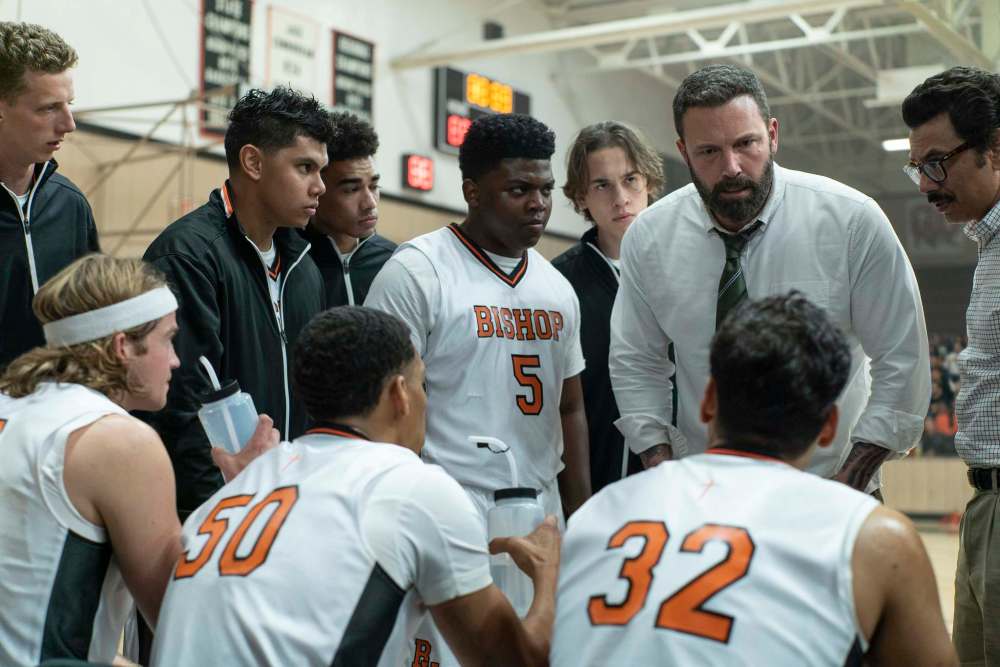
The promise of salvation is offered, not inappropriately, by the aptly named elderly priest Father Edward Devine (John Aylward). The coach of Jack’s old team, the Bishop Hayes Tigers, has had a heart attack. The good father asks Jack to step into in the coaching role. Despite his best drunken efforts, Jack can’t come up with a reason to say no.
Director Gavin O’Connor is a filmmaker who has demonstrated an ability to find a powerful emotional core to films that, in lesser hands, would succumb to big action tropes, such as his oddball 2016 assassin movie The Accountant, also starring Affleck, or his unexpectedly satisfying 2011 family drama Warrior, set against a backdrop of mixed martial arts.
Both those films were about men with father issues, and this film, written by Brad Inglesby, stays that course, revealing after a while that Jack turned his back on a promising basketball career as revenge on a dad who withheld his love.
Ironically, being a coach forces him to act as a paternal figure to this inevitably ragtag team of youths he eventually sculpts into formidable competitors, à la Hoosiers.
The film’s novelty is in its slow, slow reveal of what broke Jack in the first place. It’s a melodramatic dance of a thousand veils, as Jack’s defences are whittled down.
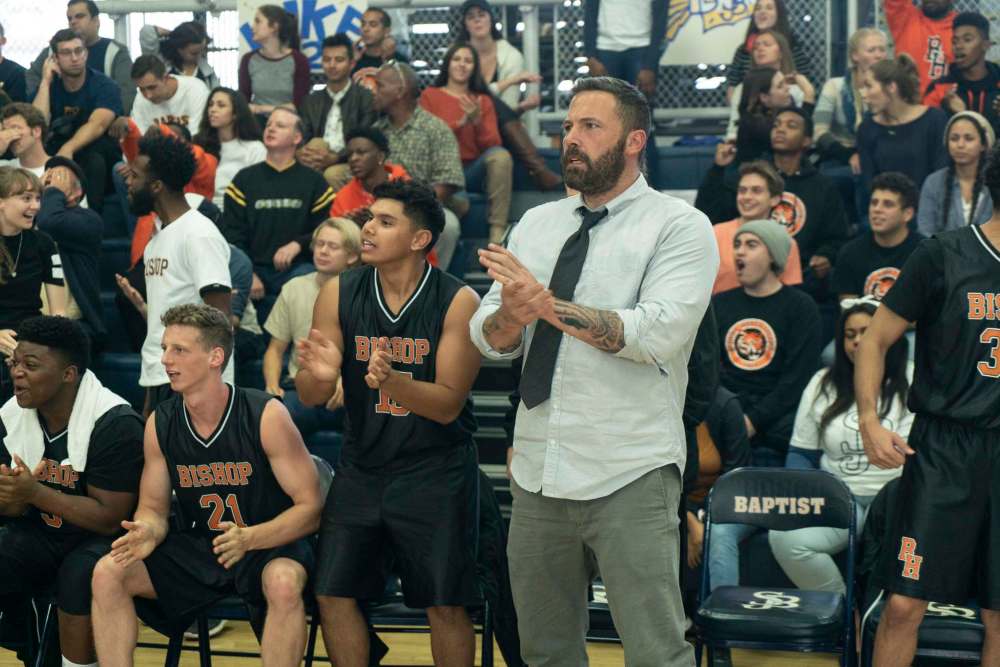
It’s not ineffective: One scene in particular in a hospital is staged for maximum wrench by O’Connor, a director who wisely casts comedic actors — including Watkins, ex of Saturday Night Live and currently on CBS sitcom The Unicorn, and Daily Show vet Al Madrigal as an out-of-his-league assistant coach — in solid dramatic roles.
If the film fails to dunk when it comes to dramatic impact, it’s mostly due to Affleck himself. While the actor admirably took the role in the wake of copping to his own alcoholism, there is a persistent disconnect about him that simply defies audience identification. (Ironically, O’Connor exploited that quality in The Accountant, in which Affleck’s obsessive-compulsive killer was on the autism spectrum, resulting in arguably his best work.)
Even a brutal back-story is not enough get viewers on Affleck’s side.

Expect a more seasoned moviegoer to exit the theatre thinking one of two things:
Damn, I miss Gene Hackman.

Damn, I miss Dennis Hopper.
randall.king@freepress.mb.ca
Twitter: @FreepKing
Our newsroom depends on a growing audience of readers to power our journalism. If you are not a paid reader, please consider becoming a subscriber.
Our newsroom depends on its audience of readers to power our journalism. Thank you for your support.
MOVIE REVIEW
The Way Back
Starring Ben Affleck
● Grant Park, Polo Park, St. Vital
● 14A
● 109 minutes
★★★ out of five
Other voices
I couldn’t help but notice the goosebumps covering my arms when the music swelled.
— Shella O’Malley, RogerEbert.com
In The Way Back, you believe the idea of what Jack Gallagher is because you believe the man who plays him, Ben Affleck.
— G. Allen Johnson, San Francisco Chronicle
Clichéd as it is, The Way Back is not a mawkish picture. Rather, it’s notable for the quiet dignity that O’Connor and Affleck bring to the proceedings.
— Soren Anderson, Seattle Times
Aside from Affleck’s quietly convincing performance, The Way Back offers nothing to make it stand out in a crowded field of underdog sports movies.
— Rafer Guzman, Newsday
Ben Affleck is still portraying a version of the Tortured Good Guy with a Past, but he exposes his vulnerabilities in ways that audiences have rarely seen.
— Mara Reinstein, Us Weekly
Affleck carries the film well on his larger-than-usual shoulders, capably showing all sides of a down-on-his-luck alcoholic — the funny, the sweet, the explosive and the self-destructive
— Lindsey Bahr, The Associated Press
It’s a reminder that the most trite material — in this case, getting a second chance at making good — can be powerful when handled honestly.
— Charles Bramesco, AV Club
Our newsroom depends on a growing audience of readers to power our journalism. If you are not a paid reader, please consider becoming a subscriber.
Our newsroom depends on its audience of readers to power our journalism. Thank you for your support.
Advertisement Advertise With Us
Advertisement Advertise With Us