

Gould confidant won iconic pianist’s trust
Advertisement
Read this article for free:
or
Already have an account? Log in here »
To continue reading, please subscribe:
Digital Subscription
One year of digital access for only $1.44 a week*
- Enjoy unlimited reading on winnipegfreepress.com
- Read the E-Edition, our digital replica newspaper
- Access News Break, our award-winning app
- Play interactive puzzles
*Billed as $5.77 plus GST every four weeks. After 52 weeks, price increases to the regular rate of $19.95 plus GST every four weeks. Offer available to new and qualified returning subscribers only. Cancel any time.
To continue reading, please subscribe:
Add Free Press access to your Brandon Sun subscription for only an additional
$1 for the first 4 weeks*
- Enjoy unlimited reading on winnipegfreepress.com
- Read the E-Edition, our digital replica newspaper
- Access News Break, our award-winning app
- Play interactive puzzles
*Your next Brandon Sun subscription payment will increase by $1.00 and you will be charged $17.95 plus GST for four weeks. After four weeks, your payment will increase to $24.95 plus GST every four weeks.
Read unlimited articles for free today:
or
Already have an account? Log in here »
Hey there, time traveller!
This article was published 23/12/2020 (1982 days ago), so information in it may no longer be current.
The classical music world lost a gentle giant on Dec. 5. And no, he wasn’t a legendary artist lighting up stages in every concert hall around the globe, but a retired insurance broker from Pickering, Ont. – and Glenn Gould’s closest confidant and trusted personal assistant; the “keeper of secrets” and a critical voice in establishing the iconic Canadian pianist’s legacy over three decades.
I had the great privilege and honour of speaking with Ray Roberts this past summer about the famously reclusive Gould as ostensibly a “pioneer for social/physical distancing,” only a few short months before the 81-year-old Roberts died of cancer.
Our exchange proved to be Roberts’ last interview, and the fact he was nearing the end of his own earthly days — something kept in strict confidence — added further urgency and poignancy to a more than surreal, 90-minute dialogue that morphed from insightful analysis to Roberts’ own heartfelt tribute to Gould. No questions were off limits, as Roberts nobly pushed through his own cancer treatment fatigue, palpably driven to “get the record straight once and for all” about the pianist whose own death in 1982 from a devastating stroke at age 50 sent shockwaves around the world.

❑ ❑ ❑
“Paradox,” replies Ray Roberts immediately when asked to describe his friend, the late, great Glenn Gould.
“He had sort of this split personality. There was this persona figure that he presented to the world as ‘Glenn Gould,’ complete with all these idiosyncrasies, but in many ways, he was just a regular guy,” Roberts says, describing his own relationship with the artist as a self-described “glorified gofer” being “very straight-up.”
Roberts speaks matter-of-factly of his dozen years spent at Gould’s side, in which his duties ranged from keeping the pianist well stocked with his beloved Arrowroot cookies, fielding a myriad of phone calls and enquiries from around the world, as well as serving as an attentive, critical, and sympathetic sounding board for Gould during his thrice daily telephone calls — in which the pianist would share his thoughts, plan ahead, and dissect the day. Roberts also recalls being tasked with plunging Gould’s arm into a vat of hot wax, in addition to giving him home ultrasound treatments to help nurse a performance injury.
Roberts first met Gould around 1970. While working in sales for Coca-Cola, he was invited by the pianist’s long-time recording engineer Lorne Tulk to assist with setting up recording equipment in the old Eaton Auditorium located in downtown Toronto, where Gould regularly recorded after growing resistant to travelling to New York City’s Columbia Records (which later became CBS Records).
He offers his own theory on why he was able to maintain a particularly close relationship with the exceedingly private artist, when so many others who had longed for greater connection and even intimacy with Gould all too often fell by the wayside.
“Frankly, Glenn was very good to me, and helped me in a lot of different ways. I was grateful to him but never felt he owed me anything,” Roberts says candidly.
“That became the secret, and he understood that I was not a threat. Glenn could let me go at any time, but of course that never happened.”
Like most human relationships, he readily admits that theirs was not always smooth sailing, including several arguments and even once getting fired — albeit briefly — while en route to New York City in Gould’s massive Lincoln, after Roberts defended the pianist’s father, Bert, for wishing to re-marry following the death of Gould’s adored mother, Florence, in 1975.
Other topics were off-limits, or even taboo during their conversations.
“I never dared to talk to him about his interpretation of music or anything like that, however, if we were talking about something else that he didn’t agree with, we could go on for three hours if you didn’t watch it,” he reveals.
“But Glenn certainly listened to my opinion on a lot of things, and would either accept them, or debate them as with anyone else. He was also very involved with news of my family and kids, and came up to my house several times as he also did with Lorne,” he says, referring to his three surviving sons, Stephen, Gordon and Wayne with his wife Cathy.
The deeply trusted Roberts also received a treasure trove of priceless memorabilia and artefacts, including around 800 recorded tapes of Gould’s piano performances, and multiple studio gizmos and gadgets to store in his basement, now being carefully sorted, documented, and preserved as historic Gould archives through Primary Wave Music Publishing, which acquired the music rights of Gould in 2017.
Former manager of the Glenn Gould Estate, and devoted friend of Roberts, Faye Perkins, helped organize Gould’s assets with Stephen Posen, sole executor of the pianist’s estate, and Roberts to be sent to the US-based company, with his recorded legacy now stored at Library and Archives Canada for research purposes.
“I had the privilege of getting to know Ray Roberts in the mid-1990s and I instantly became fascinated of his Glenn Gould knowledge. He was responsible for the filling and storing of Glenn Gould’s recorded legacy, so whenever we needed to find something, we ‘asked Ray,” Perkins writes in an email from Toronto.
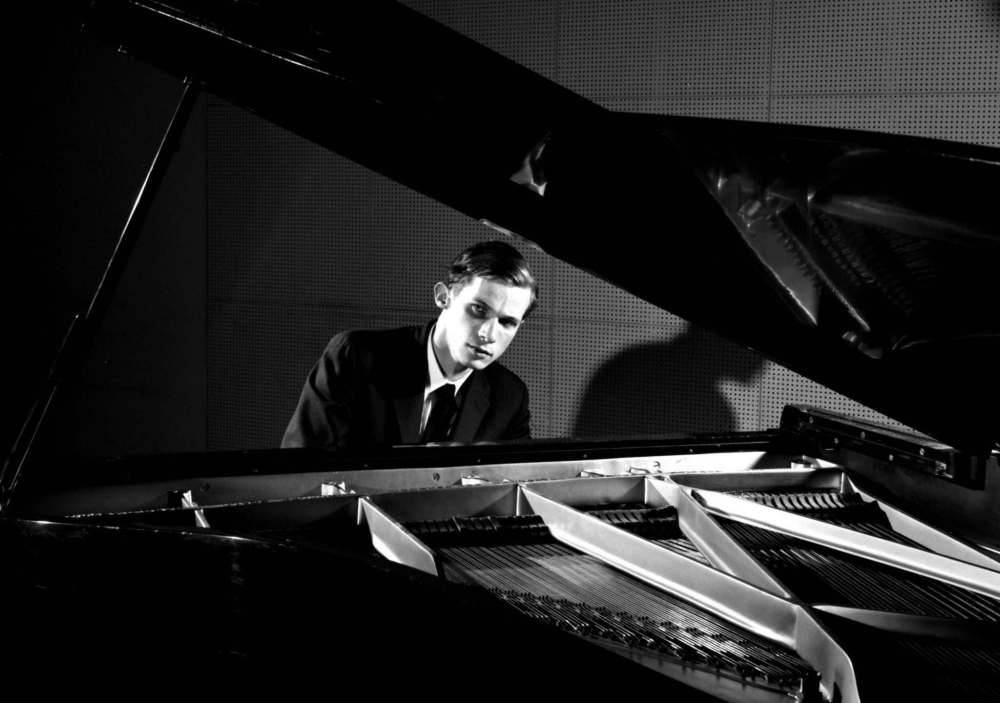
It was also Roberts who received the chilling telephone call at 3:30 in the afternoon from the pianist, who ominously told his assistant that he felt “unwell,” two days after the world marked Gould’s 50th birthday on Sept. 25, 1982, and while still basking in the celebrated release of the artist’s CBS Masterworks recording of J.S. Bach’s Goldberg Variations.
Roberts immediately sprang to Gould’s side at his home at Toronto’s Inn on the Park — recalling how the ailing pianist actually rose to open the door for him — and personally drove him to Toronto General Hospital where he was diagnosed with having suffered a severe stroke.
Gould slipped into a coma that Thursday. Roberts, still clearly affected 38 years later, grows emotional when recounting how he struggled to comfort an increasingly agitated, frightened Gould during his daily hospital visits. He also notes the overwhelming responsibility of fielding panicked, stunned calls from around the globe that fell on his shoulders during that week, and particularly after news broke of Gould’s death on Oct. 4.
“That was a horrendous week, and the world just exploded,” he says in hushed tones. “But Glenn was my friend, and there wasn’t anything that I wouldn’t have done for him. It was my job and I always said all along, that whatever he wants, I’ll try and do it as best I can.”
As Roberts faced his own final curtain call, I asked if he had also been particularly reflective, as a “life review” on his extraordinary relationship with one of the greatest pianists of all time, who rightfully takes his place among such luminaries as Horowitz, Ashkenazy, Rubinstein and Rachmaninov.
When asked what he’d like the world to know most about Gould, Roberts doesn’t miss a beat.

“That he was a caring person. He wasn’t some kind of iconic robot out there, but was always very connected to the world around him and cared deeply about people and particularly ‘small’ people,” he says.
“A woman from Saskatchewan once wrote him a letter saying, ‘Your music helps get me through the dreaded winters, and makes my life complete.’ Glenn treasured that, as doing something that caused some good in the world was very, very important to him,” Roberts adds.
“I’m indebted to him because I did things that many, many people would never get an opportunity to do. I felt very protective of him as that came with the territory, but he was always ‘just Glenn’ to me. He was my friend.”
Some of this content – although not all — first appeared in online arts magazine Ludwig van Toronto, with copyright permission granted by editor-in-chief Michael Vincent.
holly.harris@shaw.ca
Holly Harris writes about music for the Free Press Arts & Life department.
Our newsroom depends on a growing audience of readers to power our journalism. If you are not a paid reader, please consider becoming a subscriber.
Our newsroom depends on its audience of readers to power our journalism. Thank you for your support.
History
Updated on Wednesday, December 23, 2020 9:23 AM CST: Adds photos