

Creatures comfort for new humane society head
CEO Jessica Miller has open heart -- and office -- for all animals great and small
Advertisement
Read this article for free:
or
Already have an account? Log in here »
To continue reading, please subscribe:
Digital Subscription
One year of digital access for only $1.44 a week*
- Enjoy unlimited reading on winnipegfreepress.com
- Read the E-Edition, our digital replica newspaper
- Access News Break, our award-winning app
- Play interactive puzzles
*Billed as $5.77 plus GST every four weeks. After 52 weeks, price increases to the regular rate of $19.95 plus GST every four weeks. Offer available to new and qualified returning subscribers only. Cancel any time.
To continue reading, please subscribe:
Add Free Press access to your Brandon Sun subscription for only an additional
$1 for the first 4 weeks*
- Enjoy unlimited reading on winnipegfreepress.com
- Read the E-Edition, our digital replica newspaper
- Access News Break, our award-winning app
- Play interactive puzzles
*Your next Brandon Sun subscription payment will increase by $1.00 and you will be charged $17.95 plus GST for four weeks. After four weeks, your payment will increase to $24.95 plus GST every four weeks.
Read unlimited articles for free today:
or
Already have an account? Log in here »
Hey there, time traveller!
This article was published 08/03/2021 (1917 days ago), so information in it may no longer be current.
Every morning, shortly after arriving at work, Jessica Miller welcomes a special visitor into her comfortable corner office.
It would be fair to say each of these visitors is unique. Some days it’s a dog. Some days it’s a cat. Other days it might be a hamster.
It might seem odd in most workplaces, but it’s standard for Miller, who on Feb. 15 became the new chief executive officer of the Winnipeg Humane Society, taking the reins from outgoing CEO Javier Schwersensky.
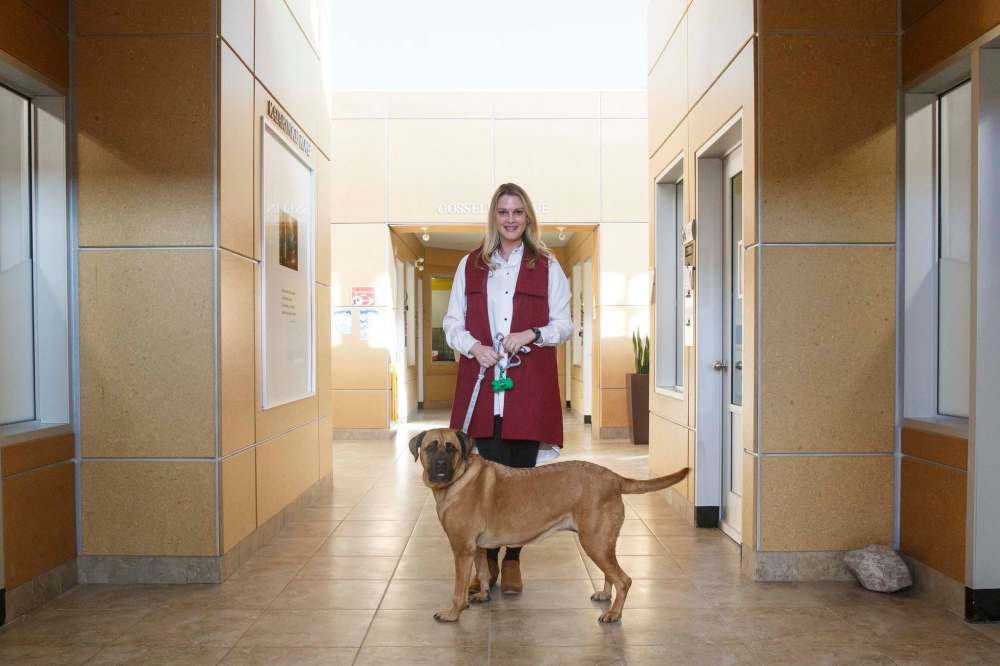
“Every morning I walk through the shelter halls and I peek through the glass to see who is still there from the night before, from the week before, and I try to choose an animal that could use a break from their space,” Miller says with a laugh.
“I bring them into the CEO office and let them lie on the dog bed I have in here, give them some treats, just to normalize their experience in the shelter a bit. Although the rooms for the dogs are great and the cat rooms have double the space they used to, it’s still monotonous to sit and stare at the same walls and hope that a volunteer is going to come and walk you or wait until animal care comes in to feed you.”
When pressed, the new CEO of the 127-year-old rescue agency concedes the animals are not the only ones who benefit from sharing an office.
“I feel like it’s my form of therapy. It’s a busy job and it can be a bureaucratic job at this level, and I wouldn’t say I’m not a little jealous sometimes of the dog walkers and volunteers,” she says.
“I want some furry love in my life, so I go out there and say, ‘Oh, this one needs some space’ and I bring it in here and I play with it. It makes me happy and motivates me for the rest of the day. When you’re in the office and doing that kind of thing, sometimes you’re far away from what we actually do and why we do it.”
On this day, her office companion is Abigail, a hefty six-year-old mastiff cross rescued from Sagkeeng First Nation and adopted through the Brandon Humane Society.
“We chose her because she looked so much like our rottweiler we had before who had since passed. They had the same sad face looking through the window in adoption,” says the 37-year-old married mother of one daughter.
It’s oddly appropriate this passionate animal lover became the public face of the humane society the day after Valentine’s Day, because it’s a job she’s wanted to do with all of her heart.
“In all sincerity, I’m just a girl who really loves animals. It’s been something I’ve done my whole life,” Miller says. “When I say all animals I mean all animals, all living things. My mom will tell you stories about when it used to rain and all the worms would come out of the grass and were on the sidewalk. I’d pick them up and put them back in the grass so no one would step on them. It was something innate in my childhood — let’s respect all living things.”
Born in Edmonton, her family moved to Winnipeg when she was just a baby and she’s been here ever since. She attended Samuel Burland elementary and Glenlawn Collegiate before spending four years at the University of Winnipeg and two at Red River College earning degrees in communications and public relations.
She worked as a communications officer with Veterans Affairs in 2006, before beginning her career in media relations as a publicist with Global TV in 2007. She spent the last six years as vice-president of marketing and communications for St. Boniface Hospital Foundation. She’s hardly a newbie at the humane society, though, spending 2008-10 as the shelter’s marketing and sponsorship specialist.
In 2018, she joined the society’s board of directors, but had to resign that post when she threw her hat in the ring for the CEO’s job. Asked if she sees herself as the new voice for Winnipeg’s animals, Miller says: “I do think that I have the opportunity to be the voice, but I do represent all of our staff, the board of directors, the strategic plan… I get to be the figurehead that represents that.”
It’s not easy taking over a shelter that helps more than 10,000 animals annually at the best of times, but it’s especially challenging in the middle of a global pandemic. The shelter is closed to walk-in patrons and has been since last March. It’s still open for business, but adoptions and admissions are by appointment only.
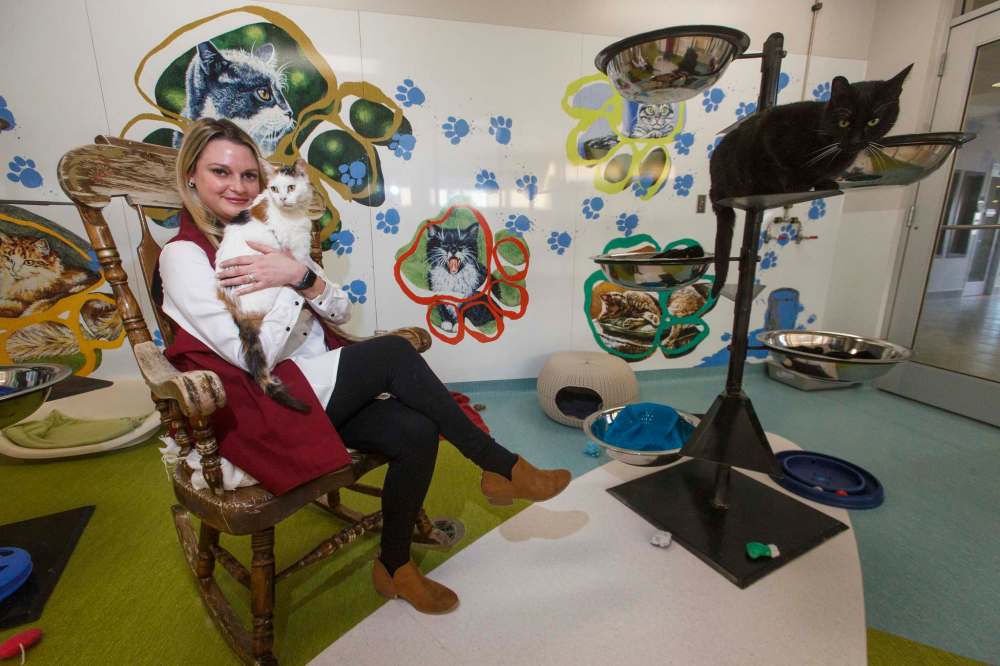
“Our staff has really put their best foot forward, though fears have been high because we do work in a fairly public place with a lot of people,” Miller says.
“There’s 100 staff members and about 800 volunteers… we still have dog walkers coming in. We’re still taking in animals that need our help. We’ve tried to convert as much of our programming as possible to virtual… We have some behaviour programs operating virtually.”
Her No. 1 goal as CEO is to use her fundraising expertise to expand services beyond what’s possible with their $6.5-million annual budget.
She capped her career at St. Boniface Hospital Foundation last year by launching Manitoba’s first-ever virtual charity gala, wherein gourmet meals and wine were delivered to the doorsteps of ticket-buying participants, who also watched a star-studded online concert.
“My top priority is I would like to fundraise enough on an annual basis to not just barely scrape by,” Miller says of her ambitions for the society. “With more money, I can have more programming, I can have more reach, I can dabble in all the other things that are important in animal welfare. I’d love to see more major gifts at a higher level. I think there’s potential for that here.”

Another goal is to strengthen bonds with the army of smaller independent rescue groups to help northern communities and First Nations get better access to veterinary care and spay and neuter clinics. Manitoba’s remote First Nations have long been plagued by packs of stray dogs roaming freely, resulting in fatal attacks. In September 2019, a two-year-old boy was killed by a pack of dogs after he wandered away from his home at God’s Lake First Nation, about 1,000 kilometres northeast of Winnipeg.
“It (dog overpopulation) is a pretty big deal. It’s not safe for the animals and the communities. It costs money to bring clinics, do remote clinics, do remote spay and neuter clinics, to provide vaccinations. That’s a big priority of mine,” she says. “A lot of them (smaller rescues) go out there and they have the connections. They know the community members. I’d love to partner on this and create my own program that would help the rescues and us and the northern communities… I’d like to see that funded as a priority. It’s just a part of animal welfare and animal population control.”
For the new head of the humane society, it’s all about advocating for animals, regardless of species. “It’s my dream job. Anyone who has known me, even from toddlerhood until now, will say that’s what I’ve dedicated my life to.”
doug.speirs@freepress.mb.ca