Canine caregivers
Service dogs go beyond physical aid, help with stress relief, emotional needs

Advertisement
Read this article for free:
or
Already have an account? Log in here »
To continue reading, please subscribe:
Digital Subscription
One year of digital access for only $1.44 a week*
- Enjoy unlimited reading on winnipegfreepress.com
- Read the E-Edition, our digital replica newspaper
- Access News Break, our award-winning app
- Play interactive puzzles
*Billed as $5.77 plus GST every four weeks. After 52 weeks, price increases to the regular rate of $19.95 plus GST every four weeks. Offer available to new and qualified returning subscribers only. Cancel any time.
To continue reading, please subscribe:
Add Free Press access to your Brandon Sun subscription for only an additional
$1 for the first 4 weeks*
- Enjoy unlimited reading on winnipegfreepress.com
- Read the E-Edition, our digital replica newspaper
- Access News Break, our award-winning app
- Play interactive puzzles
*Your next Brandon Sun subscription payment will increase by $1.00 and you will be charged $17.95 plus GST for four weeks. After four weeks, your payment will increase to $24.95 plus GST every four weeks.
Read unlimited articles for free today:
or
Already have an account? Log in here »
Hey there, time traveller!
This article was published 17/05/2021 (1986 days ago), so information in it may no longer be current.
Retired RCMP officer Anita Hart has recently paired up with a new partner — a black Labrador named Jetti.
“She’s my partner in service,” Hart says.
Hart, who was an RCMP officer for nine years, has post-traumatic stress disorder (PTSD) and her 41/2-year-old Lab has been nothing short of a game-changer. She teamed up with her service dog two years ago.
“I have a bunch of chronic illnesses, beginnings of rheumatoid arthritis and vasculitis, and then some other mental illnesses, like depression and anxiety,” Hart says. “That takes a toll on somebody mentally as well. When you’re told you’ve got an illness and you’re going to be in pain for pretty much the rest of your life, that plays with your mind. The PTSD is just the cherry on the top.”
Hart says Jetti knows when to jump into action and get her mind back on track.
“Let’s say I’m starting to feel anxious, Jetti will come and step up on my leg to make me focus on her instead of what I’m getting upset about,” she says. “In the past, she’s even put her face up against my face and made me turn my head to look at her.”
It’s at that point that Hart realizes she should try and calm herself down.
Service dogs can be placed with individuals with a variety of different conditions or disabilities, such as seizure conditions, vision impairment or people with diabetes, and be trained to recognize and respond to the onset of a medical emergency. They also benefit people requiring mobility assistance by helping with tasks such as opening and closing doors and retrieving out-of-reach or dropped items.
A few years ago, Hart, a volunteer with the Lion’s Club, began to notice some changes in her behaviour, including heightened stress and anxiety.
“I noticed that I was starting to be short with people. In a nutshell, I was a jerk,” she says. “You can say hello to me today and, a week from now, you can say hello to me in the exact same fashion and I may start bawling.”
Her health-care professionals recommended she consider getting a service dog.
“I was going to a psychologist and learning how to deal with things. Both my psychologist and my general practitioner thought a service dog would be helpful so I started looking into it,” she says.
Hart stumbled upon the MSAR Service Dogs Facebook page and spoke to George Leonard, a certified master dog trainer. They discussed Hart’s specific needs and triggers. MSAR trains dogs to assist people with a variety of medical conditions, including those with PTSD.
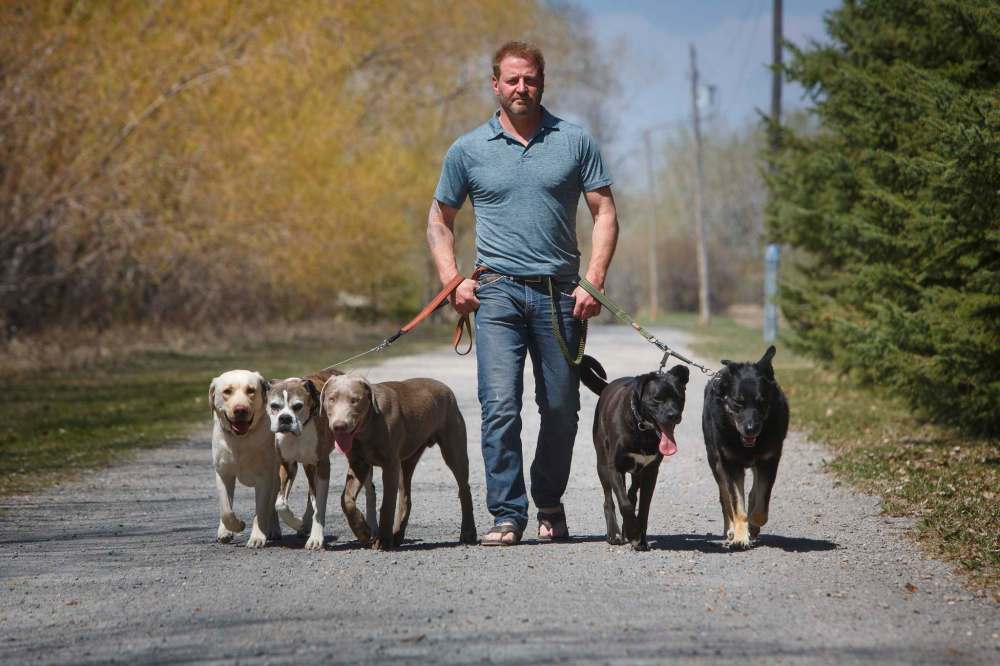
Jetti was trained by Yury Harczan — who has been training service dogs for MSAR since 2015 — starting when she was just nine weeks old. Harczan-trained service dogs have helped military war veterans, first responders and people who have suffered traumatic experiences.
“When it comes to detection and performing tasks, (service) dogs are intricately trained to help save a life and are provided to be almost a life-saving unit,” he says. “I’ve worked with dogs who aid with PTSD, medication retrieval and mobility assistance.”
In 2017, Harczan opened his own business, Paw & Order, where he helps people with dog training, canine obedience and rehabilitation. Since then, he’s been the training consultant for seven rescue organizations and has worked with more than 2,000 domestic dogs.
“I’ve done rehabilitation with dogs that are deemed dangerous or non-adoptable,” he says. “I’ve also rehabilitated seven dogs that were doomed for euthanasia.”
Getting a dog to routinely perform specialized tasks can take years of training. Dogs are put through an intensive program that begins when they’re only a few days old. They’re taught and prepared to handle potentially stressful situations. Depending on the needs of the individual, professional trainers also teach dogs to retrieve items for individuals with mobility issues and may place them in social situations, such as taking public transportation or travelling on an airplane.
“We use certain areas of training to get more focused and loyal dogs. We use the dog’s nose to detect when someone is having an ailment,” Harczan says. “Let’s say it’s somebody with diabetes. A (service) dog can detect pheromones through its sensory receptors and when it senses a change in blood-sugar levels — boom, the dog is alerted and retrieves medication.”
Service-dog training can be very specific. Hart recalls telling Harczan about a nightmare she had experienced and the anxiety that followed.
“Yury was already training Jetti and checked in on me. I said I had a really bad nightmare the week before and screamed myself awake,” Hart says. “When I told Yury about my nightmare, he said ‘OK, I’ll start doing nightmare training with Jetti.’”
Now, if Hart has a nightmare, Jetti is there to help.

“Jetti sleeps at my feet so she can monitor my heart rate. If I start thrashing around, Jetti will military crawl up the bed and lay on my chest to act as compression, almost like a heavy blanket,” she says. “When Jetti’s laying on top of me, she can continue to monitor my heart rate as well as my breathing pattern.”
Large crowds are difficult for Hart — the noise and people can be overwhelming. Jetti has become an integral part of her life when it comes to calming her down in stressful situations.
“The thought of going to a mall in early December gives me the cold sweats. There’s too much noise and too many people. I can’t see everything that’s going on around me. Just talking about this, my heart rate has gone up,” she says. “Two years ago, I wouldn’t have necessarily realized that. Jetti has helped me understand how different things affect me. She’ll come to me if I start to get worked up because my pheromones have changed. If I smell differently, she’ll come over and let me know it’s OK. She’s got me.”
When it comes to petting the dogs, Harczan says it’s common for people to not understand why you can’t touch or pet service dogs.
“We don’t pet service dogs. If it’s a highly trained service dog, especially for seizure detection, that dog cannot be distracted at all,” he says. “Your strongest pheromones come from your mouth, palms and feet. If you touch a (service) dog, you’re leaving your scent on the dog and you may end up masking the dog’s detection to its handlers’ pheromones. It’s not that we don’t want you to pet our dog, it’s that we don’t want you distracting its olfactory sense.”
Hart admits her relationship with Jetti is a work in progress. Besides having an outdoor farm dog when she was a child, she’s never owned a dog before.
“We’re constantly learning from each other. Our relationship is ever-changing and it always will be,” she says. “Two years ago, she would’ve never shown me her belly. Now she does it all the time because she’s more comfortable with me.”
So, how can you tell a service dog apart from other canines?
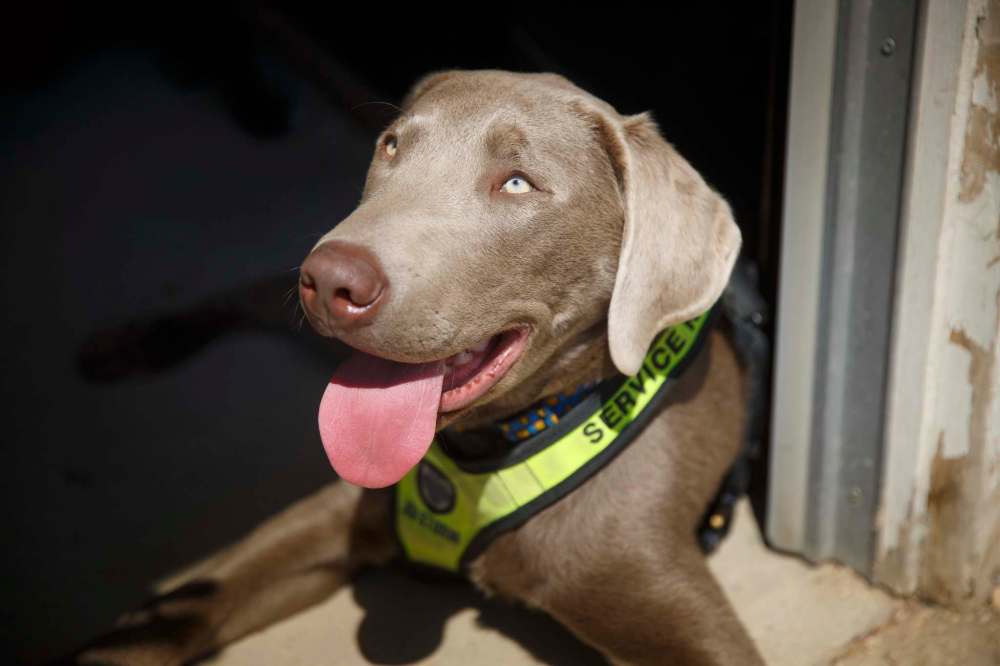
Service dogs normally sport a vest that includes their identification card and when they were certified. The vest also doubles as a carrier for specific items. You’ll also notice a service dog’s behaviour is generally calm and they’re very focused on their work.
It’s important to note you can’t always outwardly tell whether a person should have a service dog or not. Service animals support people with invisible disabilities like PTSD, epilepsy and diabetes, as well as people with visible ones.
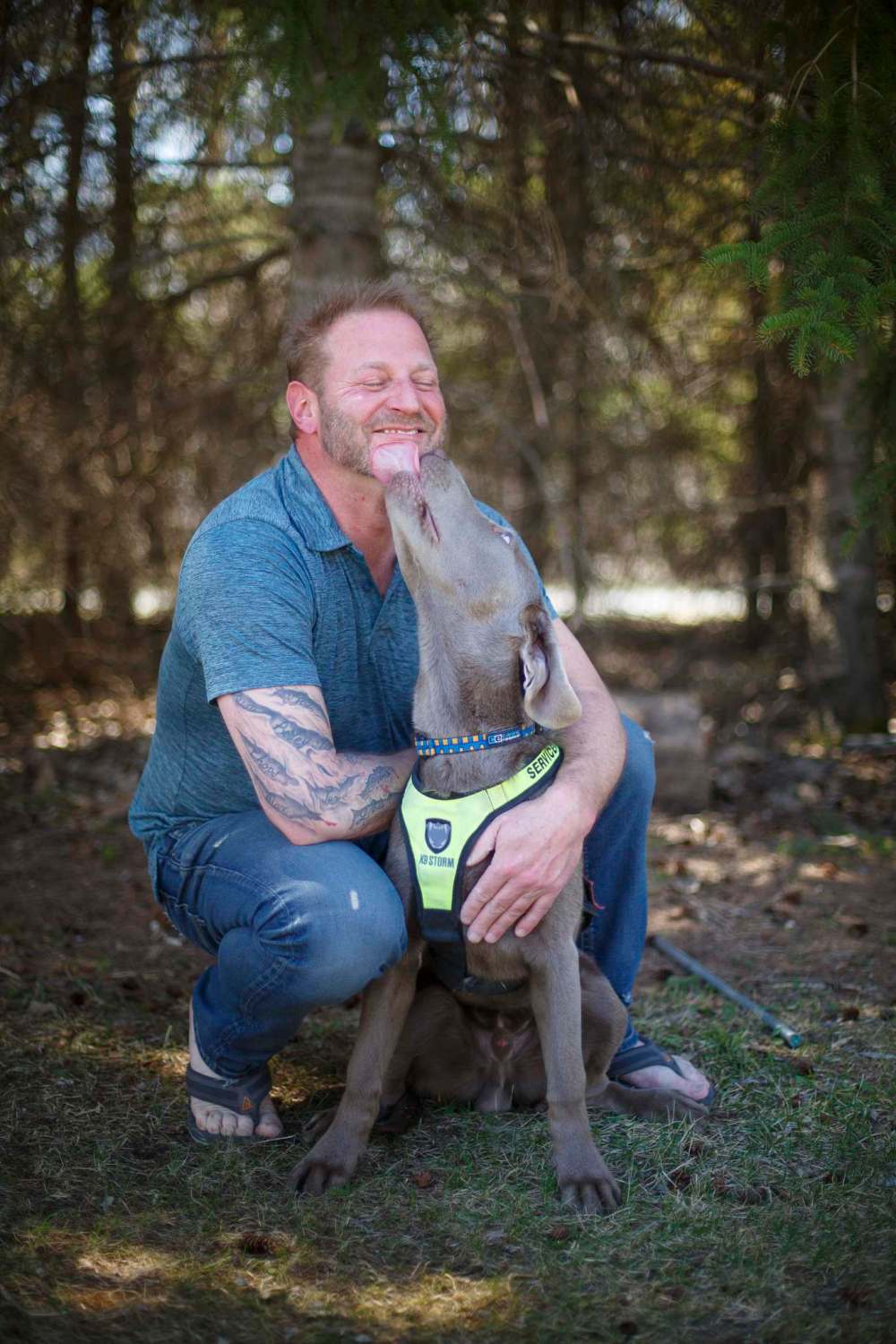
Harczan says animals have been a source of emotional support during the pandemic.

“We know that mental health is at a critical state right now with the pandemic and dogs are helping people redirect,” he says. “People are getting outside and taking their dog for a walk, getting fresh air and detoxing the mind.”
Not only is a service dog’s ability to perform tasks hugely beneficial, the other psychological, social and emotional benefits are often just as important. Harczan says the connection between a service dog and its handler runs deep — the dogs provide moral support, independence and compassion.
“These dogs are changing lives and have a huge impact on somebody who suffers from a mental illness or a sickness of some sort,” he says. “It’s important to remember that dogs are non-prejudiced. They don’t care how you look, they don’t care about your views. They’re just loyal.”
sabrinacarnevale@gmail.com
@SabrinaCsays
Sabrina Carnevale is a freelance writer and communications specialist, and former reporter and broadcaster who is a health enthusiast. She writes a twice-monthly column focusing on wellness and fitness.
Our newsroom depends on a growing audience of readers to power our journalism. If you are not a paid reader, please consider becoming a subscriber.
Our newsroom depends on its audience of readers to power our journalism. Thank you for your support.
Sabrina Carnevale is a freelance writer and communications specialist, and former reporter and broadcaster who is a health enthusiast. She writes a twice-monthly column focusing on wellness and fitness.
Our newsroom depends on a growing audience of readers to power our journalism. If you are not a paid reader, please consider becoming a subscriber.
Our newsroom depends on its audience of readers to power our journalism. Thank you for your support.

Advertisement Advertise With Us
Advertisement Advertise With Us
History
Updated on Monday, May 17, 2021 6:13 AM CDT: Adds photos