A marital postmortem in Shakespeare’s Will
Debbie Patterson rolls out her own perspective on Anne Hathaway in Vern Thiessen’s one-woman play

Advertisement
Read this article for free:
or
Already have an account? Log in here »
To continue reading, please subscribe:

Digital Subscription
One year of digital access for only $205*
- Enjoy unlimited reading on winnipegfreepress.com
- Read the E-Edition, our digital replica newspaper
- Access News Break, our award-winning app
- Play interactive puzzles
*First annual payment billed as $205.00 + GST for one year. This annual subscription will automatically renew at $233.00 + GST every 52 weeks (10% off the regular annual price of $259.35). Offer available to new and qualified returning subscribers only. Cancel any time.
To continue reading, please subscribe:
Add Free Press access to your Brandon Sun subscription for only an additional
$1 for the first 4 weeks*
- Enjoy unlimited reading on winnipegfreepress.com
- Read the E-Edition, our digital replica newspaper
- Access News Break, our award-winning app
- Play interactive puzzles
*Your next Brandon Sun subscription payment will increase by $1.00 and you will be charged $17.95 plus GST for four weeks. After four weeks, your payment will increase to $24.95 plus GST every four weeks.
Read unlimited articles for free today:
or
Already have an account? Log in here »
Hey there, time traveller!
This article was published 17/11/2021 (1749 days ago), so information in it may no longer be current.
When William Shakespeare died, in the spring of 1616, he left behind a body of work — plays like Romeo and Juliet, Hamlet, and King Lear, to name a few — unparalleled in the English language before or since.
He also left behind his wife, Anne Hathaway, and their two children. And to them, he left his last will and testament. As always with such bequeathals, a question arose: who would be left out, and why?
The bard’s final composition forms the basis of Shakespeare’s Will, by Winnipeg’s Vern Thiessen, a one-woman show that focuses on Hathaway on the day of her husband’s funeral, pondering their relationship and her whole life as she avoids reading the document, and perhaps, the realization that she was a mere chorus member in the dramatis personae of William Shakespeare’s life.
“Everything I was told about Anne Hathaway in school was dismissive of her,” says actress Debbie Patterson, who took on the role in a filmed production of the show produced by Shakespeare in the Ruins, streaming Nov. 19 through Dec. 5. “People said she probably was not very smart, that Shakespeare didn’t love her very much. It didn’t make her sound like a force to be reckoned with.”
The truth is, very little is known about Hathaway: she married Shakespeare in 1582, was eight years her husband’s senior, and together they had three children, whom she raised as her husband rose to theatrical glory. Much of what else is “known” is conjecture, using what little information is readily available to piece together details of a life long ago ended.
In academic circles, this has created a mysterious aura — a problem. But in Thiessen’s play, and in Patterson’s portrayal of the misleading lady, that problem is a solution — a chance to build a character where one previously had been lacking.
For Patterson, a founder of Shakespeare in the Ruins and the founding artistic director of local company Sick & Twisted, this was an exhilarating opportunity to explore a hidden point-of-view from a woman whose name is known, but not much more.
She almost didn’t get the chance, she says. The Hathaway role was first offered to a different actor when the production was mounted for the Royal Manitoba Theatre Centre’s Shakespeare Fest just prior to the pandemic. When that actor pulled out, Patterson was offered the spot without auditioning.
Of course, Patterson was elated. But she realized the usual approach to the role — wearing a long gown, strolling through an Elizabethan drawing room, holding a number of props, a bench — wouldn’t work for her. “What would I need a bench for?” she wondered in a piece published on the theatre site Howlround. “In my wheelchair, I’m already sitting down.”
She felt a responsibility to visibly present herself in the play as she is, rather than hiding it or trying to pretend her disability did not exist. She knew they had to “crip” the production, embracing disability and finding new possibilities for the material. In doing so, a perceived “limitation” presents creative opportunities.
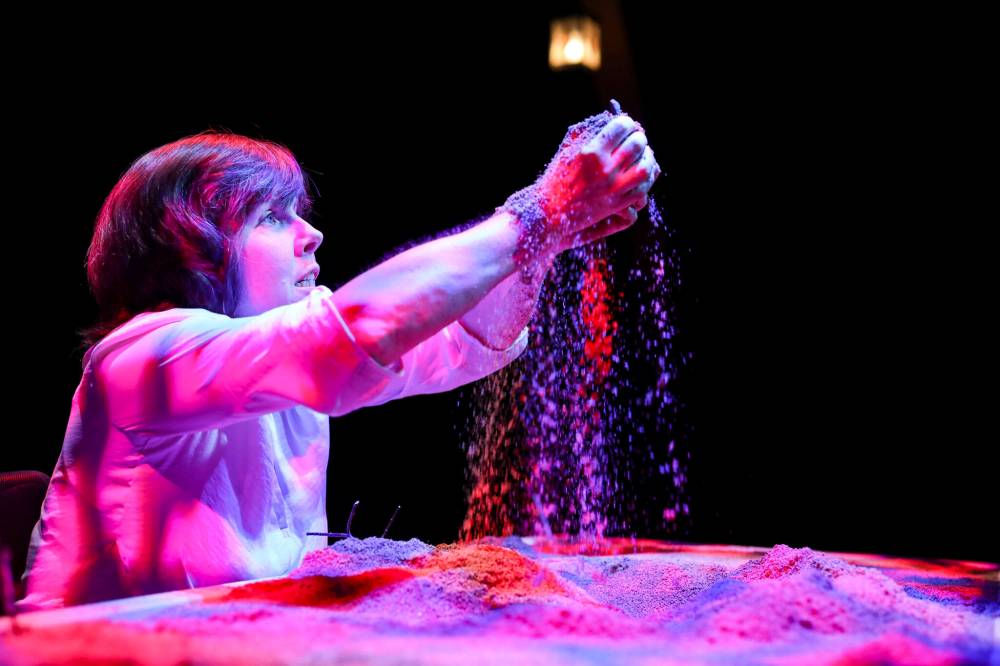
“Any time you don’t acknowledge the reality of what you’re working with, the parameters you’re working within, you’re doomed to fail,” she said. She feels strongly that disability presents limitless possibilities, and isn’t a diminishment or a limitation, as is commonly thought in an ableist society.
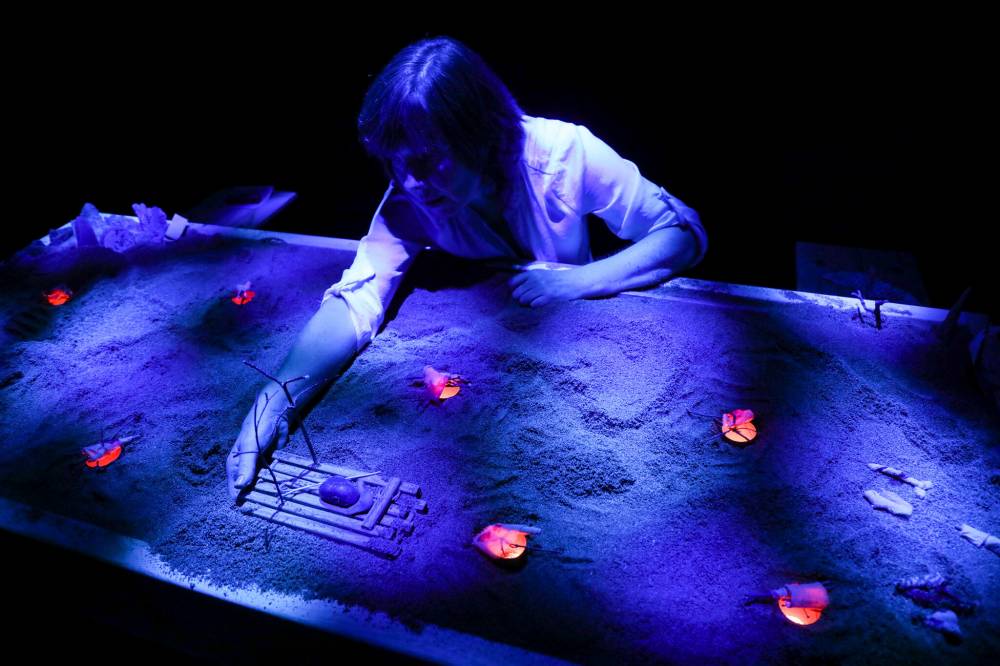
She approached director Eric Blais, who agreed with his star. An avid fan of puppetry, he then played with a different method to telling the story: using a tabletop sandbox, with Patterson moving behind it and using objects such as twigs, driftwood, and stones, pulled up from the sand, as characterizations of Hathaway, Shakespeare, their children, and memories of their relationship.
“When I sat down with the script, I read it through and made notes of all the repeated images in the text,” says Blais. A few jumped out: the beach, sand, the ocean, the shore, life and, of course, death. “It all seemed to dovetail.”
Blais then went out and collected the items from the banks of the Assiniboine River, and in Patterson’s capable hands, they became vessels of Hathaway’s story, with pieces of driftwood and twigs serving as castmates. “She’s a little twig to Shakespeare’s driftwood,” says Patterson, who found the puppetry freeing and joyful.

The director says Patterson carries the production. “First and foremost, the audience gets to see Debbie Patterson do her thing, and that in and of itself is worth the price of admission,” he says.
On screen, Patterson’s performance takes on new layers of intimacy with the audience: the objects, framed and isolated like real actors would be, become central figures, and Patterson keeps the entire thing in focus.
The result doesn’t prompt just an answer as to who Hathaway was, but also questions who we are as audience members and consumers of history. Hathaway’s mysterious aura is as much a result of how women and other groups are treated by society at large as it is a result of how this one woman was treated by one man, who so happens to be the most prolific, successful playwright of all time.
It also asks the audience to consider their own relationships — who is cursory and who is central, who is valued and who is not. What will we leave behind for them when we’re gone, and how will that leave them feeling?
ben.waldman@freepress.mb.ca
Ben Waldman is a National Newspaper Award-nominated reporter on the Arts & Life desk at the Free Press. Born and raised in Winnipeg, Ben completed three internships with the Free Press while earning his degree at Ryerson University’s (now Toronto Metropolitan University’s) School of Journalism before joining the newsroom full-time in 2019. Read more about Ben.
Every piece of reporting Ben produces is reviewed by an editing team before it is posted online or published in print — part of the Free Press‘s tradition, since 1872, of producing reliable independent journalism. Read more about Free Press’s history and mandate, and learn how our newsroom operates.
Our newsroom depends on a growing audience of readers to power our journalism. If you are not a paid reader, please consider becoming a subscriber.
Our newsroom depends on its audience of readers to power our journalism. Thank you for your support.
Ben Waldman is a National Newspaper Award-nominated reporter on the Arts & Life desk at the Free Press. Born and raised in Winnipeg, Ben completed three internships with the Free Press while earning his degree at Ryerson University’s (now Toronto Metropolitan University’s) School of Journalism before joining the newsroom full-time in 2019. Read more about Ben.
Every piece of reporting Ben produces is reviewed by an editing team before it is posted online or published in print — part of the Free Press‘s tradition, since 1872, of producing reliable independent journalism. Read more about Free Press’s history and mandate, and learn how our newsroom operates.
Our newsroom depends on a growing audience of readers to power our journalism. If you are not a paid reader, please consider becoming a subscriber.
Our newsroom depends on its audience of readers to power our journalism. Thank you for your support.
Advertisement Advertise With Us
Advertisement Advertise With Us