

Love at second sight
Reimagining of beloved musical enhances story’s topicality without losing the melody

Advertisement
Read this article for free:
or
Already have an account? Log in here »
To continue reading, please subscribe:
Monthly Digital Subscription
$0 for the first 4 weeks*
- Enjoy unlimited reading on winnipegfreepress.com
- Read the E-Edition, our digital replica newspaper
- Access News Break, our award-winning app
- Play interactive puzzles
*No charge for 4 weeks then price increases to the regular rate of $19.00 plus GST every four weeks. Offer available to new and qualified returning subscribers only. Cancel any time.
Monthly Digital Subscription
$4.75/week*
- Enjoy unlimited reading on winnipegfreepress.com
- Read the E-Edition, our digital replica newspaper
- Access News Break, our award-winning app
- Play interactive puzzles
*Billed as $19 plus GST every four weeks. Cancel any time.
To continue reading, please subscribe:
Add Free Press access to your Brandon Sun subscription for only an additional
$1 for the first 4 weeks*
*Your next subscription payment will increase by $1.00 and you will be charged $16.99 plus GST for four weeks. After four weeks, your payment will increase to $23.99 plus GST every four weeks.
Read unlimited articles for free today:
or
Already have an account? Log in here »
Hey there, time traveller!
This article was published 10/12/2021 (1480 days ago), so information in it may no longer be current.
Acrophobic moviegoers will remember the vertigo-inducing opening shots of Robert Wise’s 1961 version of West Side Story, with its god’s-eye shots of Manhattan moving ever closer to the titular setting, a canyon of tenements where a star-crossed love story is about to unfold.
In this loving but different “reimagining” of the 1957 Broadway classic, Steven Spielberg pays brief homage with an opening overhead shot that zeroes right in on its urban setting, smashed apartment buildings making way for the Lincoln Center, a slyly subversive jest that indicts consumers of high culture in the process of gentrification.
Credit screenwriter Tony Kushner (Angels in America), strategically altering the original book by Arthur Laurents, for hitting its audience where the play’s characters can no longer afford to live. Expect more of the same sauce in this version.
The year is 1957, the same year the musical debuted on Broadway. We are introduced to the Jets, a street gang intent on keeping their neighbourhood white, a futile gesture in the face of a wave of immigration from Puerto Rico. The opening skirmishes depicted in Wise’s movie transform from scrappy mischief to racist malevolence in Spielberg’s.
After the police intervene, even the bigoted cop Lt. Schrank (Corey Stoll) acknowledges the Jets are fighting a losing battle, labelling the gang as the offspring of a generation of social failures, “the last of the can’t-make-it Caucasians,” a well-aimed slap at white grievance and a tip-off to the movie’s raison d’etre: racism renewed in the age of Donald Trump. (The film was intended for a 2020 debut before COVID-19 trampled studio release dates.)
After the cops leave, the charismatic Jets leader Riff (Mike Faist) is still spoiling for a rumble with the Puerto Rican gang the Sharks, led by the tough boxer Bernardo (David Alvarez). He tries to enlist his best friend Tony (Ansel Elgort) to the cause. But Tony resists, largely because he came close to taking a life in his last rumble, and he is seeking a more peaceable life working for neighbourhood store-owner Valentina (Rita Moreno, the sole holdover from the original movie’s cast).
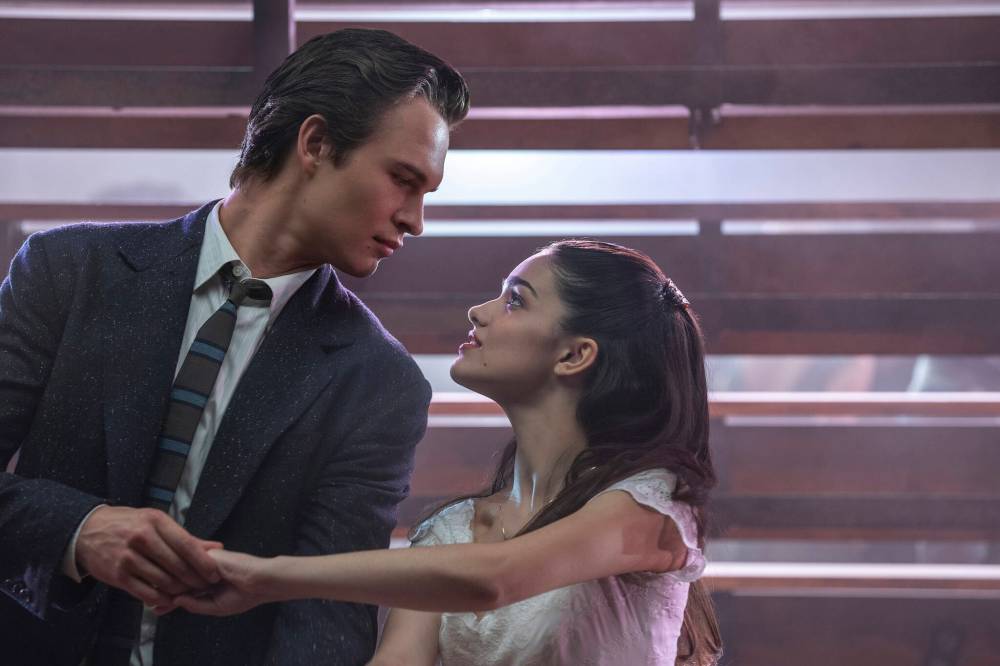
Then, at a dance intended to fuel cross-cultural understanding, Tony meets Bernardo’s sister Maria (Rachel Zegler) and it’s love at first sight for both. Bernardo wants to neutralize the romantic threat Tony poses and agrees to a rumble to make that happen. Tony and Maria try to stop the fight, with tragic consequences for all.
The remake retains the musical’s songs by Leonard Bernstein and lyricist Stephen Sondheim, with good reason. Was there ever a Broadway musical where every single song was so right, from the drippingly romantic One Hand, One Heart to the satiric splendour of Gee Officer Krupke or the anti-anthem America?

Neither Kushner nor Spielberg is afraid of some adventurous alteration. The song Cool, for example, is moved back to its pre-rumble first act and becomes a duet for Tony and Riff, an attempt for Tony at de-escalating the gang feud.
Not to give anything away, but the poignant Tony-Maria ballad Somewhere becomes something altogether different here.
Spielberg smartly applies corrective measures to the revamp, casting Puerto Rican performers in Puerto Rican roles as opposed to the casting of white actors, such as Natalie Wood and George Chakiris, in “brownface,” as in the original film.
Spielberg also sees that everyone onscreen sings with their own voice, which is ultimately preferable to hearing Marni Nixon’s polished soprano trilling forth from all the women’s mouths. This is especially gratifying in the case of Anita, played by Ariana DeBose (of the musical Hamilton), who brings the vocal fire to the songs America and A Boy Like That.
The role of Anybodys — presented as a kind of lesbian/tomboy in the original film — is acknowledged as a trans pioneer here, played intensely by non-binary actor Iris Menas. Here’s some subtlety: In both films, the character finally receives validation from the gang lieutenant Ice with the line: “You done good, buddy-boy.” The emphasis is on the first part of the sentence in the original, but it may as well be on “buddy-boy” here.


Still, Spielberg’s film won’t make anyone forget the Robert Wise original. The director goes for a kind of environmental realism here, eschewing the original’s proto-psychedelic colour palette for a toned-down look, courtesy of the director’s go-to cinematographer Janusz Kaminski (Schindler’s List, Minority Report).
One wishes Spielberg could have surrendered to his more stylistic instincts. The story’s unabashed romanticism was enhanced by Wise’s more artistic flourishes, such as the dance at the gym when Tony and Maria first spot each other across the dance floor and everybody else in the room seems to melt away. In Spielberg’s version, the two simply duck under the bleachers for their smoochy tête-a-tête.
It doesn’t cripple the movie, but the transition towards this kind of naturalism is, in every sense of the word, un-Wise.
randall.king.arts@gmail.com
Twitter: @FreepKing

Our newsroom depends on a growing audience of readers to power our journalism. If you are not a paid reader, please consider becoming a subscriber.
Our newsroom depends on its audience of readers to power our journalism. Thank you for your support.
MOVIE REVIEW
West Side Story
Starring Ansel Elgort and Rachel Zegler
● Grant Park, Kildonan Place, McGillivray, Polo Park, St. Vital, Towne
● PG
● 156 minutes
★★★★ out of five
Our newsroom depends on a growing audience of readers to power our journalism. If you are not a paid reader, please consider becoming a subscriber.
Our newsroom depends on its audience of readers to power our journalism. Thank you for your support.
Advertisement Advertise With Us
Advertisement Advertise With Us