‘Back to where they started’
Betty Sanguin chose a medically assisted death in the church where the ALS sufferer had raised her family

Advertisement
Read this article for free:
or
Already have an account? Log in here »
To continue reading, please subscribe:
Digital Subscription
One year of digital access for only $1.44 a week*
- Enjoy unlimited reading on winnipegfreepress.com
- Read the E-Edition, our digital replica newspaper
- Access News Break, our award-winning app
- Play interactive puzzles
*Billed as $5.77 plus GST every four weeks. After 52 weeks, price increases to the regular rate of $19.95 plus GST every four weeks. Offer available to new and qualified returning subscribers only. Cancel any time.
To continue reading, please subscribe:
Add Free Press access to your Brandon Sun subscription for only an additional
$1 for the first 4 weeks*
- Enjoy unlimited reading on winnipegfreepress.com
- Read the E-Edition, our digital replica newspaper
- Access News Break, our award-winning app
- Play interactive puzzles
*Your next Brandon Sun subscription payment will increase by $1.00 and you will be charged $17.95 plus GST for four weeks. After four weeks, your payment will increase to $24.95 plus GST every four weeks.
Read unlimited articles for free today:
or
Already have an account? Log in here »
Hey there, time traveller!
This article was published 04/04/2022 (1658 days ago), so information in it may no longer be current.
When Betty Sanguin decided to end her life with medical assistance, one of her final requests was for it to take place at her church.
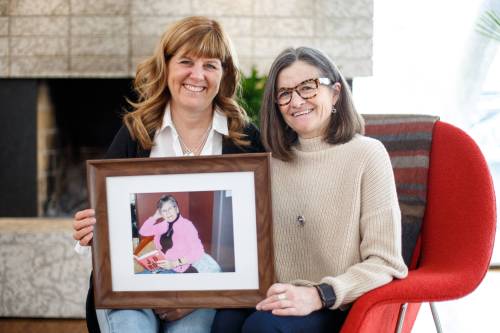
Her family helped fulfil her wish. Surrounded by loved ones, including her six children, Sanguin, 86, died in March at her “crossing over” ceremony at Churchill Park United Church. The entire procedure took 15 minutes.
A lifelong volunteer, her life changed forever last spring when she was diagnosed with ALS, better known as Lou Gehrig’s disease.

This was the first provision of medical assistance in dying (MAiD) to take place in a church in Manitoba.
Even though Sanguin’s symptoms included slurred speech and a weakened voice, her diagnosis came as a shock.
“My mom hoped that (it was) some other treatable condition that mimics ALS — she just didn’t want it to be ALS,” says Renée Sanguin, Betty’s daughter.
Sanguin, who spent many years volunteering at Oak Table, which serves Winnipeg’s impoverished and vulnerable communities, alongside her husband, Gord, wasn’t prepared for the news. She faced an unpleasant decline from the progressive and incurable motor neuron disease that leads to paralysis and respiratory failure.
Death typically occurs three to five years from the onset of symptoms. In Sanguin’s case, those started with speaking, eating and swallowing.
“Her decline was so rapid. And you hear that with ALS, that it’s different for everybody,” says Renée. “But within a very short period of time, (the doctors) were talking about a feeding tube because she couldn’t eat and swallow anymore.”
About 3,000 Canadians live with the disease, according to the ALS Society of Canada. The speed with which a person loses the use of their muscles varies — some deteriorate quickly, while others experience slow degeneration.
Doctors at the Motor Neuron Clinic at Deer Lodge Centre gave Sanguin a window of one to three years.
“My mom saw other people that were further along in their (ALS) diagnosis and all she knew is that she didn’t want that. That’s what my mom struggled with the most,” says Lynda Sanguin-Colpitts, Renée’s older sister.

By last summer, Sanguin’s health had declined rapidly. She depended on others for routine tasks and nurses stopped by daily. Her family set up home care while, at the same time, her husband of nearly 70 years was being treated for prostate cancer that had spread to his bones. He died in September.
Sanguin’s family soon realized that she could no longer live on her own, even with managed care. The disease had stolen her ability to feed herself, to swallow and her voice had weakened to a near-whisper.
She moved into Brummitt-Feasby ALS house in December, a Winnipeg-based home for ALS patients. It was donated by Lynn Brown and Faith Johnston, step-daughters of Dorothy Brummitt-Feasby, who died of ALS in 2000.
From the start, medical assistance in dying was discussed as an option among Sanguin and her doctors.
“There was a lot of openness about it; the idea that this call could be made when and if she ever felt ready,” says Renée. “They normalize it as much as they can. My mom knew it was available and it was her decision, on her terms and in her own time. She didn’t have to feel that she was doing this for anybody but of her own complete and total volition.”
In the ensuing months, Sanguin learned more about her prognosis. A respirologist informed her of the long road ahead — pulmonary exercises, lung volume recruitment machines, the potential of a lung infection and all the work it would take to keep her lungs functioning.
ALS’s assault on Sanguin’s central nervous system continued. By February, she could hardly walk and had lost her ability to speak, relying on text-to-speech software to communicate. Her breaking point was the thought of losing her independence.
“(Knowing that) she couldn’t feed herself anymore was something she couldn’t tolerate. She stopped being able to eat and enjoy food at all,” says Renée. “She didn’t want to be dependent on others or be cared for 24-7. That would’ve been intolerable for my mom.”
The worsening symptoms, plus several frightening choking episodes, caused Sanguin to think more seriously about medical aid in dying. There were questions: when? How do you — how can you — know when it’s time to go? The choking had become so severe that Sanguin was afraid she was going to choke to death.

So, Betty met with a social worker, with whom she had a close relationship through palliative care, and asked her to speak to the medical team on her behalf. At Betty’s request, they began the MAiD process.
“It was her decision. We had nothing to do with whether she chose it or not,” says Lynda. “She realized that (MAiD) was an option. She didn’t have to die from ALS, or suffocation, or pneumonia, or be in a hospital in her last days.”
Once she was deemed eligible for medical assistance in dying, Sanguin began to plan. One of her requests was to die at her church – something never before done in Manitoba.
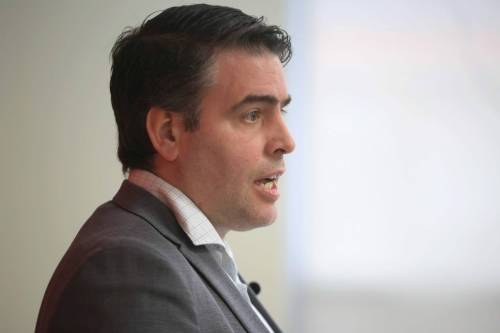
“I would say (in a church) was unique. But we were very happy to accommodate this lovely lady’s request,” says Colleen Barbour, client care coordinator with the Manitoba MAiD team. “Her family and the church made it all happen.”
Barbour says if there’s a special request or ritual that a patient wants, the MAiD team will look into the logistics to see if it’s feasible and try to make it happen.
“Renée and the family took this all on themselves. They were the ones who liaised with the church and congregation and then came to us to ask, ‘Would this be something that you could accommodate?’ And so we did,” says Barbour. “It was quite simple for us to come in and participate from our end and allow this woman to be in this space that she really wanted to be, surrounded by people who loved her.”
MAiD has been available in Manitoba since 2016 and is provided to legally eligible patients who give consent. To date, 919 patients have used the service — including 58 so far this year, according to a spokesperson from Shared Health.
According to Shared Health, safeguards have been put in place to protect vulnerable patients and help all patients to make an informed decision.
Barbour says Sanguin’s family “moved mountains” on her behalf.

“Just to be in the presence of that amount of support, love and understanding; to make what can be a really somber, difficult day, full of love, laughter and beauty, that doesn’t get lost on our team. You could tell that (Betty) was so happy and appreciative and exactly where she should have been.”
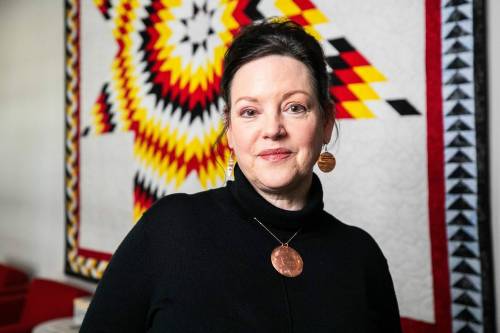
In attendance on the appointed day — which Sanguin coined her “special day” — were her children, grandchildren and more than 30 close friends, including Reverend Dawn Rolke. When the family inquired about the availability of the church, Rolke was committed to seeing it through.
“My response was, ‘Yes, whatever Betty wants,’” she says. “We said we’d do whatever we could to accommodate her request.”
Rolke, a reverend for more than 25 years, says the idea of MAiD in the church felt natural for her because of her previous work and time spent in chapels as a spiritual care provider in hospitals and personal care homes.
“There were conversations about (MAiD) happening in the chapels as a safe space,” she says. “My involvement in hospitals with their warm, hospitable chapels, I think that’s what helped me visualize it.”
Rolke says the family felt comfortable in the church as the Sanguin children grew up there.
“The family loved the beauty of the space and the light in the windows. They shared their memories of growing up there,” she says. “Betty brought them back to where they started. It wasn’t an unfamiliar space to them and that was moving in its own way.”
On her “special day,” Sanguin sat in a recliner surrounded by her children, her favourite music played, her handmade quilts were on display and her grandchildren sang to her.
“When we wheeled her into her ceremony, her eyes lit up when she saw all of her friends and family,” says Lynda.

Grief is one thing but watching somebody die is something entirely different. Lynda felt comfort knowing that her mom was able to make this important decision on her own.

“We were proud of our mom, and heartbroken, every emotion possible. She planned the service, my kids sang, and it couldn’t have been more perfect,” she says.
At the appointed hour, the MAiD team arrived and the guests exited the church. At her request, Sanguin’s children and grandchildren remained by her side and held her hand.
In the end, Sanguin was able to say goodbye.
“We got to hug our mom and say goodbye,” says Lynda. “And just as importantly, my mom got to say goodbye to all the people that meant so much to her in her life.”
sabrinacarnevale@gmail.com
Sabrina Carnevale is a freelance writer and communications specialist, and former reporter and broadcaster who is a health enthusiast. She writes a twice-monthly column focusing on wellness and fitness.
Our newsroom depends on a growing audience of readers to power our journalism. If you are not a paid reader, please consider becoming a subscriber.
Our newsroom depends on its audience of readers to power our journalism. Thank you for your support.
Sabrina Carnevale is a freelance writer and communications specialist, and former reporter and broadcaster who is a health enthusiast. She writes a twice-monthly column focusing on wellness and fitness.
Our newsroom depends on a growing audience of readers to power our journalism. If you are not a paid reader, please consider becoming a subscriber.
Our newsroom depends on its audience of readers to power our journalism. Thank you for your support.
Advertisement Advertise With Us
Advertisement Advertise With Us